

The Ventilated Thermocline: The Two-Layer Model
191
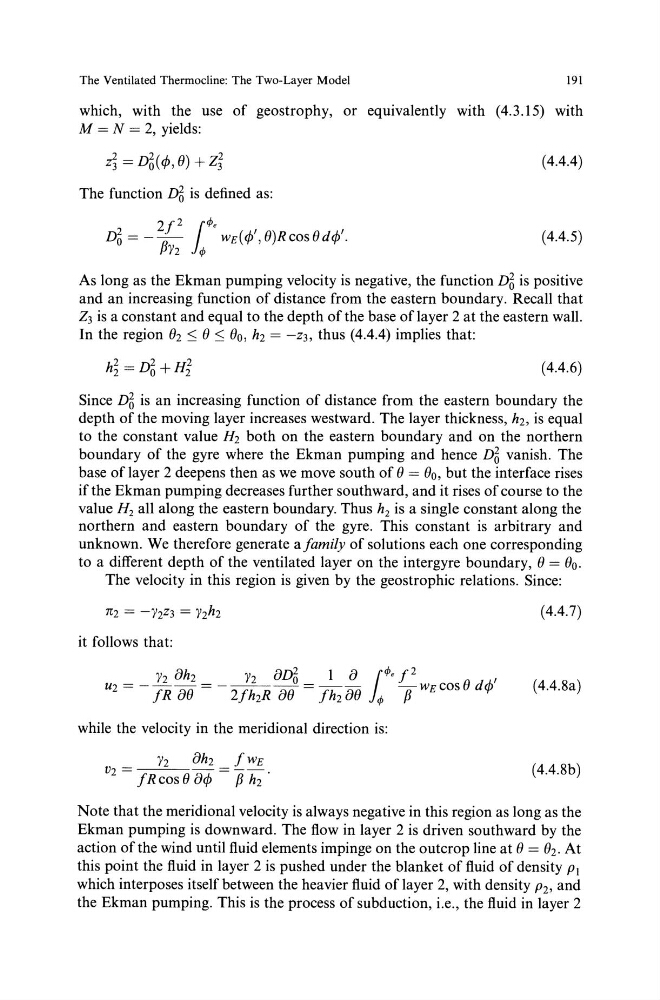
which, with the use of geostrophy, or equivalently with (4.3.15) with
M = N = 2, yields:
( 4.4.4)
The function D6 is defined as:
2J21c/>e
D6 = - -
13
wE(¢',8)Rcos8d¢'.
1'2 1>
( 4.4.5)
As long as the Ekman pumping velocity is negative, the function D6 is positive
and an increasing function of distance from the eastern boundary. Recall that
Z 3 is a constant and equal to the depth of the base of layer 2 at the eastern wall.
In the region 82 :S: (} :S: 80 , h2 = -z3, thus (4.4.4) implies that:
h 2
2
2
2 =Do +H2
( 4.4.6)
Since D6 is an increasing function of distance from the eastern boundary the
depth of the moving layer increases westward. The layer thickness, h2, is equal
to the constant value H 2 both on the eastern boundary and on the northern
boundary of the gyre where the Ekman pumping and hence D6 vanish. The
base of layer 2 deepens then as we move south of(} = Bo, but the interface rises
if the Ekman pumping decreases further southward, and it rises of course to the
value H 2 all along the eastern boundary. Thus h 2 is a single constant along the
northern and eastern boundary of the gyre. This constant is arbitrary and
unknown. We therefore generate a family of solutions each one corresponding
to a different depth of the ventilated layer on the intergyre boundary, (} = 80 .
The velocity in this region is given by the geostrophic relations. Since:
(4.4.7)
it follows that:
(4.4.8a)
while the velocity in the meridional direction is:
(4.4.8b)
Note that the meridional velocity is always negative in this region as long as the
Ekman pumping is downward. The flow in layer 2 is driven southward by the
action of the wind until fluid elements impinge on the outcrop line at(}= 82• At
this point the fluid in layer 2 is pushed under the blanket of fluid of density p 1
which interposes itself between the heavier fluid of layer 2, with density p 2 , and
the Ekman pumping. This is the process of subduction, i.e., the fluid in layer 2
191
which, with the use of geostrophy, or equivalently with (4.3.15) with
M = N = 2, yields:
( 4.4.4)
The function D6 is defined as:
2J21c/>e
D6 = - -
13
wE(¢',8)Rcos8d¢'.
1'2 1>
( 4.4.5)
As long as the Ekman pumping velocity is negative, the function D6 is positive
and an increasing function of distance from the eastern boundary. Recall that
Z 3 is a constant and equal to the depth of the base of layer 2 at the eastern wall.
In the region 82 :S: (} :S: 80 , h2 = -z3, thus (4.4.4) implies that:
h 2
2
2
2 =Do +H2
( 4.4.6)
Since D6 is an increasing function of distance from the eastern boundary the
depth of the moving layer increases westward. The layer thickness, h2, is equal
to the constant value H 2 both on the eastern boundary and on the northern
boundary of the gyre where the Ekman pumping and hence D6 vanish. The
base of layer 2 deepens then as we move south of(} = Bo, but the interface rises
if the Ekman pumping decreases further southward, and it rises of course to the
value H 2 all along the eastern boundary. Thus h 2 is a single constant along the
northern and eastern boundary of the gyre. This constant is arbitrary and
unknown. We therefore generate a family of solutions each one corresponding
to a different depth of the ventilated layer on the intergyre boundary, (} = 80 .
The velocity in this region is given by the geostrophic relations. Since:
(4.4.7)
it follows that:
(4.4.8a)
while the velocity in the meridional direction is:
(4.4.8b)
Note that the meridional velocity is always negative in this region as long as the
Ekman pumping is downward. The flow in layer 2 is driven southward by the
action of the wind until fluid elements impinge on the outcrop line at(}= 82• At
this point the fluid in layer 2 is pushed under the blanket of fluid of density p 1
which interposes itself between the heavier fluid of layer 2, with density p 2 , and
the Ekman pumping. This is the process of subduction, i.e., the fluid in layer 2