

Formulation of the Model
181
(4.2.14)
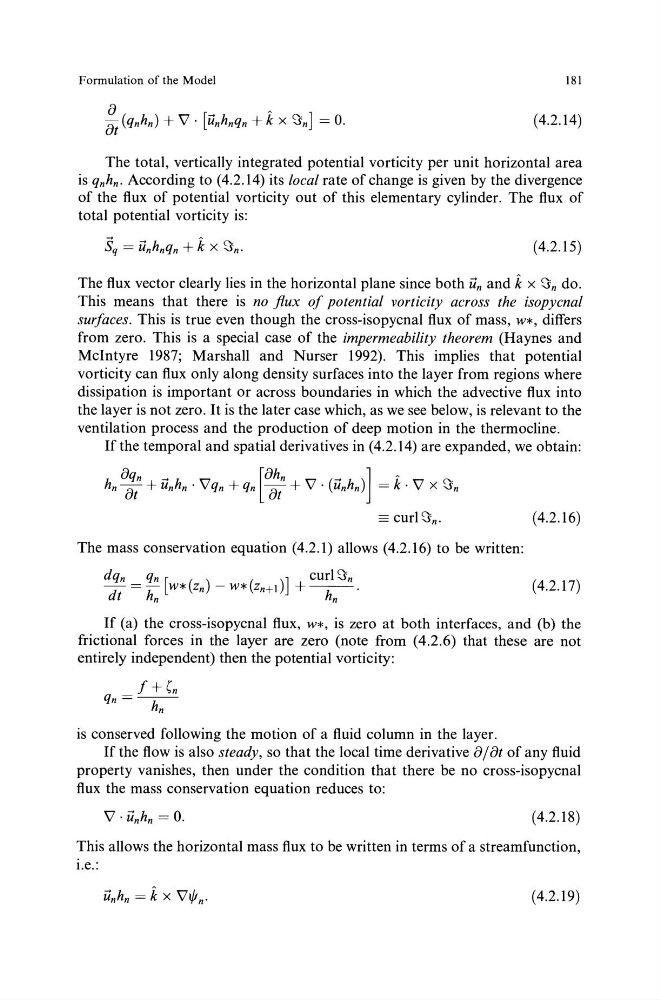
The total, vertically integrated potential vorticity per unit horizontal area
is qnhn. According to ( 4.2.14) its local rate of change is given by the divergence
of the flux of potential vorticity out of this elementary cylinder. The flux of
total potential vorticity is:
(4.2.15)
The flux vector clearly lies in the horizontal plane since both un and k x ':Sn do.
This means that there is no flux of potential vorticity across the isopycnal
surfaces. This is true even though the cross-isopycnal flux of mass, W*, differs
from zero. This is a special case of the impermeability theorem (Haynes and
Mcintyre 1987; Marshall and Nurser 1992). This implies that potential
vorticity can flux only along density surfaces into the layer from regions where
dissipation is important or across boundaries in which the advective flux into
the layer is not zero. It is the later case which, as we see below, is relevant to the
ventilation process and the production of deep motion in the thermocline.
If the temporal and spatial derivatives in (4.2.14) are expanded, we obtain:
hn aXtn + Unhn · "Vqn + qn [a;tn + "V · (unhn)] = k · "V X ':Sn
(4.2.16)
The mass conservation equation ( 4.2.1) allows ( 4.2.16) to be written:
dqn qn [
] curl ':Sn
dt = hn W* (zn) - W* (zn+I) +------,;;-.
( 4.2.17)
If (a) the cross-isopycnal flux, W*, is zero at both interfaces, and (b) the
frictional forces in the layer are zero (note from (4.2.6) that these are not
entirely independent) then the potential vorticity:
f +(n
qn=-hn
is conserved following the motion of a fluid column in the layer.
If the flow is also steady, so that the local time derivative a I at of any fluid
property vanishes, then under the condition that there be no cross-isopycnal
flux the mass conservation equation reduces to:
(4.2.18)
This allows the horizontal mass flux to be written in terms of a streamfunction,
i.e.:
(4.2.19)
181
(4.2.14)
The total, vertically integrated potential vorticity per unit horizontal area
is qnhn. According to ( 4.2.14) its local rate of change is given by the divergence
of the flux of potential vorticity out of this elementary cylinder. The flux of
total potential vorticity is:
(4.2.15)
The flux vector clearly lies in the horizontal plane since both un and k x ':Sn do.
This means that there is no flux of potential vorticity across the isopycnal
surfaces. This is true even though the cross-isopycnal flux of mass, W*, differs
from zero. This is a special case of the impermeability theorem (Haynes and
Mcintyre 1987; Marshall and Nurser 1992). This implies that potential
vorticity can flux only along density surfaces into the layer from regions where
dissipation is important or across boundaries in which the advective flux into
the layer is not zero. It is the later case which, as we see below, is relevant to the
ventilation process and the production of deep motion in the thermocline.
If the temporal and spatial derivatives in (4.2.14) are expanded, we obtain:
hn aXtn + Unhn · "Vqn + qn [a;tn + "V · (unhn)] = k · "V X ':Sn
(4.2.16)
The mass conservation equation ( 4.2.1) allows ( 4.2.16) to be written:
dqn qn [
] curl ':Sn
dt = hn W* (zn) - W* (zn+I) +------,;;-.
( 4.2.17)
If (a) the cross-isopycnal flux, W*, is zero at both interfaces, and (b) the
frictional forces in the layer are zero (note from (4.2.6) that these are not
entirely independent) then the potential vorticity:
f +(n
qn=-hn
is conserved following the motion of a fluid column in the layer.
If the flow is also steady, so that the local time derivative a I at of any fluid
property vanishes, then under the condition that there be no cross-isopycnal
flux the mass conservation equation reduces to:
(4.2.18)
This allows the horizontal mass flux to be written in terms of a streamfunction,
i.e.:
(4.2.19)