

180
Theory of the Ventilated Thermocline
(4.2.6)
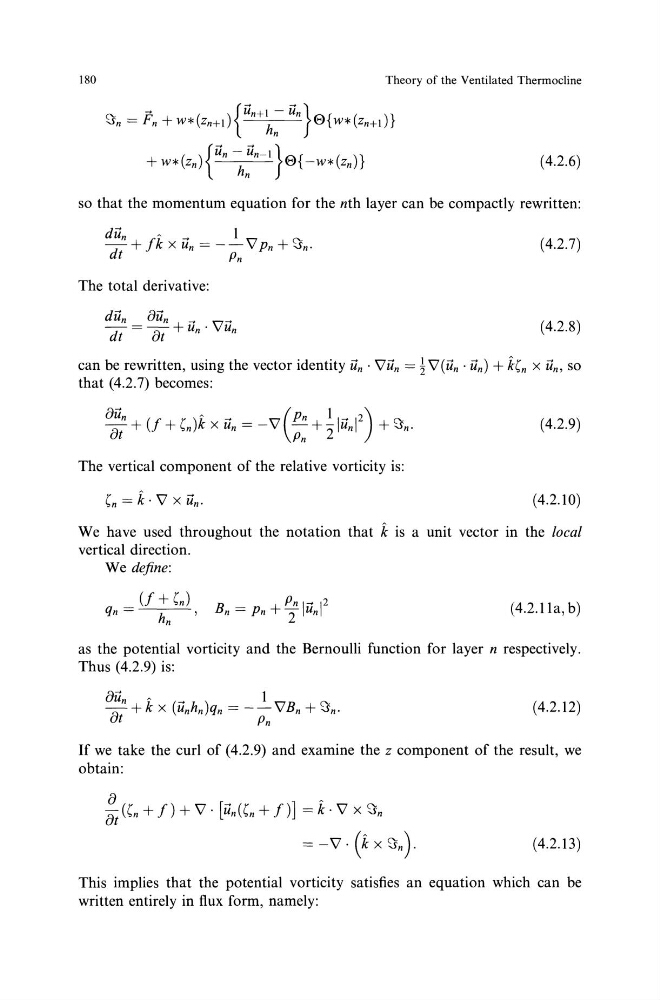
so that the momentum equation for the nth layer can be compactly rewritten:
dun fA _ _
1
()<
-d + k X Un- --'Vpn + "Sn·
t
Pn
(4.2.7)
The total derivative:
dun _ Bun _ . .,dt - at +un VUn
(4.2.8)
can be rewritten, using the vector identity Un · 'Vun =! 'V(un · un) + k(n x un, so
that (4.2.7) becomes:
Bun (f r )k' _ _ "(Pn 1 1
_ l2) ()<
8t + +'on X Un - - V Pn + 2 Un + "Sn.
(4.2.9)
The vertical component of the relative vorticity is:
Cn = k · V' X Un.
(4.2.10)
We have used throughout the notation that k is a unit vector in the local
vertical direction.
We define:
(! + Cn) B
Pn ~- 12
qn = h
n = Pn + - 2 Un
n
(4.2.11a, b)
as the potential vorticity and the Bernoulli function for layer n respectively.
Thus (4.2.9) is:
Bun kA (- h ) _
1 "
()<
- 8 + X Un n qn---vBn+:;sn·
t
Pn
( 4.2.12)
If we take the curl of (4.2.9) and examine the z component of the result, we
obtain:
a
A
Bt(Cn+f)+'V· [un(Cn+f)] =k·'VX~n
= -'\7 · (k X ~n)·
(4.2.13)
This implies that the potential vorticity satisfies an equation which can be
written entirely in flux form, namely:
Theory of the Ventilated Thermocline
(4.2.6)
so that the momentum equation for the nth layer can be compactly rewritten:
dun fA _ _
1
()<
-d + k X Un- --'Vpn + "Sn·
t
Pn
(4.2.7)
The total derivative:
dun _ Bun _ . .,dt - at +un VUn
(4.2.8)
can be rewritten, using the vector identity Un · 'Vun =! 'V(un · un) + k(n x un, so
that (4.2.7) becomes:
Bun (f r )k' _ _ "(Pn 1 1
_ l2) ()<
8t + +'on X Un - - V Pn + 2 Un + "Sn.
(4.2.9)
The vertical component of the relative vorticity is:
Cn = k · V' X Un.
(4.2.10)
We have used throughout the notation that k is a unit vector in the local
vertical direction.
We define:
(! + Cn) B
Pn ~- 12
qn = h
n = Pn + - 2 Un
n
(4.2.11a, b)
as the potential vorticity and the Bernoulli function for layer n respectively.
Thus (4.2.9) is:
Bun kA (- h ) _
1 "
()<
- 8 + X Un n qn---vBn+:;sn·
t
Pn
( 4.2.12)
If we take the curl of (4.2.9) and examine the z component of the result, we
obtain:
a
A
Bt(Cn+f)+'V· [un(Cn+f)] =k·'VX~n
= -'\7 · (k X ~n)·
(4.2.13)
This implies that the potential vorticity satisfies an equation which can be
written entirely in flux form, namely: