

182
Theory of the Ventilated Thermocline
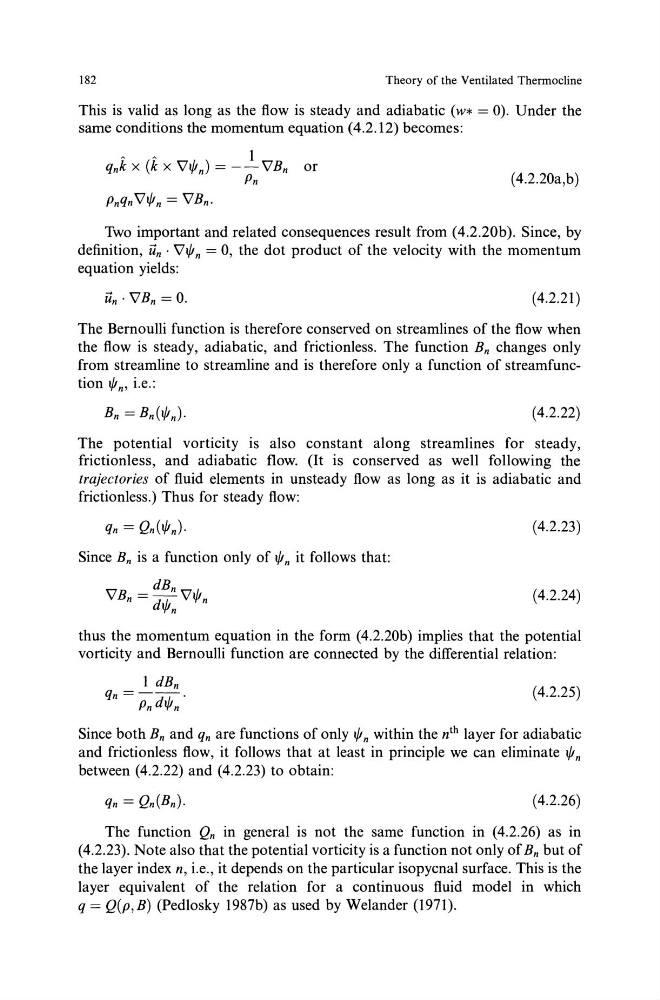
This is valid as long as the flow is steady and adiabatic (w* = 0). Under the
same conditions the momentum equation (4.2.12) becomes:
( 4.2.20a, b)
Two important and related consequences result from ( 4.2.20b ). Since, by
definition, itn · '\ll/Jn = 0, the dot product of the velocity with the momentum
equation yields:
(4.2.21)
The Bernoulli function is therefore conserved on streamlines of the flow when
the flow is steady, adiabatic, and frictionless. The function Bn changes only
from streamline to streamline and is therefore only a function of streamfunction l/1 n' i.e.:
(4.2.22)
The potential vorticity is also constant along streamlines for steady,
frictionless, and adiabatic flow. (It is conserved as well following the
trajectories of fluid elements in unsteady flow as long as it is adiabatic and
frictionless.) Thus for steady flow:
(4.2.23)
Since Bn is a function only of l/ln it follows that:
dBn
'\!Bn = dl/Jn '\ll/Jn
(4.2.24)
thus the momentum equation in the form (4.2.20b) implies that the potential
vorticity and Bernoulli function are connected by the differential relation:
(4.2.25)
Since both Bn and qn are functions of only l/Jn within the nth layer for adiabatic
and frictionless flow, it follows that at least in principle we can eliminate l/Jn
between (4.2.22) and (4.2.23) to obtain:
(4.2.26)
The function Qn in general is not the same function in (4.2.26) as in
(4.2.23). Note also that the potential vorticity is a function not only of Bn but of
the layer index n, i.e., it depends on the particular isopycnal surface. This is the
layer equivalent of the relation for a continuous fluid model in which
q = Q(p,B) (Pedlosky 1987b) as used by Welander (1971).
Theory of the Ventilated Thermocline
This is valid as long as the flow is steady and adiabatic (w* = 0). Under the
same conditions the momentum equation (4.2.12) becomes:
( 4.2.20a, b)
Two important and related consequences result from ( 4.2.20b ). Since, by
definition, itn · '\ll/Jn = 0, the dot product of the velocity with the momentum
equation yields:
(4.2.21)
The Bernoulli function is therefore conserved on streamlines of the flow when
the flow is steady, adiabatic, and frictionless. The function Bn changes only
from streamline to streamline and is therefore only a function of streamfunction l/1 n' i.e.:
(4.2.22)
The potential vorticity is also constant along streamlines for steady,
frictionless, and adiabatic flow. (It is conserved as well following the
trajectories of fluid elements in unsteady flow as long as it is adiabatic and
frictionless.) Thus for steady flow:
(4.2.23)
Since Bn is a function only of l/ln it follows that:
dBn
'\!Bn = dl/Jn '\ll/Jn
(4.2.24)
thus the momentum equation in the form (4.2.20b) implies that the potential
vorticity and Bernoulli function are connected by the differential relation:
(4.2.25)
Since both Bn and qn are functions of only l/Jn within the nth layer for adiabatic
and frictionless flow, it follows that at least in principle we can eliminate l/Jn
between (4.2.22) and (4.2.23) to obtain:
(4.2.26)
The function Qn in general is not the same function in (4.2.26) as in
(4.2.23). Note also that the potential vorticity is a function not only of Bn but of
the layer index n, i.e., it depends on the particular isopycnal surface. This is the
layer equivalent of the relation for a continuous fluid model in which
q = Q(p,B) (Pedlosky 1987b) as used by Welander (1971).