

Homogenization of Potential Vorticity
133
dQni _ -
d·'·
KUn · td£ = 0
'f'n Co/!
(3.8.5)
Note that we take d Q,. / dt/1 n outside the integral since it is a function only of t/1 n
and hence constant on Ct/J. As long asK is positive, the integral in (3.8.5) differs
from zero and so for all closed streamlines in layer n on which there is motion:
dQ,. =0
dt/J n
.
(3.8.6)
Thus, there is no variation of the potential vorticity from streamline to
streamline within the region of motion. The potential vorticity is constant and
equal to the potential vorticity, q,.0 , on the outermost streamline which bounds
the pool of constant potential vorticity.
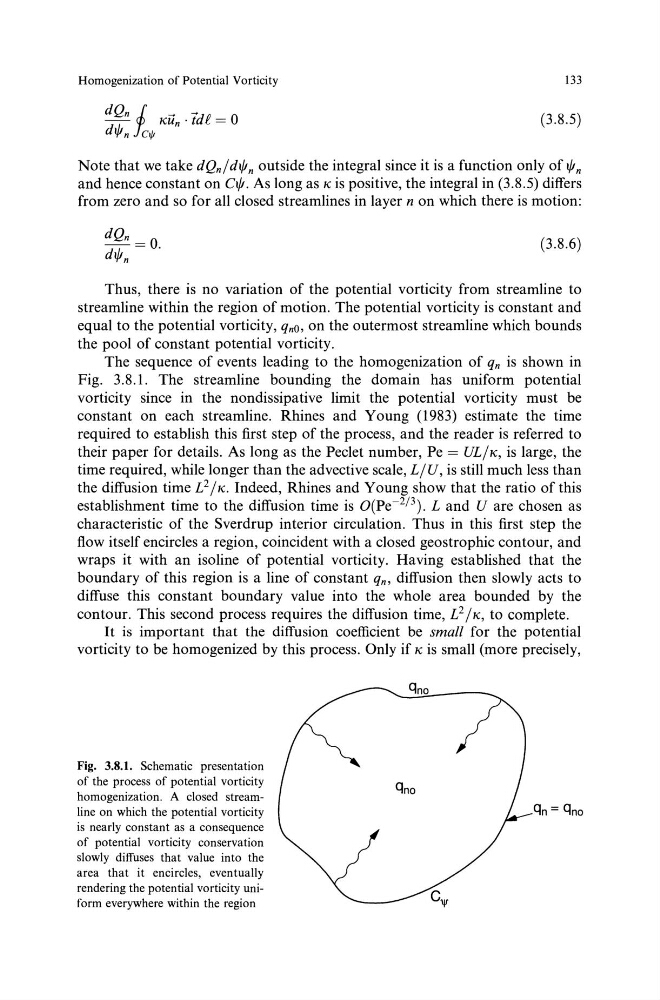
The sequence of events leading to the homogenization of q11 is shown in
Fig. 3.8.1. The streamline bounding the domain has uniform potential
vorticity since in the nondissipative limit the potential vorticity must be
constant on each streamline. Rhines and Young (1983) estimate the time
required to establish this first step of the process, and the reader is referred to
their paper for details. As long as the Peclet number, Pe = UL/K, is large, the
time required, while longer than the advective scale, L/U, is still much less than
the diffusion time L 2 jK. Indeed, Rhines and Young show that the ratio of this
establishment time to the diffusion time is O(Pe- 2 1 3 ). L and U are chosen as
characteristic of the Sverdrup interior circulation. Thus in this first step the
flow itself encircles a region, coincident with a closed geostrophic contour, and
wraps it with an isoline of potential vorticity. Having established that the
boundary of this region is a line of constant q11 , diffusion then slowly acts to
diffuse this constant boundary value into the whole area bounded by the
contour. This second process requires the diffusion time, L 2 /K, to complete.
It is important that the diffusion coefficient be small for the potential
vorticity to be homogenized by this process. Only if K is small (more precisely,
Fig. 3.8.1. Schematic presentation
of the process of potential vorticity
homogenization. A closed streamline on which the potential vorticity
is nearly constant as a consequence
of potential vorticity conservation
slowly diffuses that value into the
area that it encircles, eventually
rendering the potential vorticity uniform everywhere within the region
133
dQni _ -
d·'·
KUn · td£ = 0
'f'n Co/!
(3.8.5)
Note that we take d Q,. / dt/1 n outside the integral since it is a function only of t/1 n
and hence constant on Ct/J. As long asK is positive, the integral in (3.8.5) differs
from zero and so for all closed streamlines in layer n on which there is motion:
dQ,. =0
dt/J n
.
(3.8.6)
Thus, there is no variation of the potential vorticity from streamline to
streamline within the region of motion. The potential vorticity is constant and
equal to the potential vorticity, q,.0 , on the outermost streamline which bounds
the pool of constant potential vorticity.
The sequence of events leading to the homogenization of q11 is shown in
Fig. 3.8.1. The streamline bounding the domain has uniform potential
vorticity since in the nondissipative limit the potential vorticity must be
constant on each streamline. Rhines and Young (1983) estimate the time
required to establish this first step of the process, and the reader is referred to
their paper for details. As long as the Peclet number, Pe = UL/K, is large, the
time required, while longer than the advective scale, L/U, is still much less than
the diffusion time L 2 jK. Indeed, Rhines and Young show that the ratio of this
establishment time to the diffusion time is O(Pe- 2 1 3 ). L and U are chosen as
characteristic of the Sverdrup interior circulation. Thus in this first step the
flow itself encircles a region, coincident with a closed geostrophic contour, and
wraps it with an isoline of potential vorticity. Having established that the
boundary of this region is a line of constant q11 , diffusion then slowly acts to
diffuse this constant boundary value into the whole area bounded by the
contour. This second process requires the diffusion time, L 2 /K, to complete.
It is important that the diffusion coefficient be small for the potential
vorticity to be homogenized by this process. Only if K is small (more precisely,
Fig. 3.8.1. Schematic presentation
of the process of potential vorticity
homogenization. A closed streamline on which the potential vorticity
is nearly constant as a consequence
of potential vorticity conservation
slowly diffuses that value into the
area that it encircles, eventually
rendering the potential vorticity uniform everywhere within the region