

134
Vertical Structure: Baroclinic Quasi-Geostrophic Models
only ifPe » 1) is the flow able to establish the boundary of the pool as a line of
constant qn which is then diffused inwards establishing a uniform internal
value. If the diffusion coefficient is large, and diffusion dominates advection,
the generally nonuniform values of qn on the boundary of the gyre would be
diffused inwards. Diffusion would control the potential vorticity, but qn would
not be uniform. If K is a function of position, it is necessary only that it be small
on the bounding contour so that a uniform value of potential vorticity can be
established there by advective wrapping of the qn contours. Large values of K
interior to the pool's boundary would then shorten the homogenization period.
Thus we need only require that the mixing of vorticity be small on the
boundary established by the outermost of the closed geostrophic contours.
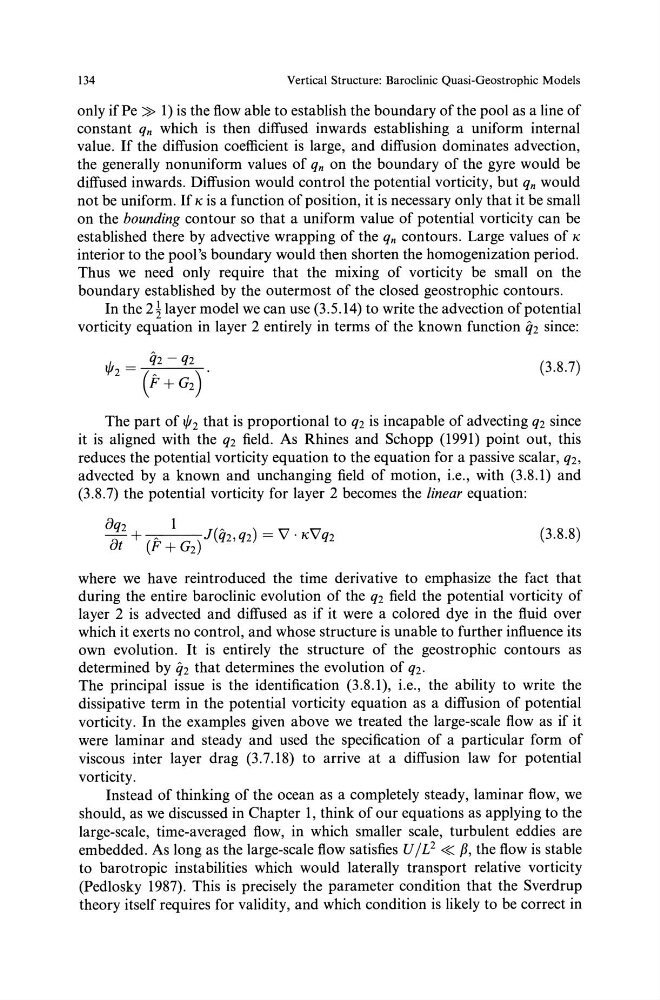
In the 2! layer model we can use (3.5.14) to write the advection of potential
vorticity equation in layer 2 entirely in terms of the known function q2 since:
(3.8. 7)
The part of l/1 2 that is proportional to qz is incapable of advecting q2 since
it is aligned with the q2 field. As Rhines and Schopp (1991) point out, this
reduces the potential vorticity equation to the equation for a passive scalar, q2,
advected by a known and unchanging field of motion, i.e., with (3.8.1) and
(3.8.7) the potential vorticity for layer 2 becomes the linear equation:
(3.8.8)
where we have reintroduced the time derivative to emphasize the fact that
during the entire baroclinic evolution of the q2 field the potential vorticity of
layer 2 is advected and diffused as if it were a colored dye in the fluid over
which it exerts no control, and whose structure is unable to further influence its
own evolution. It is entirely the structure of the geostrophic contours as
determined by qz that determines the evolution of q2 .
The principal issue is the identification (3.8.1), i.e., the ability to write the
dissipative term in the potential vorticity equation as a diffusion of potential
vorticity. In the examples given above we treated the large-scale flow as if it
were laminar and steady and used the specification of a particular form of
viscous inter layer drag (3.7.18) to arrive at a diffusion law for potential
vorticity.
Instead of thinking of the ocean as a completely steady, laminar flow, we
should, as we discussed in Chapter 1, think of our equations as applying to the
large-scale, time-averaged flow, in which smaller scale, turbulent eddies are
embedded. As long as the large-scale flow satisfies U / L 2 « [3, the flow is stable
to barotropic instabilities which would laterally transport relative vorticity
(Pedlosky 1987). This is precisely the parameter condition that the Sverdrup
theory itself requires for validity, and which condition is likely to be correct in
Vertical Structure: Baroclinic Quasi-Geostrophic Models
only ifPe » 1) is the flow able to establish the boundary of the pool as a line of
constant qn which is then diffused inwards establishing a uniform internal
value. If the diffusion coefficient is large, and diffusion dominates advection,
the generally nonuniform values of qn on the boundary of the gyre would be
diffused inwards. Diffusion would control the potential vorticity, but qn would
not be uniform. If K is a function of position, it is necessary only that it be small
on the bounding contour so that a uniform value of potential vorticity can be
established there by advective wrapping of the qn contours. Large values of K
interior to the pool's boundary would then shorten the homogenization period.
Thus we need only require that the mixing of vorticity be small on the
boundary established by the outermost of the closed geostrophic contours.
In the 2! layer model we can use (3.5.14) to write the advection of potential
vorticity equation in layer 2 entirely in terms of the known function q2 since:
(3.8. 7)
The part of l/1 2 that is proportional to qz is incapable of advecting q2 since
it is aligned with the q2 field. As Rhines and Schopp (1991) point out, this
reduces the potential vorticity equation to the equation for a passive scalar, q2,
advected by a known and unchanging field of motion, i.e., with (3.8.1) and
(3.8.7) the potential vorticity for layer 2 becomes the linear equation:
(3.8.8)
where we have reintroduced the time derivative to emphasize the fact that
during the entire baroclinic evolution of the q2 field the potential vorticity of
layer 2 is advected and diffused as if it were a colored dye in the fluid over
which it exerts no control, and whose structure is unable to further influence its
own evolution. It is entirely the structure of the geostrophic contours as
determined by qz that determines the evolution of q2 .
The principal issue is the identification (3.8.1), i.e., the ability to write the
dissipative term in the potential vorticity equation as a diffusion of potential
vorticity. In the examples given above we treated the large-scale flow as if it
were laminar and steady and used the specification of a particular form of
viscous inter layer drag (3.7.18) to arrive at a diffusion law for potential
vorticity.
Instead of thinking of the ocean as a completely steady, laminar flow, we
should, as we discussed in Chapter 1, think of our equations as applying to the
large-scale, time-averaged flow, in which smaller scale, turbulent eddies are
embedded. As long as the large-scale flow satisfies U / L 2 « [3, the flow is stable
to barotropic instabilities which would laterally transport relative vorticity
(Pedlosky 1987). This is precisely the parameter condition that the Sverdrup
theory itself requires for validity, and which condition is likely to be correct in