

132
Vertical Structure: Baroclinic Quasi-Geostrophic Models
only term that survives since the advection of potential vorticity across a
streamline is zero.
In the low dissipation limit where the potential vorticity is, to first
approximation, conserved along streamlines the functional relation between
the potential vorticity and the streamlines is determined, as we have seen in the
previous example, by the cumulative, integrated effects of the dissipation. The
potential vorticity and streamfunction in these layers, which are without direct
wind forcing, are both constant on geostrophic contours, but the determination
of the amplitude of each of these functions on each geostrophic contour is fixed
by the long-term action of dissipation.
We saw in the previous section that when the dissipation of potential
vorticity can be written as a diffusion of the potential vorticity itself, the
potential vorticity in the pool region becomes a constant. We can see this
directly without detailed calculation. The proof is given by the PrandtlBatchelor theorem (Batchelor 1956), whose outlines we give here.
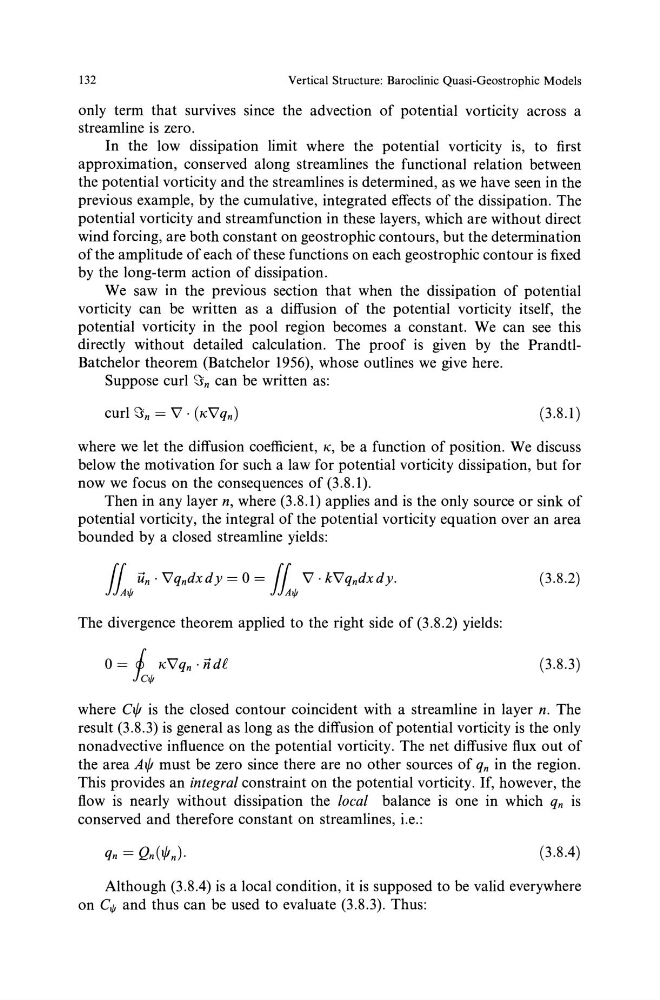
Suppose curl CSn can be written as:
(3.8.1)
where we let the diffusion coefficient, K, be a function of position. We discuss
below the motivation for such a law for potential vorticity dissipation, but for
now we focus on the consequences of (3.8.1).
Then in any layer n, where (3.8.1) applies and is the only source or sink of
potential vorticity, the integral of the potential vorticity equation over an area
bounded by a closed streamline yields:
(3.8.2)
The divergence theorem applied to the right side of (3.8.2) yields:
(3.8.3)
where Ct/1 is the closed contour coincident with a streamline in layer n. The
result (3.8.3) is general as long as the diffusion of potential vorticity is the only
nonadvective influence on the potential vorticity. The net diffusive flux out of
the area At/! must be zero since there are no other sources of qn in the region.
This provides an integral constraint on the potential vorticity. If, however, the
flow is nearly without dissipation the local balance is one in which qn is
conserved and therefore constant on streamlines, i.e.:
(3.8.4)
Although (3.8.4) is a local condition, it is supposed to be valid everywhere
on Cl/1 and thus can be used to evaluate (3.8.3). Thus:
Vertical Structure: Baroclinic Quasi-Geostrophic Models
only term that survives since the advection of potential vorticity across a
streamline is zero.
In the low dissipation limit where the potential vorticity is, to first
approximation, conserved along streamlines the functional relation between
the potential vorticity and the streamlines is determined, as we have seen in the
previous example, by the cumulative, integrated effects of the dissipation. The
potential vorticity and streamfunction in these layers, which are without direct
wind forcing, are both constant on geostrophic contours, but the determination
of the amplitude of each of these functions on each geostrophic contour is fixed
by the long-term action of dissipation.
We saw in the previous section that when the dissipation of potential
vorticity can be written as a diffusion of the potential vorticity itself, the
potential vorticity in the pool region becomes a constant. We can see this
directly without detailed calculation. The proof is given by the PrandtlBatchelor theorem (Batchelor 1956), whose outlines we give here.
Suppose curl CSn can be written as:
(3.8.1)
where we let the diffusion coefficient, K, be a function of position. We discuss
below the motivation for such a law for potential vorticity dissipation, but for
now we focus on the consequences of (3.8.1).
Then in any layer n, where (3.8.1) applies and is the only source or sink of
potential vorticity, the integral of the potential vorticity equation over an area
bounded by a closed streamline yields:
(3.8.2)
The divergence theorem applied to the right side of (3.8.2) yields:
(3.8.3)
where Ct/1 is the closed contour coincident with a streamline in layer n. The
result (3.8.3) is general as long as the diffusion of potential vorticity is the only
nonadvective influence on the potential vorticity. The net diffusive flux out of
the area At/! must be zero since there are no other sources of qn in the region.
This provides an integral constraint on the potential vorticity. If, however, the
flow is nearly without dissipation the local balance is one in which qn is
conserved and therefore constant on streamlines, i.e.:
(3.8.4)
Although (3.8.4) is a local condition, it is supposed to be valid everywhere
on Cl/1 and thus can be used to evaluate (3.8.3). Thus: