

Homogenization of Potential Vorticity
131
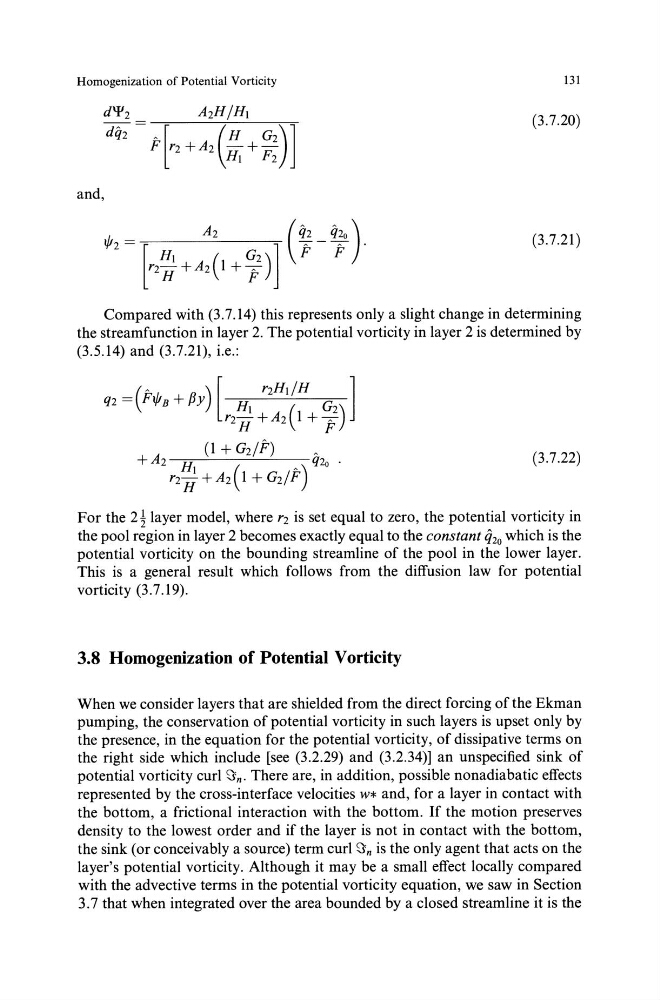
(3.7.20)
and,
(3.7.21)
Compared with (3.7.14) this represents only a slight change in determining
the streamfunction in layer 2. The potential vorticity in layer 2 is determined by
(3.5.14) and (3. 7.21 ), i.e.:
(3.7.22)
For the 2~ layer model, where r 2 is set equal to zero, the potential vorticity in
the pool region in layer 2 becomes exactly equal to the constant q 20 which is the
potential vorticity on the bounding streamline of the pool in the lower layer.
This is a general result which follows from the diffusion law for potential
vorticity (3.7.19).
3.8 Homogenization of Potential Vorticity
When we consider layers that are shielded from the direct forcing of the Ekman
pumping, the conservation of potential vorticity in such layers is upset only by
the presence, in the equation for the potential vorticity, of dissipative terms on
the right side which include [see (3.2.29) and (3.2.34)] an unspecified sink of
potential vorticity curl 'Sn. There are, in addition, possible nonadiabatic effects
represented by the cross-interface velocities W* and, for a layer in contact with
the bottom, a frictional interaction with the bottom. If the motion preserves
density to the lowest order and if the layer is not in contact with the bottom,
the sink (or conceivably a source) term curl 'Sn is the only agent that acts on the
layer's potential vorticity. Although it may be a small effect locally compared
with the advective terms in the potential vorticity equation, we saw in Section
3.7 that when integrated over the area bounded by a closed streamline it is the
131
(3.7.20)
and,
(3.7.21)
Compared with (3.7.14) this represents only a slight change in determining
the streamfunction in layer 2. The potential vorticity in layer 2 is determined by
(3.5.14) and (3. 7.21 ), i.e.:
(3.7.22)
For the 2~ layer model, where r 2 is set equal to zero, the potential vorticity in
the pool region in layer 2 becomes exactly equal to the constant q 20 which is the
potential vorticity on the bounding streamline of the pool in the lower layer.
This is a general result which follows from the diffusion law for potential
vorticity (3.7.19).
3.8 Homogenization of Potential Vorticity
When we consider layers that are shielded from the direct forcing of the Ekman
pumping, the conservation of potential vorticity in such layers is upset only by
the presence, in the equation for the potential vorticity, of dissipative terms on
the right side which include [see (3.2.29) and (3.2.34)] an unspecified sink of
potential vorticity curl 'Sn. There are, in addition, possible nonadiabatic effects
represented by the cross-interface velocities W* and, for a layer in contact with
the bottom, a frictional interaction with the bottom. If the motion preserves
density to the lowest order and if the layer is not in contact with the bottom,
the sink (or conceivably a source) term curl 'Sn is the only agent that acts on the
layer's potential vorticity. Although it may be a small effect locally compared
with the advective terms in the potential vorticity equation, we saw in Section
3.7 that when integrated over the area bounded by a closed streamline it is the