

130
Vertical Structure: Baroclinic Quasi-Geostrophic Models
density jump across layers 1 and 2 so that G2 « ft, the potential vorticity in
layer 2 becomes equal to a constant everywhere within the pool of motion in
the layer, i.e.:
(3.7.17)
which is the potential vorticity of the outermost geostrophic contour. For
example, in the disk problem of the last section q2 would be equal to f3r1
everywhere in the pool. In this limit the potential vorticity in the pool region is
rendered uniform by the action of dissipation. As Rhines andY oung put it, the
potential vorticity in the pool becomes homogenized. It is important to note
that outside the pool region the potential vorticity in layer 2, where the fluid is
motionless, possesses strong gradients on the order of the planetary vorticity
gradient.
The sensitive relationship of the potential vorticity in layer 2 to the form of
the dissipation is an interesting and important one. In the example discussed we
chose a form of dissipation (3.7.5) in a rather arbitrary manner. Other choices
are equally, if not more, plausible. For example, in the 2! layer model we might
include a frictional drag law for layer 2 which includes a drag with a deep
nearly motionless layer beneath layer 2 as well as a frictional coupling with
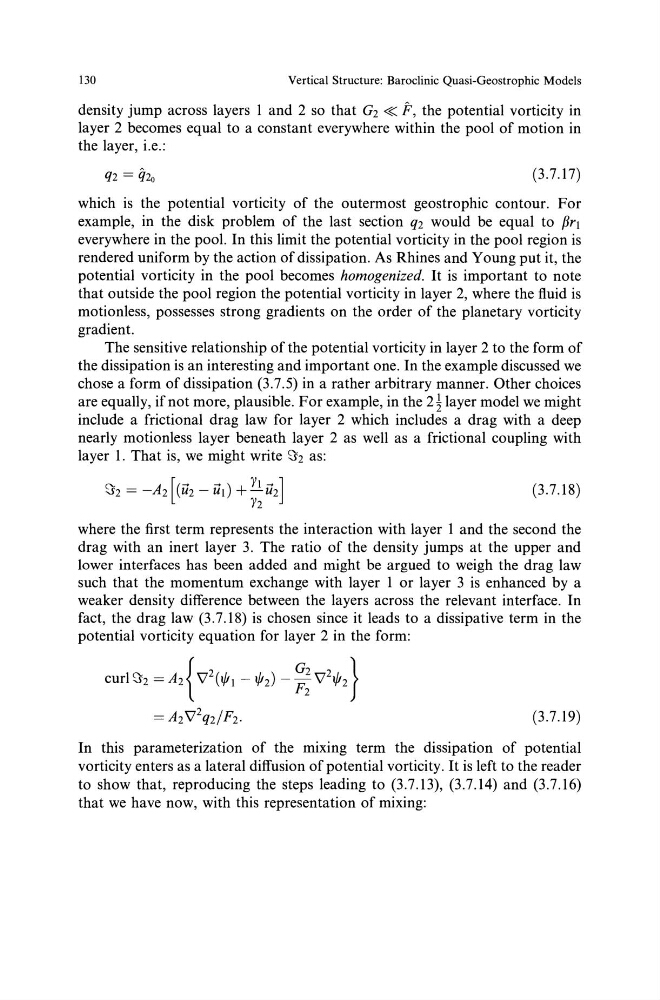
layer 1. That is, we might write CSz as:
CSz = -Az [(uz- !11) + ~~ i1z J
(3.7.18)
where the first term represents the interaction with layer 1 and the second the
drag with an inert layer 3. The ratio of the density jumps at the upper and
lower interfaces has been added and might be argued to weigh the drag law
such that the momentum exchange with layer 1 or layer 3 is enhanced by a
weaker density difference between the layers across the relevant interface. In
fact, the drag law (3.7.18) is chosen since it leads to a dissipative term in the
potential vorticity equation for layer 2 in the form:
{
2
Gz 2 }
curl CSz = Az V' (l/11 -l/12) - Fz V' l /12
= AzV' 2 qz/Fz.
(3.7.19)
In this parameterization of the mlXlng term the dissipation of potential
vorticity enters as a lateral diffusion of potential vorticity. It is left to the reader
to show that, reproducing the steps leading to (3.7.13), (3.7.14) and (3.7.16)
that we have now, with this representation of mixing:
Vertical Structure: Baroclinic Quasi-Geostrophic Models
density jump across layers 1 and 2 so that G2 « ft, the potential vorticity in
layer 2 becomes equal to a constant everywhere within the pool of motion in
the layer, i.e.:
(3.7.17)
which is the potential vorticity of the outermost geostrophic contour. For
example, in the disk problem of the last section q2 would be equal to f3r1
everywhere in the pool. In this limit the potential vorticity in the pool region is
rendered uniform by the action of dissipation. As Rhines andY oung put it, the
potential vorticity in the pool becomes homogenized. It is important to note
that outside the pool region the potential vorticity in layer 2, where the fluid is
motionless, possesses strong gradients on the order of the planetary vorticity
gradient.
The sensitive relationship of the potential vorticity in layer 2 to the form of
the dissipation is an interesting and important one. In the example discussed we
chose a form of dissipation (3.7.5) in a rather arbitrary manner. Other choices
are equally, if not more, plausible. For example, in the 2! layer model we might
include a frictional drag law for layer 2 which includes a drag with a deep
nearly motionless layer beneath layer 2 as well as a frictional coupling with
layer 1. That is, we might write CSz as:
CSz = -Az [(uz- !11) + ~~ i1z J
(3.7.18)
where the first term represents the interaction with layer 1 and the second the
drag with an inert layer 3. The ratio of the density jumps at the upper and
lower interfaces has been added and might be argued to weigh the drag law
such that the momentum exchange with layer 1 or layer 3 is enhanced by a
weaker density difference between the layers across the relevant interface. In
fact, the drag law (3.7.18) is chosen since it leads to a dissipative term in the
potential vorticity equation for layer 2 in the form:
{
2
Gz 2 }
curl CSz = Az V' (l/11 -l/12) - Fz V' l /12
= AzV' 2 qz/Fz.
(3.7.19)
In this parameterization of the mlXlng term the dissipation of potential
vorticity enters as a lateral diffusion of potential vorticity. It is left to the reader
to show that, reproducing the steps leading to (3.7.13), (3.7.14) and (3.7.16)
that we have now, with this representation of mixing: