

The Quasi-Geostrophic Model
99
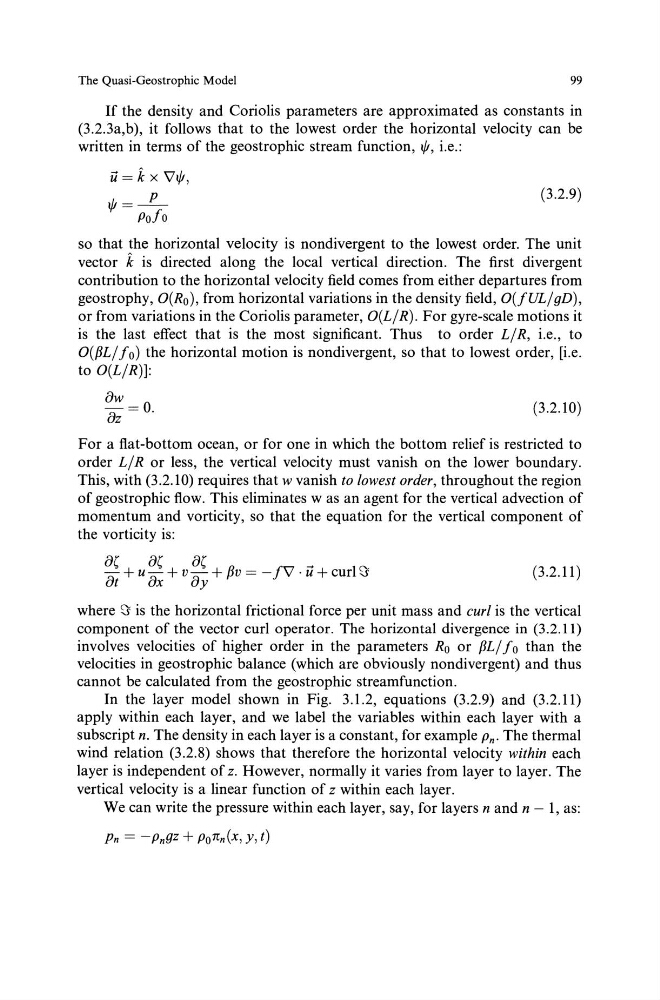
If the density and Coriolis parameters are approximated as constants in
(3.2.3a,b), it follows that to the lowest order the horizontal velocity can be
written in terms of the geostrophic stream function, t/J, i.e.:
U = k X '\lt/J,
t/1 = __!!_
Polo
(3.2.9)
so that the horizontal velocity is nondivergent to the lowest order. The unit
vector k is directed along the local vertical direction. The first divergent
contribution to the horizontal velocity field comes from either departures from
geostrophy, O(Ro), from horizontal variations in the density field, O(JULjgD),
or from variations in the Coriolis parameter, O(L/R). For gyre-scale motions it
is the last effect that is the most significant. Thus to order LjR, i.e., to
O(PL/ fo) the horizontal motion is nondivergent, so that to lowest order, [i.e.
to O(L/R)]:
aw
az =O.
(3.2.10)
For a flat-bottom ocean, or for one in which the bottom relief is restricted to
order L/R or less, the vertical velocity must vanish on the lower boundary.
This, with (3.2.10) requires that w vanish to lowest order, throughout the region
of geostrophic flow. This eliminates was an agent for the vertical advection of
momentum and vorticity, so that the equation for the vertical component of
the vorticity is:
a, a, a,
~
- + u- + v- + Pv = - f'\1 · u + curl <;:5
at ax ay
(3.2.11)
where <;.)< is the horizontal frictional force per unit mass and curl is the vertical
component of the vector curl operator. The horizontal divergence in (3.2.11)
involves velocities of higher order in the parameters R0 or PL/ fo than the
velocities in geostrophic balance (which are obviously nondivergent) and thus
cannot be calculated from the geostrophic streamfunction.
In the layer model shown in Fig. 3.1.2, equations (3.2.9) and (3.2.11)
apply within each layer, and we label the variables within each layer with a
subscript n. The density in each layer is a constant, for example Pn· The thermal
wind relation (3.2.8) shows that therefore the horizontal velocity within each
layer is independent of z. However, normally it varies from layer to layer. The
vertical velocity is a linear function of z within each layer.
We can write the pressure within each layer, say, for layers nand n- 1, as:
Pn = -pngz + Ponn(X, y, t)
99
If the density and Coriolis parameters are approximated as constants in
(3.2.3a,b), it follows that to the lowest order the horizontal velocity can be
written in terms of the geostrophic stream function, t/J, i.e.:
U = k X '\lt/J,
t/1 = __!!_
Polo
(3.2.9)
so that the horizontal velocity is nondivergent to the lowest order. The unit
vector k is directed along the local vertical direction. The first divergent
contribution to the horizontal velocity field comes from either departures from
geostrophy, O(Ro), from horizontal variations in the density field, O(JULjgD),
or from variations in the Coriolis parameter, O(L/R). For gyre-scale motions it
is the last effect that is the most significant. Thus to order LjR, i.e., to
O(PL/ fo) the horizontal motion is nondivergent, so that to lowest order, [i.e.
to O(L/R)]:
aw
az =O.
(3.2.10)
For a flat-bottom ocean, or for one in which the bottom relief is restricted to
order L/R or less, the vertical velocity must vanish on the lower boundary.
This, with (3.2.10) requires that w vanish to lowest order, throughout the region
of geostrophic flow. This eliminates was an agent for the vertical advection of
momentum and vorticity, so that the equation for the vertical component of
the vorticity is:
a, a, a,
~
- + u- + v- + Pv = - f'\1 · u + curl <;:5
at ax ay
(3.2.11)
where <;.)< is the horizontal frictional force per unit mass and curl is the vertical
component of the vector curl operator. The horizontal divergence in (3.2.11)
involves velocities of higher order in the parameters R0 or PL/ fo than the
velocities in geostrophic balance (which are obviously nondivergent) and thus
cannot be calculated from the geostrophic streamfunction.
In the layer model shown in Fig. 3.1.2, equations (3.2.9) and (3.2.11)
apply within each layer, and we label the variables within each layer with a
subscript n. The density in each layer is a constant, for example Pn· The thermal
wind relation (3.2.8) shows that therefore the horizontal velocity within each
layer is independent of z. However, normally it varies from layer to layer. The
vertical velocity is a linear function of z within each layer.
We can write the pressure within each layer, say, for layers nand n- 1, as:
Pn = -pngz + Ponn(X, y, t)