

98
Vertical Structure: Baroclinic Quasi-Geostrophic Models
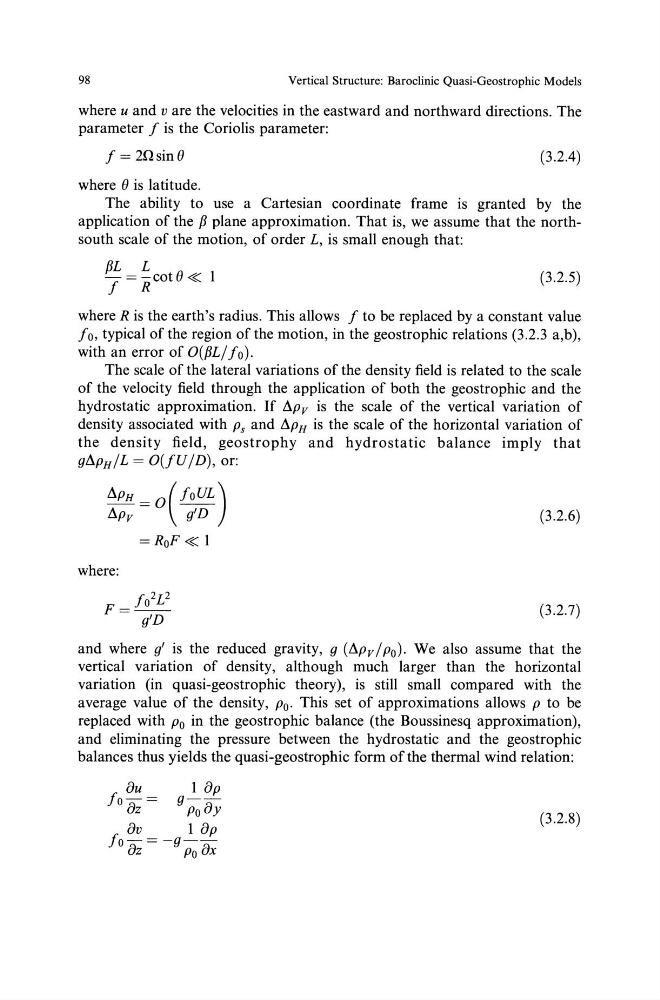
where u and v are the velocities in the eastward and northward directions. The
parameter f is the Coriolis parameter:
f = 2Qsin8
(3.2.4)
where e is latitude.
The ability to use a Cartesian coordinate frame is granted by the
application of the f3 plane approximation. That is, we assume that the northsouth scale of the motion, of order L, is small enough that:
f3L
L
-=-cote« 1
f
R
(3.2.5)
where R is the earth's radius. This allows f to be replaced by a constant value
fo, typical of the region of the motion, in the geostrophic relations (3.2.3 a,b),
with an error of O(f3L/ fo).
The scale of the lateral variations of the density field is related to the scale
of the velocity field through the application of both the geostrophic and the
hydrostatic approximation. If !1pv is the scale of the vertical variation of
density associated with Ps and !1pH is the scale of the horizontal variation of
the density field, geostrophy and hydrostatic balance imply that
g!1pH/L = O(JU /D), or:
!1pH = a(foUL)
!1pv
g'D
(3.2.6)
= RoF « 1
where:
F = fo2L2
g'D
(3.2.7)
and where g' is the reduced gravity, g (!1pv/ p 0 ). We also assume that the
vertical variation of density, although much larger than the horizontal
variation (in quasi-geostrophic theory), is still small compared with the
average value of the density, p 0 . This set of approximations allows p to be
replaced with Po in the geostrophic balance (the Boussinesq approximation),
and eliminating the pressure between the hydrostatic and the geostrophic
balances thus yields the quasi-geostrophic form of the thermal wind relation:
8u
1 8p
fo-=
g - -
8z
PoOY
8v
1 8p
fo-= - g - -
8z
Po 8x
(3.2.8)
Vertical Structure: Baroclinic Quasi-Geostrophic Models
where u and v are the velocities in the eastward and northward directions. The
parameter f is the Coriolis parameter:
f = 2Qsin8
(3.2.4)
where e is latitude.
The ability to use a Cartesian coordinate frame is granted by the
application of the f3 plane approximation. That is, we assume that the northsouth scale of the motion, of order L, is small enough that:
f3L
L
-=-cote« 1
f
R
(3.2.5)
where R is the earth's radius. This allows f to be replaced by a constant value
fo, typical of the region of the motion, in the geostrophic relations (3.2.3 a,b),
with an error of O(f3L/ fo).
The scale of the lateral variations of the density field is related to the scale
of the velocity field through the application of both the geostrophic and the
hydrostatic approximation. If !1pv is the scale of the vertical variation of
density associated with Ps and !1pH is the scale of the horizontal variation of
the density field, geostrophy and hydrostatic balance imply that
g!1pH/L = O(JU /D), or:
!1pH = a(foUL)
!1pv
g'D
(3.2.6)
= RoF « 1
where:
F = fo2L2
g'D
(3.2.7)
and where g' is the reduced gravity, g (!1pv/ p 0 ). We also assume that the
vertical variation of density, although much larger than the horizontal
variation (in quasi-geostrophic theory), is still small compared with the
average value of the density, p 0 . This set of approximations allows p to be
replaced with Po in the geostrophic balance (the Boussinesq approximation),
and eliminating the pressure between the hydrostatic and the geostrophic
balances thus yields the quasi-geostrophic form of the thermal wind relation:
8u
1 8p
fo-=
g - -
8z
PoOY
8v
1 8p
fo-= - g - -
8z
Po 8x
(3.2.8)