

The Quasi-Geostrophic Model
97
geographical location, this vertical squeezing would result, in the limiting case
of an infinite number of layers, in the Sverdrup transport being carried in the
first layer of infinitesimal thickness, i.e., with a delta function distribution of
velocity with depth. One way of characterizing different theories for the vertical
structure of the velocity field is by the mechanism used in each theory to resolve
the perplexity of this absurd limit for the velocity field as the vertical resolution
is improved. The important theoretical task ahead is in clarifying what has
been overlooked in the oversimplified view of the dynamics that has led to this
apparent paradox for the vertical structure of the velocity. The present chapter
describes quasi-geostrophic theories that deal with this issue.
3.2 The Quasi-Geostrophic Model
The formulation of the quasi-geostrophic model, both in its layer form and for
a continuously stratified fluid, can be found in many texts. A careful
development of the theory can be found in Pedlosky (1987), in which the
equations are developed in an asymptotic series in the small parameter:
u
Ro=fL
(3.2.1)
R0 is the Rossby number and U, f, and L are characteristic values for the
horizontal velocity, the Coriolis parameter, and the horizontal length scale of
the motion, respectively. This section develops the equations in a more
informal manner concentrating on the physical character of the derivation.
Along with the Ross by number the aspect ratio of the motion, b, is a small
parameter. If Dis the vertical scale of the motion, then:
D
b=r« I.
(3.2.2)
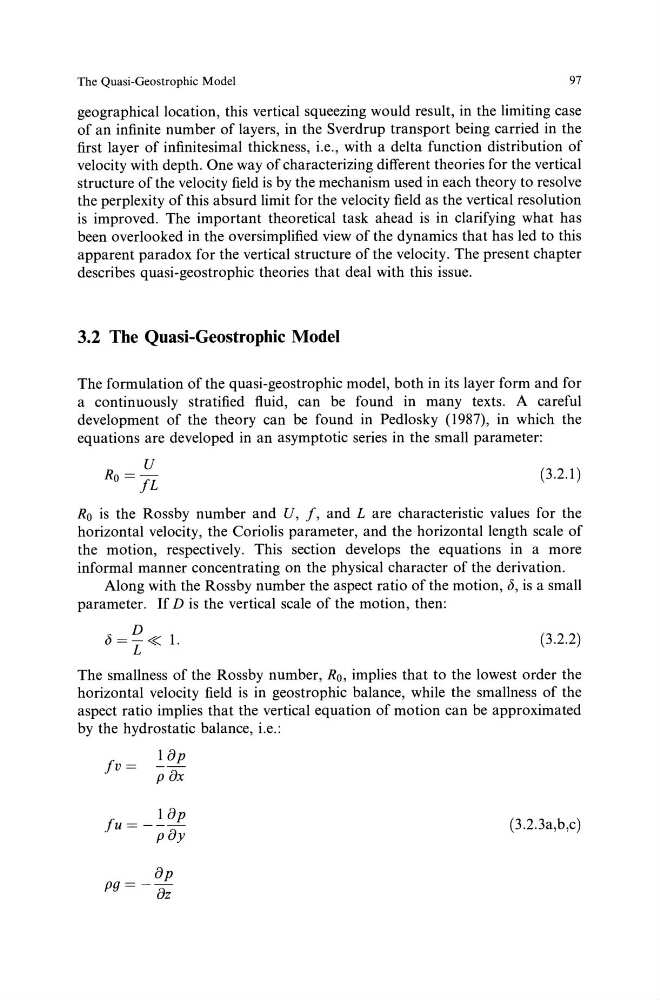
The smallness of the Rossby number, Ro, implies that to the lowest order the
horizontal velocity field is in geostrophic balance, while the smallness of the
aspect ratio implies that the vertical equation of motion can be approximated
by the hydrostatic balance, i.e.:
lop
pax
fv=
lop
fu=--p8y
8p
pg=-8z
(3.2.3a,b,c)
97
geographical location, this vertical squeezing would result, in the limiting case
of an infinite number of layers, in the Sverdrup transport being carried in the
first layer of infinitesimal thickness, i.e., with a delta function distribution of
velocity with depth. One way of characterizing different theories for the vertical
structure of the velocity field is by the mechanism used in each theory to resolve
the perplexity of this absurd limit for the velocity field as the vertical resolution
is improved. The important theoretical task ahead is in clarifying what has
been overlooked in the oversimplified view of the dynamics that has led to this
apparent paradox for the vertical structure of the velocity. The present chapter
describes quasi-geostrophic theories that deal with this issue.
3.2 The Quasi-Geostrophic Model
The formulation of the quasi-geostrophic model, both in its layer form and for
a continuously stratified fluid, can be found in many texts. A careful
development of the theory can be found in Pedlosky (1987), in which the
equations are developed in an asymptotic series in the small parameter:
u
Ro=fL
(3.2.1)
R0 is the Rossby number and U, f, and L are characteristic values for the
horizontal velocity, the Coriolis parameter, and the horizontal length scale of
the motion, respectively. This section develops the equations in a more
informal manner concentrating on the physical character of the derivation.
Along with the Ross by number the aspect ratio of the motion, b, is a small
parameter. If Dis the vertical scale of the motion, then:
D
b=r« I.
(3.2.2)
The smallness of the Rossby number, Ro, implies that to the lowest order the
horizontal velocity field is in geostrophic balance, while the smallness of the
aspect ratio implies that the vertical equation of motion can be approximated
by the hydrostatic balance, i.e.:
lop
pax
fv=
lop
fu=--p8y
8p
pg=-8z
(3.2.3a,b,c)