

96
2
•
•
•
Vertical Structure: Baroclinic Quasi-Geostrophic Models
------l~'t
Pn-1
zn-1
n 1 ________________ -n--- - -
Pn - - -
Z n - - - - - -
n
Pn+1 - - -
Z
n~+11------------~~----n+1 ______ _
Zn+2
•
•
•
N-1
N
PN-1
'777777777777777777777777777777777777777777777
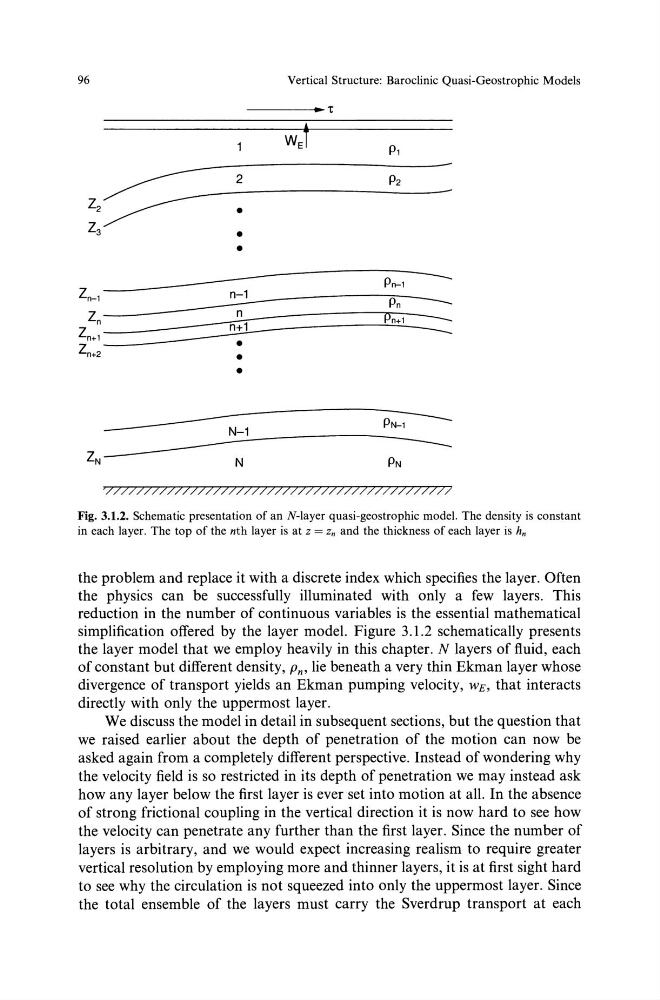
Fig. 3.1.2. Schematic presentation of an N-layer quasi-geostrophic model. The density is constant
in each layer. The top of the nth layer is at z = z. and the thickness of each layer is hn
the problem and replace it with a discrete index which specifies the layer. Often
the physics can be successfully illuminated with only a few layers. This
reduction in the number of continuous variables is the essential mathematical
simplification offered by the layer model. Figure 3.1.2 schematically presents
the layer model that we employ heavily in this chapter. N layers of fluid, each
of constant but different density, Pm lie beneath a very thin Ekman layer whose
divergence of transport yields an Ekman pumping velocity, W£, that interacts
directly with only the uppermost layer.
We discuss the model in detail in subsequent sections, but the question that
we raised earlier about the depth of penetration of the motion can now be
asked again from a completely different perspective. Instead of wondering why
the velocity field is so restricted in its depth of penetration we may instead ask
how any layer below the first layer is ever set into motion at all. In the absence
of strong frictional coupling in the vertical direction it is now hard to see how
the velocity can penetrate any further than the first layer. Since the number of
layers is arbitrary, and we would expect increasing realism to require greater
vertical resolution by employing more and thinner layers, it is at first sight hard
to see why the circulation is not squeezed into only the uppermost layer. Since
the total ensemble of the layers must carry the Sverdrup transport at each
2
•
•
•
Vertical Structure: Baroclinic Quasi-Geostrophic Models
------l~'t
Pn-1
zn-1
n 1 ________________ -n--- - -
Pn - - -
Z n - - - - - -
n
Pn+1 - - -
Z
n~+11------------~~----n+1 ______ _
Zn+2
•
•
•
N-1
N
PN-1
'777777777777777777777777777777777777777777777
Fig. 3.1.2. Schematic presentation of an N-layer quasi-geostrophic model. The density is constant
in each layer. The top of the nth layer is at z = z. and the thickness of each layer is hn
the problem and replace it with a discrete index which specifies the layer. Often
the physics can be successfully illuminated with only a few layers. This
reduction in the number of continuous variables is the essential mathematical
simplification offered by the layer model. Figure 3.1.2 schematically presents
the layer model that we employ heavily in this chapter. N layers of fluid, each
of constant but different density, Pm lie beneath a very thin Ekman layer whose
divergence of transport yields an Ekman pumping velocity, W£, that interacts
directly with only the uppermost layer.
We discuss the model in detail in subsequent sections, but the question that
we raised earlier about the depth of penetration of the motion can now be
asked again from a completely different perspective. Instead of wondering why
the velocity field is so restricted in its depth of penetration we may instead ask
how any layer below the first layer is ever set into motion at all. In the absence
of strong frictional coupling in the vertical direction it is now hard to see how
the velocity can penetrate any further than the first layer. Since the number of
layers is arbitrary, and we would expect increasing realism to require greater
vertical resolution by employing more and thinner layers, it is at first sight hard
to see why the circulation is not squeezed into only the uppermost layer. Since
the total ensemble of the layers must carry the Sverdrup transport at each