

100
Vertical Structure: Baroclinic Quasi-Geostrophic Models
Pn-1 = -Pn-lgz + Po'lrn-1 (x, y, t)
(3.2.12)
which automatically satisfies the hydrostatic equation. It is the hydrostatic
approximation which requires that nn be independent of z. At the interface
z = zn(x, y, t) between layers nand n- 1, the pressure must be continuous, i.e.,
Pn must equal Pn-1· Thus:
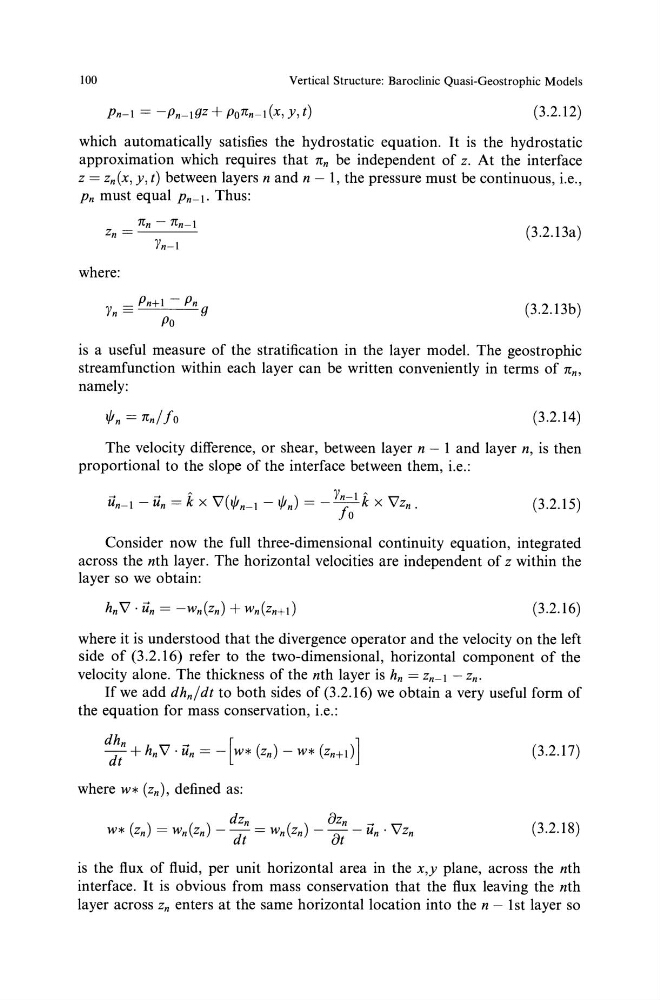
Yn-1
(3.2.13a)
where:
p 1- p
Yn = n+ n g
Po
(3.2.13b)
is a useful measure of the stratification in the layer model. The geostrophic
streamfunction within each layer can be written conveniently in terms of nn,
namely:
(3.2.14)
The velocity difference, or shear, between layer n- 1 and layer n, is then
proportional to the slope of the interface between them, i.e.:
Un-1- Un = k X 'V(l/Jn-1 -1/Jn) = - )'~~~ k X 'Vzn.
(3.2.15)
Consider now the full three-dimensional continuity equation, integrated
across the nth layer. The horizontal velocities are independent of z within the
layer so we obtain:
(3.2.16)
where it is understood that the divergence operator and the velocity on the left
side of (3 .2.16) refer to the two-dimensional, horizontal component of the
velocity alone. The thickness of the nth layer is hn = Zn-I - Zn.
If we add dhn/ dt to both sides of (3.2.16) we obtain a very useful form of
the equation for mass conservation, i.e.:
(3.2.17)
where W* (zn), defined as:
(3.2.18)
is the flux of fluid, per unit horizontal area in the x,y plane, across the nth
interface. It is obvious from mass conservation that the flux leaving the nth
layer across Zn enters at the same horizontal location into the n - 1st layer so
Vertical Structure: Baroclinic Quasi-Geostrophic Models
Pn-1 = -Pn-lgz + Po'lrn-1 (x, y, t)
(3.2.12)
which automatically satisfies the hydrostatic equation. It is the hydrostatic
approximation which requires that nn be independent of z. At the interface
z = zn(x, y, t) between layers nand n- 1, the pressure must be continuous, i.e.,
Pn must equal Pn-1· Thus:
Yn-1
(3.2.13a)
where:
p 1- p
Yn = n+ n g
Po
(3.2.13b)
is a useful measure of the stratification in the layer model. The geostrophic
streamfunction within each layer can be written conveniently in terms of nn,
namely:
(3.2.14)
The velocity difference, or shear, between layer n- 1 and layer n, is then
proportional to the slope of the interface between them, i.e.:
Un-1- Un = k X 'V(l/Jn-1 -1/Jn) = - )'~~~ k X 'Vzn.
(3.2.15)
Consider now the full three-dimensional continuity equation, integrated
across the nth layer. The horizontal velocities are independent of z within the
layer so we obtain:
(3.2.16)
where it is understood that the divergence operator and the velocity on the left
side of (3 .2.16) refer to the two-dimensional, horizontal component of the
velocity alone. The thickness of the nth layer is hn = Zn-I - Zn.
If we add dhn/ dt to both sides of (3.2.16) we obtain a very useful form of
the equation for mass conservation, i.e.:
(3.2.17)
where W* (zn), defined as:
(3.2.18)
is the flux of fluid, per unit horizontal area in the x,y plane, across the nth
interface. It is obvious from mass conservation that the flux leaving the nth
layer across Zn enters at the same horizontal location into the n - 1st layer so