

Sea-Surface Temperature Estimations Using a Modem Analog Technique
85
I Core GeoB 2204 - Foram
assemblage comparison
40
35
Q/
(.)
c:
'"
't:I
c:
30
25
+----1 0 783 em (27 .7 deg .) f - - - - - --i
_ _ -; 0 373 em (27.4 deg.) f - - - - - - -
~
.0
20
«
333 em (25 .8 deg.)
Q/
15
.~
-:; 10
a;
0::
5
0
::J
:2
0,
III
'5> Qj :; ffi ~
....
Qj
III
CT
III
,
Q)
(ij
c:
:0
:; 0, c
(.)
.c
Q)
0
~
Q)
c:
ro
2
.0
ro
(.)
(.)
(.)
't:I
E
a.
2
species
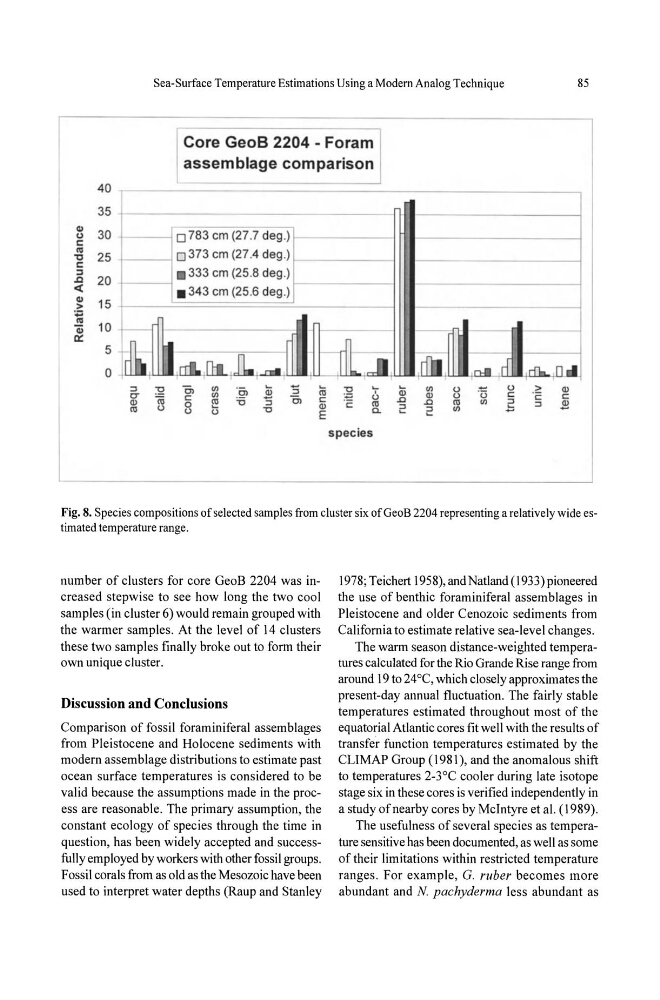
Fig. 8. Species compositions of selected samples from cluster six of GeoB 2204 representing a relatively wide estimated temperature range.
number of clusters for core GeoB 2204 was increased stepwise to see how long the two cool
samples (in cluster 6) would remain grouped with
the warmer samples. At the level of 14 clusters
these two samples finally broke out to form their
own unique cluster.
Discussion and Conclusions
Comparison of fossil foraminiferal assemblages
from Pleistocene and Holocene sediments with
modern assemblage distributions to estimate past
ocean surface temperatures is considered to be
valid because the assumptions made in the process are reasonable. The primary assumption, the
constant ecology of species through the time in
question, has been widely accepted and successfully employed by workers with other fossil groups.
Fossil corals from as old as the Mesozoic have been
used to interpret water depths (Raup and Stanley
1978; Teichert 1958), and Natland (1933) pioneered
the use of benthic foraminiferal assemblages in
Pleistocene and older Cenozoic sediments from
California to estimate relative sea-level changes.
The warm season distance-weighted temperatures calculated for the Rio Grande Rise range from
around 19 to 24°C, which closely approximates the
present-day annual fluctuation. The fairly stable
temperatures estimated throughout most of the
equatorial Atlantic cores fit well with the results of
transfer function temperatures estimated by the
CLIMAP Group (1981), and the anomalous shift
to temperatures 2-3°C cooler during late isotope
stage six in these cores is verified independently in
a study of nearby cores by McIntyre et al . (1989).
The usefulness of several species as temperature sensitive has been documented, as well as some
of their limitations within restricted temperature
ranges . For example, G. ruber becomes more
abundant and N. pachyderma less abundant as
85
I Core GeoB 2204 - Foram
assemblage comparison
40
35
Q/
(.)
c:
'"
't:I
c:
30
25
+----1 0 783 em (27 .7 deg .) f - - - - - --i
_ _ -; 0 373 em (27.4 deg.) f - - - - - - -
~
.0
20
«
333 em (25 .8 deg.)
Q/
15
.~
-:; 10
a;
0::
5
0
::J
:2
0,
III
'5> Qj :; ffi ~
....
Qj
III
CT
III
,
Q)
(ij
c:
:0
:; 0, c
(.)
.c
Q)
0
~
Q)
c:
ro
2
.0
ro
(.)
(.)
(.)
't:I
E
a.
2
species
Fig. 8. Species compositions of selected samples from cluster six of GeoB 2204 representing a relatively wide estimated temperature range.
number of clusters for core GeoB 2204 was increased stepwise to see how long the two cool
samples (in cluster 6) would remain grouped with
the warmer samples. At the level of 14 clusters
these two samples finally broke out to form their
own unique cluster.
Discussion and Conclusions
Comparison of fossil foraminiferal assemblages
from Pleistocene and Holocene sediments with
modern assemblage distributions to estimate past
ocean surface temperatures is considered to be
valid because the assumptions made in the process are reasonable. The primary assumption, the
constant ecology of species through the time in
question, has been widely accepted and successfully employed by workers with other fossil groups.
Fossil corals from as old as the Mesozoic have been
used to interpret water depths (Raup and Stanley
1978; Teichert 1958), and Natland (1933) pioneered
the use of benthic foraminiferal assemblages in
Pleistocene and older Cenozoic sediments from
California to estimate relative sea-level changes.
The warm season distance-weighted temperatures calculated for the Rio Grande Rise range from
around 19 to 24°C, which closely approximates the
present-day annual fluctuation. The fairly stable
temperatures estimated throughout most of the
equatorial Atlantic cores fit well with the results of
transfer function temperatures estimated by the
CLIMAP Group (1981), and the anomalous shift
to temperatures 2-3°C cooler during late isotope
stage six in these cores is verified independently in
a study of nearby cores by McIntyre et al . (1989).
The usefulness of several species as temperature sensitive has been documented, as well as some
of their limitations within restricted temperature
ranges . For example, G. ruber becomes more
abundant and N. pachyderma less abundant as