

Simulation of Oxygen Isotopes in a Global Ocean Model
665
Meridional Overturning Stream/unction
The zonally integrated meridional overturning
streamfunction is presented in Figs. Sa-c. Figure
5a shows the total transport of all the ocean basins
in one section, whereas Figs. 5b and c show the
total transport broken down among the Atlantic and
Indo-Pacific basins, restricted to those latitudes
where the ocean basins are limited zonally by continental boundaries. The sections that represent the
meridional overturning stream function are read in
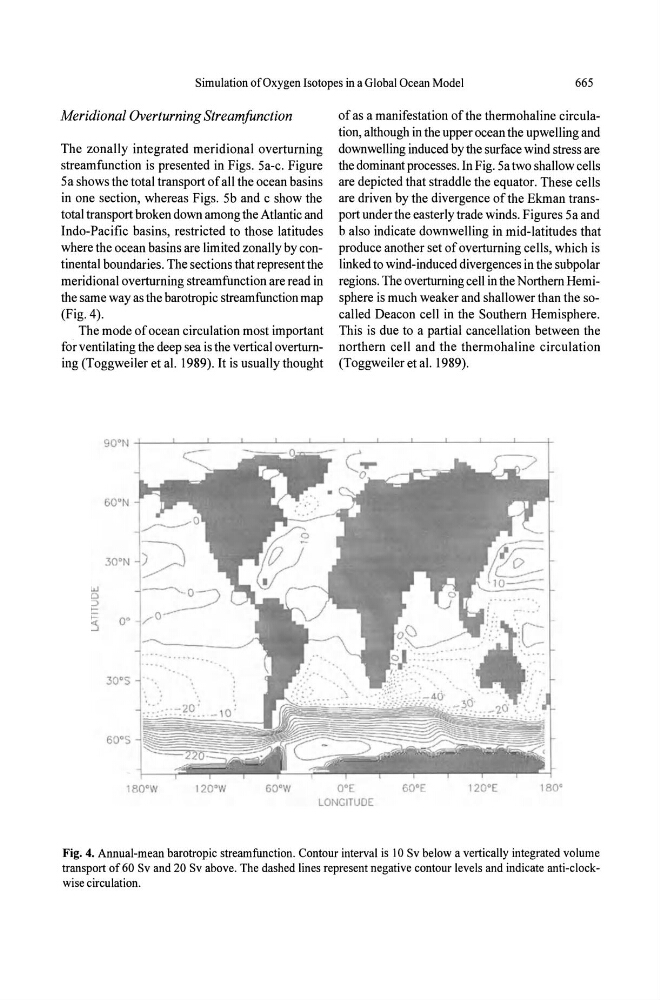
the same way as the barotropic stream function map
(Fig. 4).
The mode of ocean circulation most important
for ventilating the deep sea is the vertical overturning (Toggweiler et al. 1989). It is usually thought
of as a manifestation of the thermohaline circulation, although in the upper ocean the upwelling and
downwelling induced by the surface wind stress are
the dominant processes. In Fig. 5a two shallow cells
are depicted that straddle the equator. These cells
are driven by the divergence of the Ekman transport under the easterly trade winds. Figures 5a and
b also indicate downwelling in mid-latitudes that
produce another set of overturning cells, which is
linked to wind-induced divergences in the subpolar
regions. The overturning cell in the Northern Hemisphere is much weaker and shallower than the socalled Deacon cell in the Southern Hemisphere.
This is due to a partial cancellation between the
northern cell and the thermohaline circulation
(Toggweiler et al. 1989).
900N~--~----~--~--~----~---L--~----~--~--~----~---+
60"N
30 0 N
18DOW
12DOW
6D'W
DOE
LONGITUD[
1200E
Fig. 4. Annual-mean barotropic stream function. Contour interval is 10 Sv below a vertically integrated volume
transport of 60 Sv and 20 Sv above. The dashed lines represent negative contour levels and indicate anti-clockwise circulation.