

660
Paul eta!'
F "-n (n) [(I-tan'¢~
- v . Vh v u + J,1,
,
a
2Sin¢t3v/OA]
a' cos' ¢
(8)
r = 'V. (J,1,'Vv) + J,1,[(I- ta~2 ¢~ + 2sin¢iJu /OA]
a
a' cos' ¢ ,
(9)
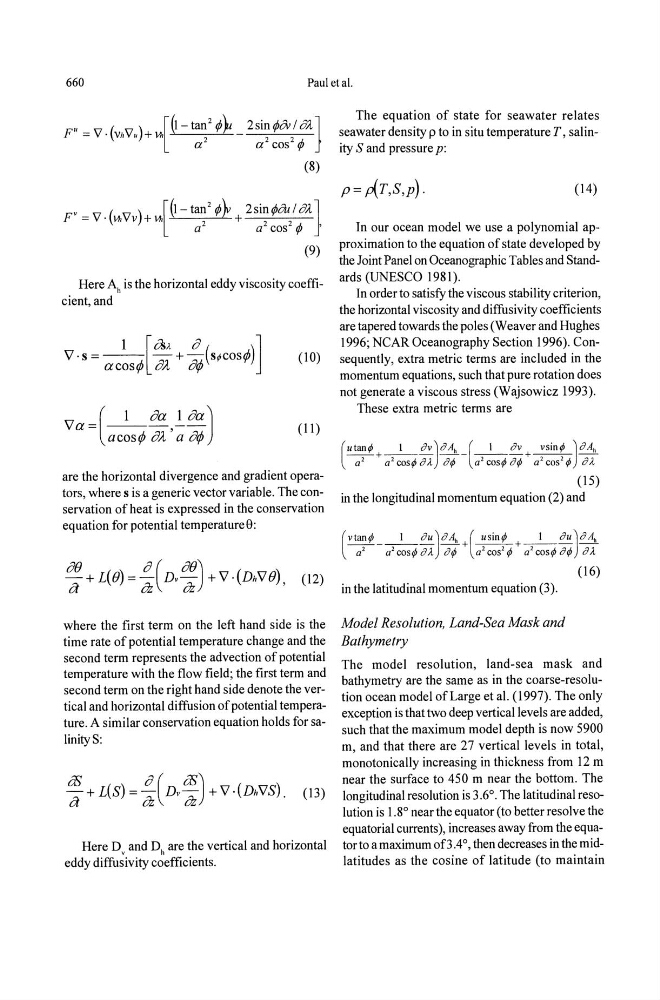
Here Ah is the horizontal eddy viscosity coefficient, and
'V. s = _l_[aA + ~(s¢cos¢)] (10)
acos¢ OA o¢
va=(_l_oa ~oa I
acos¢ OA' a o¢)
(11)
are the horizontal divergence and gradient operators, where s is a generic vector variable. The conservation of heat is expressed in the conservation
equation for potential temperatureS:
(12)
where the first term on the left hand side is the
time rate of potential temperature change and the
second term represents the advection of potential
temperature with the flow field; the first term and
second term on the right hand side denote the vertical and horizontal diffusion of potential temperature. A similar conservation equation holds for salinityS:
(13)
Here Dv and Dh are the vertical and horizontal
eddy diffusivity coefficients.
The equation of state for seawater relates
seawater density p to in situ temperature T, salinity S and pressure p:
p= ri..,r,s,p).
(14)
In our ocean model we use a polynomial approximation to the equation of state developed by
the Joint Panel on Oceanographic Tables and Standards (UNESCO 1981).
In order to satisfy the viscous stability criterion,
the horizontal viscosity and diffusivity coefficients
are tapered towards the poles (Weaver and Hughes
1996; NCAR Oceanography Section 1996). Consequently, extra metric terms are included in the
momentum equations, such that pure rotation does
not generate a viscous stress (Wajsowicz 1993).
These extra metric terms are
( utan¢
I
OV)OAh ( 1 OV
vsin¢ )OAh
---;;z-+ a'cos¢oJ. --;j¢- a'cos¢o¢+ a'cos'¢ 8T
(15)
in the longitudinal momentum equation (2) and
( vtan¢
I
OU)OAh (usin¢
I
OU)OAh
---;;z-- a'cos¢oJ. --;j¢+ a'cos'¢+ a'cos¢o¢ 8T
in the latitudinal momentum equation (3).
Model Resolution, Land-Sea Mask and
Bathymetry
(16)
The model resolution, land-sea mask and
bathymetry are the same as in the coarse-resolution ocean model of Large et al. (1997). The only
exception is that two deep vertical levels are added,
such that the maximum model depth is now 5900
m, and that there are 27 vertical levels in total,
monotonically increasing in thickness from 12 m
near the surface to 450 m near the bottom. The
longitudinal resolution is 3.6°. The latitudinal resolution is 1.8° near the equator (to betterresolve the
equatorial currents), increases away from the equator to a maximum on.4 0 , then decreases in the midlatitudes as the cosine of latitude (to maintain