

Simulation of Oxygen Isotopes in a Global Ocean Model
659
The coordinate z is measured from the sea-level
geo-potential surfacea= 6367.456 km, parallel to
the local direction of gravity (Gill 1982). Seven variables specify the physical state of the ocean: the
longitudinal, latitudinal and vertical velocity components u, v and w, pressure p, density p, potential
temperature 8 and salinity S.
Discussions of the governing equations may be
found in the books by Washington and Parkinson
(1986) and McGuffie and Henderson-Sellers (\996)
at an introductory level, and in the book by Landau
and Lifschitz (1987) and the articles by Veronis
(1973), Cane (1986) and Semtner (1986) at an
advanced level. Several approximations are used
to simplify the conservation equations for momentum (Navier-Stokes equation) and mass (continuity equation):
·the thin shell approximation (on account of the
shallowness of the ocean z « a)
·the hydrostatic approximation (because ocean
motions are slow, the gravitational force and the
vertical gradient of pressure are balanced very
well)
·the Boussinesq approximation (since seawater
is nearly incompressible, variations in density are
neglected, except where buoyancy effects are
concerned)
·the neglect of terms involving w in the horizontal momentum equations (on the basis of scale
analysis)
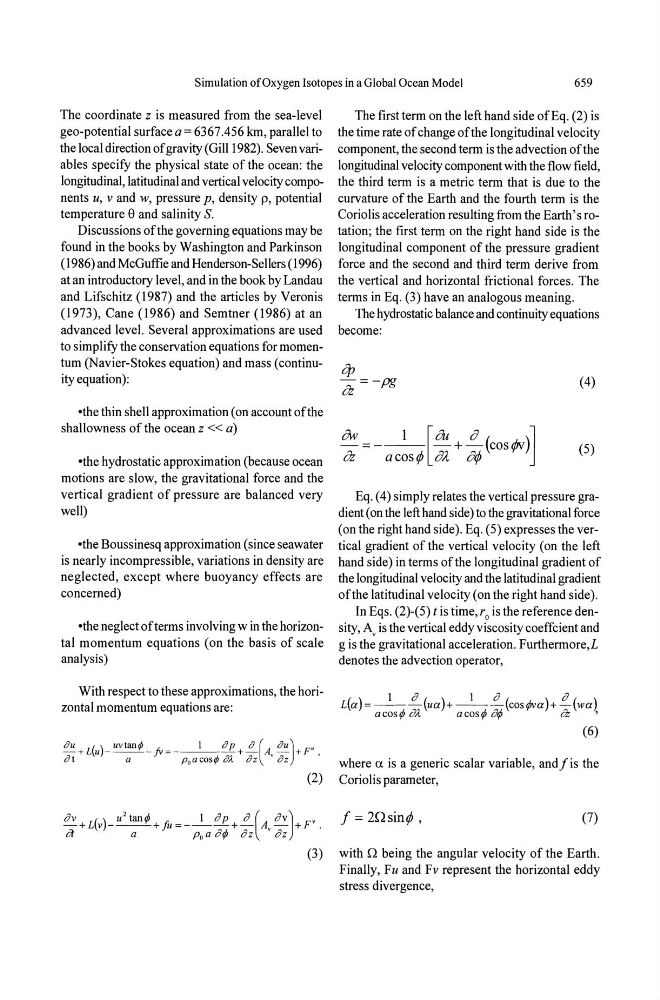
With respect to these approximations, the horizontal momentum equations are:
au +L(u)- uvtan¢ _ fo~ ___ l_ap +~(A, aU)+F" ,
at
a
poacos¢ a.i az
az
(2)
ov () u'tan¢
1 op o( Ov) ,
-+Lv ---+ju=---+- A,- +F .
it
a
P" a o¢ OZ oz
The first term on the left hand side ofEq. (2) is
the time rate of change ofthe longitudinal velocity
component, the second term is the advection of the
longitudinal velocity component with the flow field,
the third term is a metric term that is due to the
curvature of the Earth and the fourth term is the
Corio lis acceleration reSUlting from the Earth's rotation; the first term on the right hand side is the
longitudinal component of the pressure gradient
force and the second and third term derive from
the vertical and horizontal frictional forces. The
terms in Eq. (3) have an analogous meaning.
The hydrostatic balance and continuity equations
become:
iP
-=-pg
&
(4)
- = - - - -+-(cos¢V)
Ow
1 [at 0
]
&
acos¢ 0,1, o¢
(5)
Eq. (4) simply relates the vertical pressure gradient (on the left hand side) to the gravitational force
(on the right hand side). Eq. (5) expresses the vertical gradient of the vertical velocity (on the left
hand side) in terms of the longitudinal gradient of
the longitudinal velocity and the latitudinal gradient
of the latitudinal velocity (on the right hand side).
In Eqs. (2)-(5) t is time, ro is the reference density, Av is the vertical eddy viscosity coeffcient and
g is the gravitational acceleration. Furthermore,L
denotes the advection operator,
1
0
1
0
O(
)
L(a)=---(ua)+---(cos¢Va)+- wa
acos¢ OA
acos¢ ap
& ,
(6)
where a is a generic scalar variable, andfis the
Coriolis parameter,
f = 2Qsin¢,
(7)
(3) with n being the angular velocity of the Earth.
Finally, Fu and Fv represent the horizontal eddy
stress divergence,