

Using Rock Magnetic Proxy Records for Orbital Tuning and Extended Time Series Analyses
611
GeoB 1523-1
GeoB 1515-1
SPECMAP
8 18 0 [%0]
8 18 0 [%0]
K [10- 6 SI]
8 18 0 [%0]
K [10- 6 SI]
-3 -2 -1 0 1 2
-2 -1.5 -1 -0.5 0 50 100150200250
-2 -1.5 -1 -0.5 0 50 100150200250
°M~~~········~LlLu-Llu-Lili.-'-'4- 0
50
100
2
150
3
0
m
(1)
-'"
-0
' Q;' 200
s:
en
4]
5
300
6
350
11.1
7
400
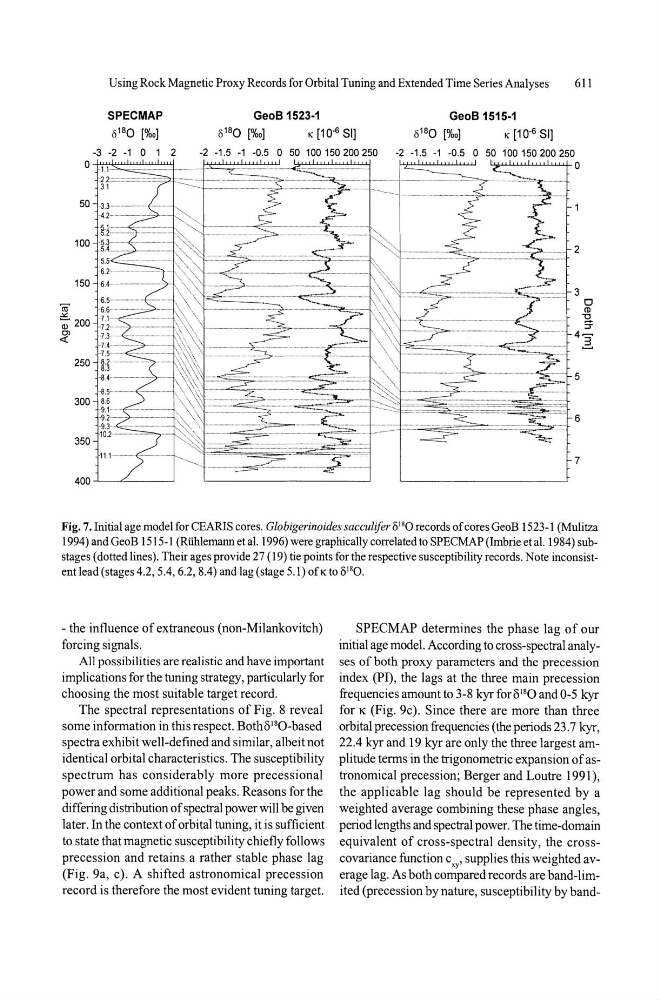
Fig. 7. Initial age model for CEARIS cores. Globigerinoides sacculifer 1) 18 0 records of cores GeoB 1523-1 (Mulitza
1994) and GeoB 1515-1 (Riihlemann et al. 1996) were graphically correlated to SPECMAP (Imbrie et al. 1984) substages (dotted lines). Their ages provide 27 (19) tie points for the respective susceptibility records. Note inconsistent lead (stages 4.2,5.4,6.2,8.4) and lag (stage 5.1) OfK to 1) 18 0.
- the influence of extraneous (non-Milankovitch)
forcing signals.
All possibilities are realistic and have important
implications for the tuning strategy, particularly for
choosing the most suitable target record.
The spectral representations of Fig. 8 reveal
some information in this respect. Both8 18 0-based
spectra exhibit well-defined and similar, albeit not
identical orbital characteristics. The susceptibility
spectrum has considerably more precessional
power and some additional peaks. Reasons for the
differing distribution of spectral power will be given
later. In the context of orbital tuning, it is sufficient
to state that magnetic susceptibility chiefly follows
precession and retains a rather stable phase lag
(Fig. 9a, c). A shifted astronomical precession
record is therefore the most evident tuning target.
SPECMAP determines the phase lag of our
initial age model. According to cross-spectral analyses of both proxy parameters and thc precession
index (PI), the lags at the three main precession
frequencies amount to 3-8 kyr for8 18 0 and 0-5 kyr
for K (Fig. 9c). Since there are more than three
orbital precession frequencies (the periods 23.7 kyr,
22.4 kyr and 19 kyr are only the three largest amplitude terms in the trigonometric expansion of astronomical precession; Berger and Loutre 1991),
the applicable lag should be represented by a
weighted average combining these phase angles,
period lengths and spectral power. The time-domain
equivalent of cross-spectral density, the crosscovariance function c xy ' supplies this weighted average lag. As both compared records are band-limited (precession by nature, susceptibility by band-