

610
von Dobeneck and Schmieder
6' N
S' N
4' N
3' N
2' N
1' N
0'
1' S
2' S
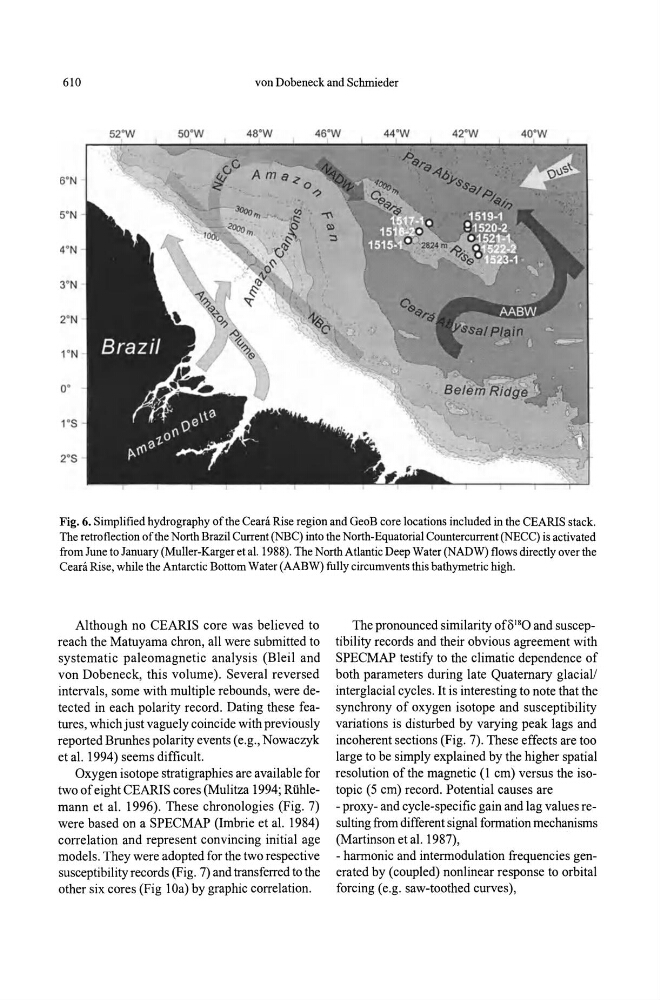
Fig. 6. Simplified hydrography of the Ceara Rise region and GeoB core locations included in the CEARlS stack.
The retroflection of the North Brazil Current (NBC) into the North-Equatorial Countercurrent (NECC) is activated
from June to January (Muller-Karger et al. 1988). The North Atlantic Deep Water (NADW) flows directly over the
Ceara Rise, while the Antarctic Bottom Water (AABW) fully circumvents this bathymetric high.
Although no CEARIS core was believed to
reach the Matuyama cbron, all were submitted to
systematic paleomagnetic analysis (Bleil and
von Dobeneck, this volume) . Several reversed
intervals, some with multiple rebounds, were detected in each polarity record. Dating these features, which just vaguely coincide with previously
reported Brunhes polarity events (e.g., Nowaczyk
et al. 1994) seems difficult.
Oxygen isotope stratigraphies are available for
two of eight CEARIS cores (Mulitza 1994; Rtihlemann et al. 1996). These chronologies (Fig. 7)
were based on a SPECMAP (Imbrie et al. 1984)
correlation and represent convincing initial age
models. They were adopted for the two respective
susceptibility records (Fig. 7) and transferred to the
other six cores (Fig lOa) by graphic correlation.
The pronounced similarity of8 18 0 and susceptibility records and their obvious agreement with
SPECMAP testify to the climatic dependence of
both parameters during late Quaternary glacial/
interglacial cycles. It is interesting to note that the
synchrony of oxygen isotope and susceptibility
variations is disturbed by varying peak lags and
incoherent sections (Fig. 7). These effects are too
large to be simply explained by the higher spatial
resolution of the magnetic (1 cm) versus the isotopic (5 cm) record. Potential causes are
- proxy- and cycle-specific gain and lag values resulting from different signal formation mechanisms
(Martinson et al. 1987),
- harmonic and intermodulation frequencies generated by (coupled) nonlinear response to orbital
forcing (e.g. saw-toothed curves),