

608
GeoS
115 j
1211·3 80
45
1034·3
65
1035-4 35
5
190
3801·6 125
60
Brunhes
von Dobeneck and Schmieder
Grain Size Shift
Turbidite
Hiatus
Laminated Layers
Laminated
Diatom Ooze
1.6
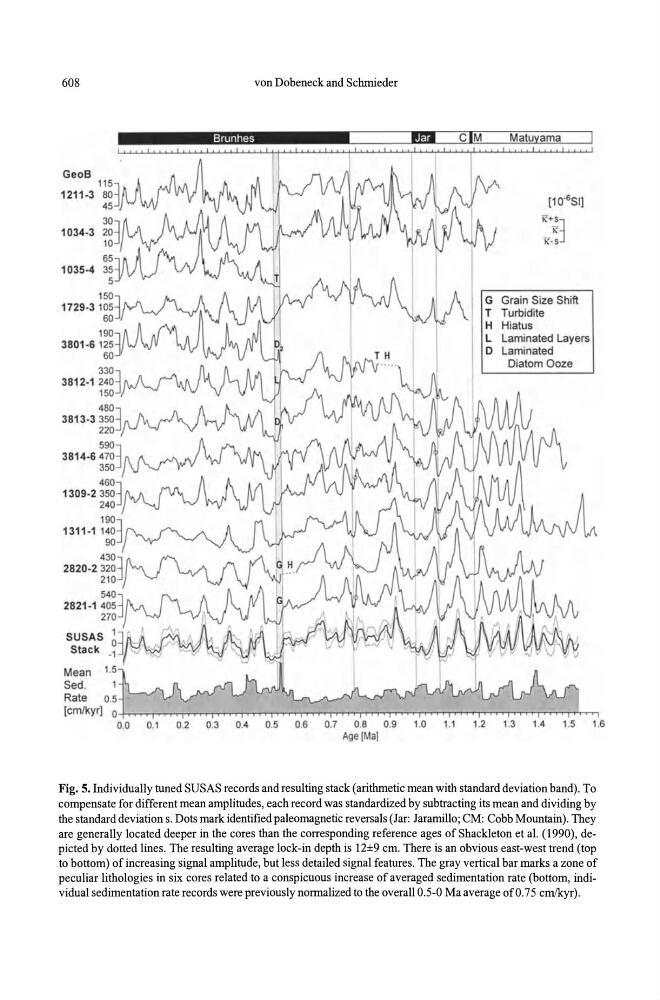
Fig. 5. Individually tuned SUSAS records and resulting stack (arithmetic mean with standard deviation band). To
compensate for different mean amplitudes, each record was standardized by subtracting its mean and dividing by
the standard deviation s. Dots mark identified paleomagnetic reversals (Jar: Jaramillo; CM: Cobb Mountain). They
are generally located deeper in the cores than the corresponding reference ages of Shackleton et al. (1990), de·
picted by dotted lines. The resulting average lock·in depth is 12±9 cm. There is an obvious east-west trend (top
to bottom) of increasing signal amplitude, but less detailed signal features. The gray vertical bar marks a zone of
peculiar lithologies in six cores related to a conspicuous increase of averaged sedimentation rate (bottom, indio
vidual sedimentation rate records were previously normalized to the overall 0.5·0 Ma average ofO. 75 cmlkyr).