

Using Rock Magnetic Proxy Records for Orbital Tuning and Extended Time Series Analyses
607
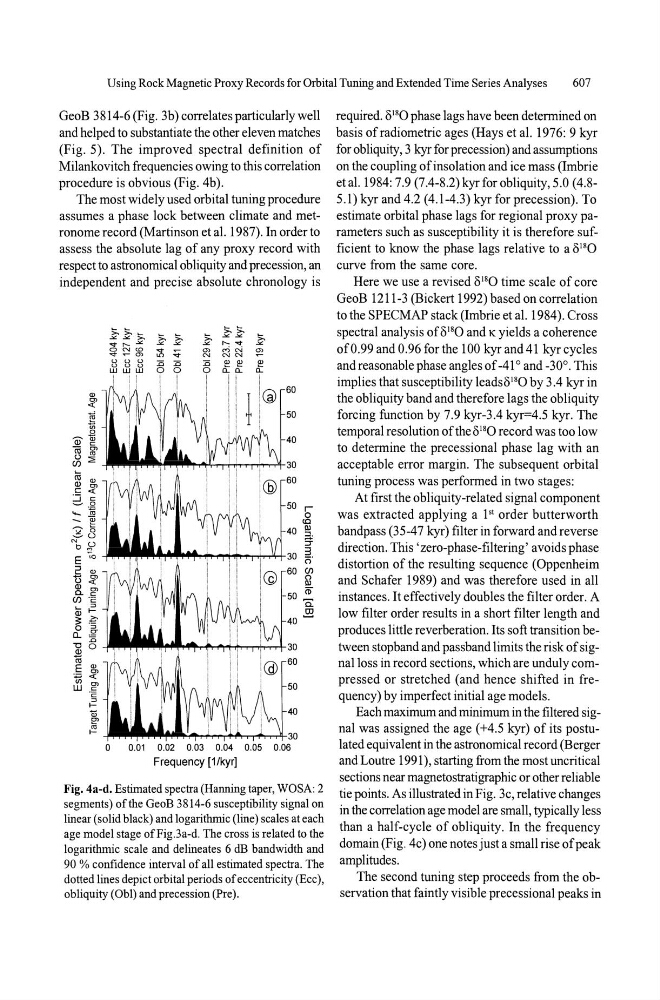
GeoB 3814-6 (Fig. 3b) correlates particularly well
and helped to substantiate the other eleven matches
(Fig. 5). The improved spectral definition of
Milankovitch frequencies owing to this correlation
procedure is obvious (Fig. 4b).
The most widely used orbital tuning procedure
assumes a phase lock between climate and metronome record (Martinson et al.1987). In order to
assess the absolute lag of any proxy record with
respect to astronomical obliquity and precession, an
independent and precise absolute chronology is
~ ~ ~ } ~
~
}} }
""
.... ..... ""
"" ""
.........
0
'"
0>
MC'\i
~
.... ~ 0>
'" '" '"
t.)
t.)
t.)
:c
t.)
t.)
t.)
w w w
0
o 0.01 0.02 0.03 0.04 0.05 0.06
Frequency [1/kyr]
Fig. 4a-d. Estimated spectra (Hanning taper, WOSA: 2
segments) of the GeoB 3814-6 susceptibility signal on
linear (solid black) and logarithmic (line) scales at each
age model stage ofFig.3a-d. The cross is related to the
logarithmic scale and delineates 6 dB bandwidth and
90 % confidence interval of all estimated spectra. The
dotted lines depict orbital periods of eccentricity (Ecc),
obliquity (Obi) and precession (Pre).
required. 8 18 0 phase lags have been determined on
basis of radiometric ages (Hays et al. 1976: 9 kyr
for obliquity, 3 kyr for precession) and assumptions
on the coupling of insolation and ice mass (Imbrie
et al. 1984: 7.9 (7.4-8.2) kyr for obliquity, 5.0 (4.85.1) kyr and 4.2 (4.1-4.3) kyr for precession). To
estimate orbital phase lags for regional proxy parameters such as susceptibility it is therefore sufficient to know the phase lags relative to a 8 18 0
curve from the same core.
Here we use a revised 8 18 0 time scale of core
GeoB 1211-3 (Bickert 1992) based on correlation
to the SPECMAP stack (Imbrie et al. 1984). Cross
spectral analysis of8 18 0 and K yields a coherence
of 0.99 and 0.96 for the 100 kyr and 41 kyr cycles
and reasonable phase angles of -41 0 and -30 0 • This
implies that susceptibility leads8 18 0 by 3.4 kyr in
the obliquity band and therefore lags the obliquity
forcing function by 7.9 kyr-3.4 kyr=4.5 kyr. The
temporal resolution of the 8 18 0 record was too low
to determine the precessional phase lag with an
acceptable error margin. The subsequent orbital
tuning process was performed in two stages:
At first the obliquity-related signal component
was extracted applying a 1 st order butterworth
bandpass (35-47 kyr) filter in forward and reverse
direction. This 'zero-phase-filtering' avoids phase
distortion of the resulting sequence (Oppenheim
and Schafer 1989) and was therefore used in all
instances. It effectively doubles the filter order. A
low filter order results in a short filter length and
produces little reverberation. Its soft transition between stopband and passband limits the risk of signalloss in record sections, which are unduly compressed or stretched (and hence shifted in frequency) by imperfect initial age models.
Each maximum and minimum in the filtered signal was assigned the age (+4.5 kyr) of its postulated equivalent in the astronomical record (Berger
and Loutre 1991), starting from the most uncritical
sections near magnetostratigraphic or other reliable
tie points. As illustrated in Fig. 3c, relative changes
in the correlation age model are small, typically less
than a half-cycle of obliquity. In the frequency
domain (Fig. 4c) one notes just a small rise of peak
amplitudes.
The second tuning step proceeds from the observation that faintly visible precessional peaks in