

606
von Dobeneck and Schmieder
All initial spectra display significant maxima at
around 40 kyr as core GeoB 3814-6 (Fig. 4a), but
show little or no indications of a precessional signal component. As a spectrum represents an average over the integral record, it would be overly
optimistic to infer that all obliquity-related oscillations can be extracted at this stage by filtering the
record in the respective frequency band. Instead,
all susceptibility records were mutually correlated
to identify missing or expanded intervals. This comparison enables to estimate the extent of some short
gaps and two laminated diatom ooze layers (Fig. 5),
which had obviously been deposited in very short
time. Core to core correlation revealed that simply
Polarity
removing these sections from the sequence results
in complete records.
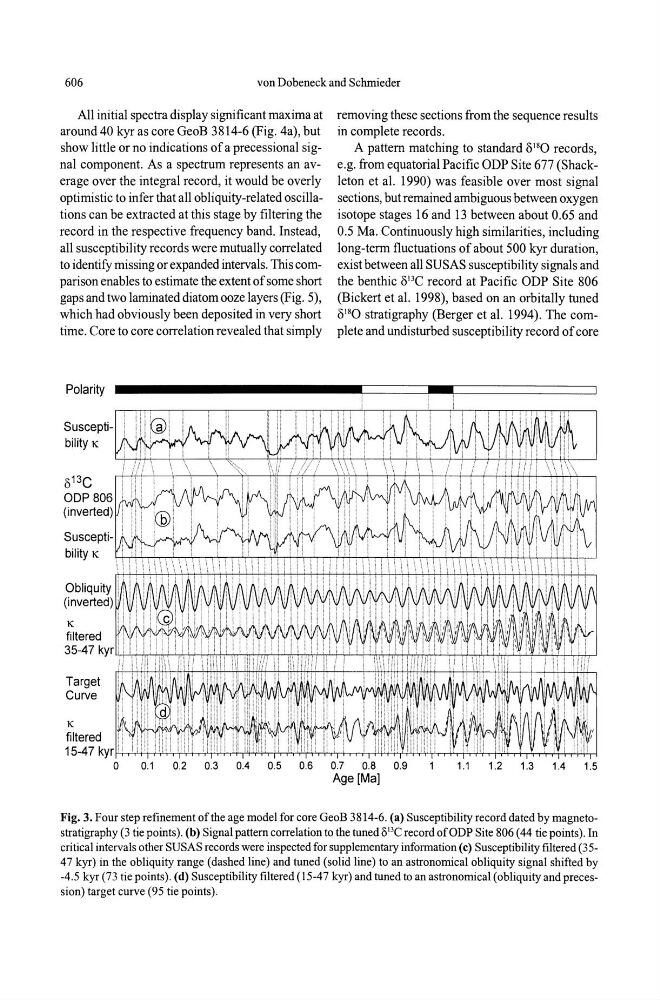
A pattern matching to standard 0 18 0 records,
e.g. from equatorial Pacific ODP Site 677 (Shackleton et al. 1990) was feasible over most signal
sections, but remained ambiguous between oxygen
isotope stages 16 and 13 between about 0.65 and
0.5 Ma. Continuously high similarities, including
long-term fluctuations of about 500 kyr duration,
exist between all SUSAS susceptibility signals and
the benthic ODC record at Pacific ODP Site 806
(Bickert et al. 1998), based on an orbitally tuned
0 18 0 stratigraphy (Berger et al. 1994). The complete and undisturbed susceptibility record of core
i i i
~:;:::'-~
013C
i 'i,
ODP 806
(inverted)
SusceptibilitYK
Obliquity Ii
(inverted) , !
K
filtered . ,
35-47 kyr""i,!'-'+ftL+±+-'Yrl-t+++h'+r'-r
Target
Curve
~tered i i I ' i ~
[' -i' i""""''''
15-47 kyr 1'+' , -rY-1' '.,." +' i+YT-Y+-rYf'W-T'+T'i.lf-hrtT-H+T-M-+.T-h-T+ri"+'+'i'T+'-~rn-t'rtYH---r+'il.j.,..1rr'r-.-'r+;..ri++rl
o 0.1 0.2 0.3 0.4 0.5 0.6 0.7 0.8 0.9
Age [Ma]
1.1
1.2
1.3
1.4
1.5
Fig. 3. Four step refinement of the age model for core GeoB 3814-6. (a) Susceptibility record dated by magnetostratigraphy (3 tie points). (b) Signal pattern correlation to the tuned 8 13 C record ofODP Site 806 (44 tie points). In
critical intervals other SUSAS records were inspected for supplementary infonnation (c) Susceptibility fIltered (3547 kyr) in the obliquity range (dashed line) and tuned (solid line) to an astronomical obliquity signal shifted by
-4.5 kyr (73 tie points). (d) Susceptibility fIltered (15-47 kyr) and tuned to an astronomical (obliquity and precession) target curve (95 tie points).