

Using Rock Magnetic Proxy Records for Orbital Tuning and Extended Time Series Analyses
605
ChRM Inclination [0]
ro
E
~
.a;
:::r::
1.77 •
1.95
0
2
3
4
0
5 CD
~
6
]:
7
8
9
10
11
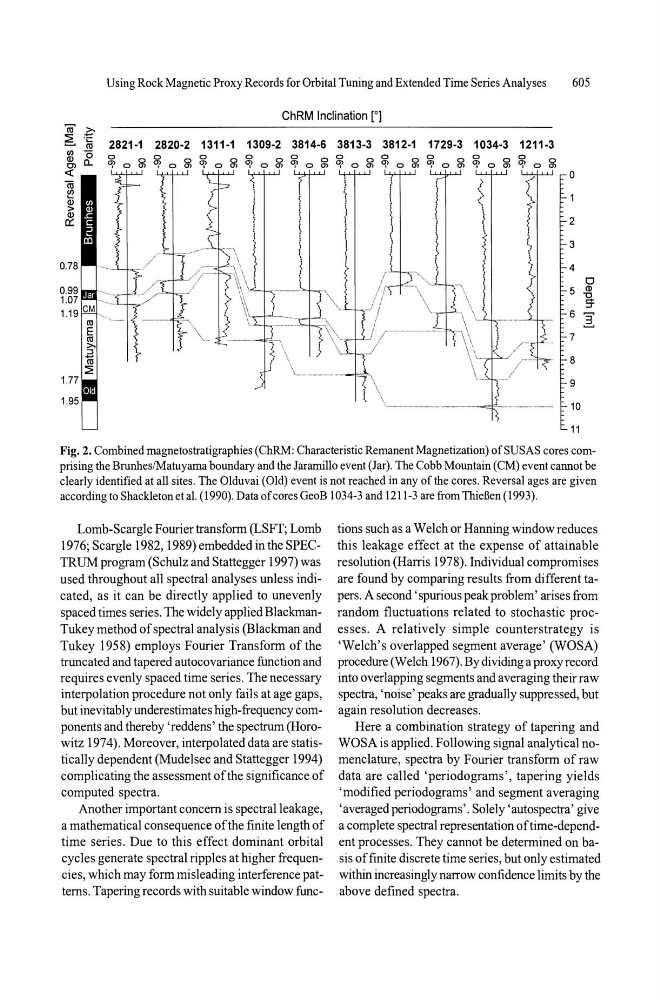
Fig. 2. Combined magnetostratigraphies (ChRM: Characteristic Remanent Magnetization) of SUS AS cores comprising the BrunhestMatuyarna boundary and the Jaramillo event (Jar). The Cobb Mountain (CM) event cannot be
clearly identified at all sites. The Olduvai (Old) event is not reached in any of the cores. Reversal ages are given
according to Shackleton eta!. (1990). Data of cores GeoB 1034-3 and 1211-3 are from ThieBen (1993).
Lomb-Scargle Fourier transform (LSFT; Lomb
1976; Scargle 1982, 1989) embedded in the SPECTRUM program (Schulz and Stattegger 1997) was
used throughout all spectral analyses unless indicated, as it can be directly applied to unevenly
spaced times series. The widely applied BlackmanTukey method of spectral analysis (Blackman and
Tukey 1958) employs Fourier Transform of the
truncated and tapered autocovariance function and
requires evenly spaced time series. The necessary
interpolation procedure not only fails at age gaps,
but inevitably underestimates high-frequency components and thereby 'reddens' the spectrum (Horowitz 1974). Moreover, interpolated data are statistically dependent (Mudelsee and Stattegger 1994)
complicating the assessment of the significance of
computed spectra.
Another important concern is spectral leakage,
a mathematical consequence of the finite length of
time series. Due to this effect dominant orbital
cycles generate spectral ripples at higher frequencies, which may form misleading interference patterns. Tapering records with suitable window functions such as a Welch or Hanning window reduces
this leakage effect at the expense of attainable
resolution (Harris 1978). Individual compromises
are found by comparing results from different tapers. A second' spurious peak problem' arises from
random fluctuations related to stochastic processes. A relatively simple counterstrategy is
'Welch's overlapped segment average' (WOSA)
procedure (Welch 1967). By dividing a proxy record
into overlapping segments and averaging their raw
spectra, 'noise' peaks are gradually suppressed, but
again resolution decreases.
Here a combination strategy of tapering and
WOSA is applied. Following signal analytical nomenclature, spectra by Fourier transform of raw
data are called 'periodograms', tapering yields
'modified periodograms' and segment averaging
'averaged periodograms'. Solely 'autospectra' give
a complete spectral representation of time-dependent processes. They cannot be determined on basis of finite discrete time series, but only estimated
within increasingly narrow confidence limits by the
above defined spectra.