

Pollen and Spores in Marine Sediments from the East Atlantic
529
-20
-15
-10 ! -5
35
,
30
20
25
25
20
· 20
15
Pinus (%)
15
15
10
10
., ++ .. ,."
10
t ..
"i l
~
.;.;
5
, .
5
5
o ~~----~--~-----+
-20
-15
-10
-5
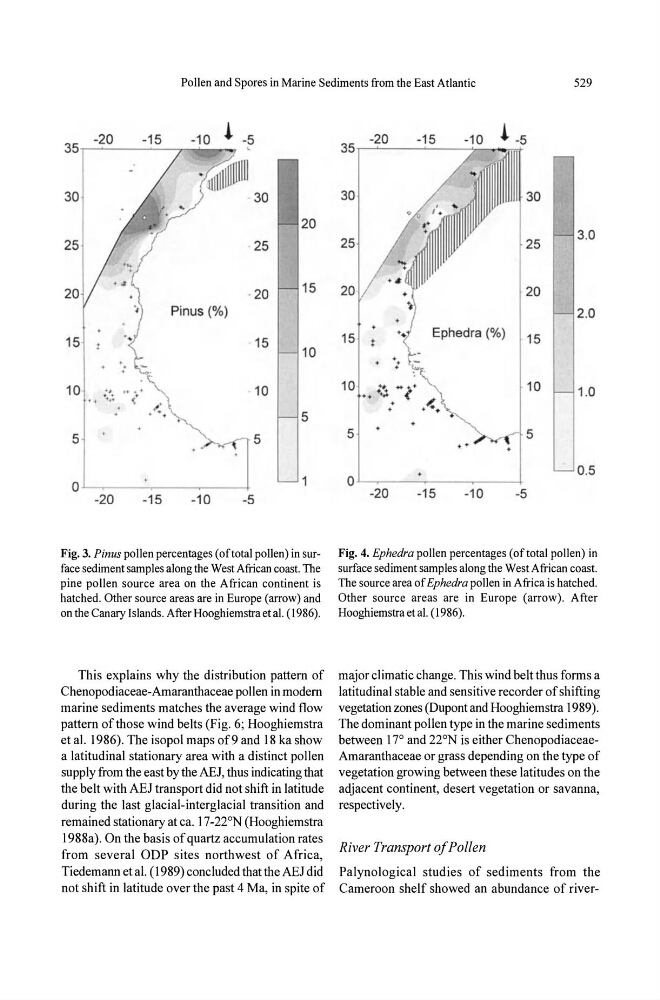
Fig. 3. Pinus pollen percentages (of total pollen) in surface sediment samples along the West African coast. The
pine pollen source area on the African continent is
hatched. Other source areas are in Europe ( arrow) and
on the Canary Islands. After Hooghiemstra et at. (1986).
This explains why the distribution pattern of
Chenopodiaceae-Amaranthaceae pollen in modern
marine sediments matches the average wind flow
pattern of those wind belts (Fig. 6; Hooghiemstra
et aL 1986). The isopol maps of9 and 18 ka show
a latitudinal stationary area with a distinct pollen
supply from the east by the AEJ, thus indicating that
the belt with AEJ transport did not shift in latitude
during the last glacial-interglacial transition and
remained stationary at ca. 17-22°N (Hooghiemstra
1988a). On the basis of quartz accumulation rates
from several ODP sites northwest of Africa,
Tiedemann et aL (1989) concluded that the AEJ did
not shift in latitude over the past 4 Ma, in spite of
30
25
3.0
20
2.0
15
15
10
+;
.. (+
+ +.,1
+
.;..
+
10
1.0
5
5
0.5
-20
-15
-10
-5
Fig. 4. Ephedra pollen percentages (of total pollen) in
surface sediment samples along the West African coast.
The source area of Ephedra pollen in Africa is hatched.
Other source areas are in Europe (arrow). After
Hooghiemstra et at. (1986).
major climatic change. This wind belt thus forms a
latitudinal stable and sensitive recorder of shifting
vegetation zones (Dupont and Hooghiemstra 1989).
The dominant pollen type in the marine sediments
between 17° and 22°N is either ChenopodiaceaeAmaranthaceae or grass depending on the type of
vegetation growing between these latitudes on the
adjacent continent, desert vegetation or savanna,
respectively.
River Transport of Pollen
Palynological studies of sediments from the
Cameroon shelf showed an abundance of river-
529
-20
-15
-10 ! -5
35
,
30
20
25
25
20
· 20
15
Pinus (%)
15
15
10
10
., ++ .. ,."
10
t ..
"i l
~
.;.;
5
, .
5
5
o ~~----~--~-----+
-20
-15
-10
-5
Fig. 3. Pinus pollen percentages (of total pollen) in surface sediment samples along the West African coast. The
pine pollen source area on the African continent is
hatched. Other source areas are in Europe ( arrow) and
on the Canary Islands. After Hooghiemstra et at. (1986).
This explains why the distribution pattern of
Chenopodiaceae-Amaranthaceae pollen in modern
marine sediments matches the average wind flow
pattern of those wind belts (Fig. 6; Hooghiemstra
et aL 1986). The isopol maps of9 and 18 ka show
a latitudinal stationary area with a distinct pollen
supply from the east by the AEJ, thus indicating that
the belt with AEJ transport did not shift in latitude
during the last glacial-interglacial transition and
remained stationary at ca. 17-22°N (Hooghiemstra
1988a). On the basis of quartz accumulation rates
from several ODP sites northwest of Africa,
Tiedemann et aL (1989) concluded that the AEJ did
not shift in latitude over the past 4 Ma, in spite of
30
25
3.0
20
2.0
15
15
10
+;
.. (+
+ +.,1
+
.;..
+
10
1.0
5
5
0.5
-20
-15
-10
-5
Fig. 4. Ephedra pollen percentages (of total pollen) in
surface sediment samples along the West African coast.
The source area of Ephedra pollen in Africa is hatched.
Other source areas are in Europe (arrow). After
Hooghiemstra et at. (1986).
major climatic change. This wind belt thus forms a
latitudinal stable and sensitive recorder of shifting
vegetation zones (Dupont and Hooghiemstra 1989).
The dominant pollen type in the marine sediments
between 17° and 22°N is either ChenopodiaceaeAmaranthaceae or grass depending on the type of
vegetation growing between these latitudes on the
adjacent continent, desert vegetation or savanna,
respectively.
River Transport of Pollen
Palynological studies of sediments from the
Cameroon shelf showed an abundance of river-