

528
Dupont
40
p
35
;;7
30
25
Sahara
20
658
15
} sahel
savannna
16415
.~
10
~fromontane
5
} transitional forest
& savanna
0
) Go 'oeo-Co090"OO
rain forest
-5
-25
-20
-15
-10
-1 0
Zambezian
woodland incl.
-15
Miombo (light)
-20
jKalaha,'
-25
Namib (coast)
-5
0
5
10
15
20
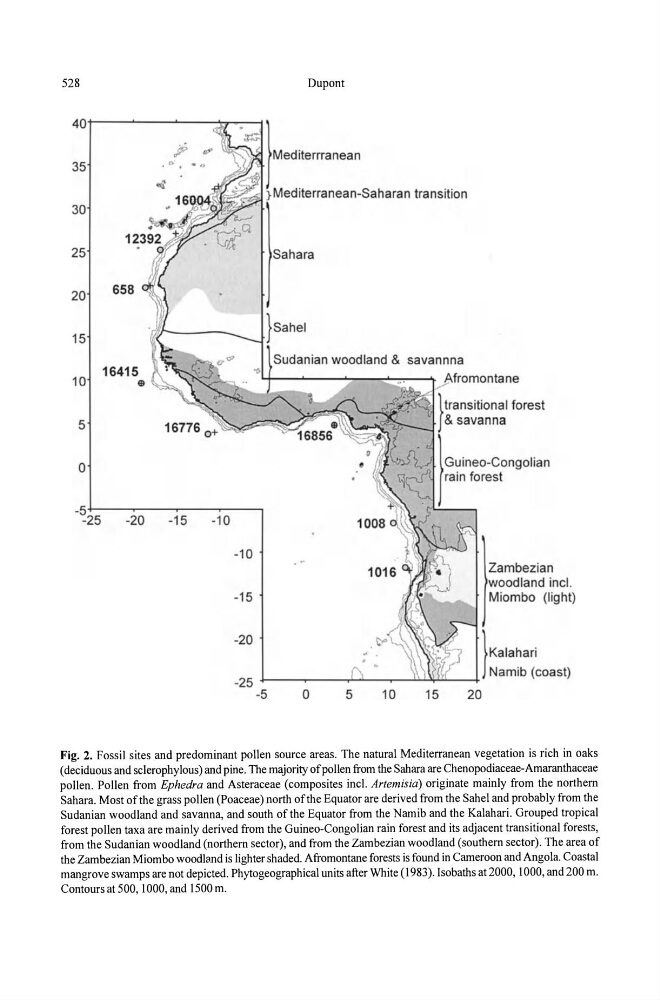
Fig. 2. Fossil sites and predominant pollen source areas. The natural Mediterranean vegetation is rich in oaks
(deciduous and sclerophylous) and pine. The majority of pollen from the Sahara are Chenopodiaceae-Amaranthaceae
pollen. Pollen from Ephedra and Asteraceae (composites inc\. Artemisia) originate mainly from the northern
Sahara. Most of the grass pollen (Poaceae) north ofthe Equator are derived from the Sahel and probably from the
Sudanian woodland and savanna, and south of the Equator from the Namib and the Kalahari. Grouped tropical
forest pollen taxa are mainly derived from the Guineo-Congolian rain forest and its adjacent transitional forests,
from the Sudanian woodland (northern sector), and from the Zambezian woodland (southern sector). The area of
the Zambezian Miombo woodls,nd is lighter shaded. Afromontane forests is found in Cameroon and Angola. Coastal
mangrove swamps are not depicted. Phytogeographical units after White (1 983). Isobaths at 2000, 1000, and 200 m.
Contours at 500, 1000, and 1500 m.
Dupont
40
p
35
;;7
30
25
Sahara
20
658
15
} sahel
savannna
16415
.~
10
~fromontane
5
} transitional forest
& savanna
0
) Go 'oeo-Co090"OO
rain forest
-5
-25
-20
-15
-10
-1 0
Zambezian
woodland incl.
-15
Miombo (light)
-20
jKalaha,'
-25
Namib (coast)
-5
0
5
10
15
20
Fig. 2. Fossil sites and predominant pollen source areas. The natural Mediterranean vegetation is rich in oaks
(deciduous and sclerophylous) and pine. The majority of pollen from the Sahara are Chenopodiaceae-Amaranthaceae
pollen. Pollen from Ephedra and Asteraceae (composites inc\. Artemisia) originate mainly from the northern
Sahara. Most of the grass pollen (Poaceae) north ofthe Equator are derived from the Sahel and probably from the
Sudanian woodland and savanna, and south of the Equator from the Namib and the Kalahari. Grouped tropical
forest pollen taxa are mainly derived from the Guineo-Congolian rain forest and its adjacent transitional forests,
from the Sudanian woodland (northern sector), and from the Zambezian woodland (southern sector). The area of
the Zambezian Miombo woodls,nd is lighter shaded. Afromontane forests is found in Cameroon and Angola. Coastal
mangrove swamps are not depicted. Phytogeographical units after White (1 983). Isobaths at 2000, 1000, and 200 m.
Contours at 500, 1000, and 1500 m.