

504
Bijmaetal.
Impact of Respired CO 2
Because isotopes are conserved in metabolism, the
extent of l3C depletion of respired CO 2 must reflect the Ol3C of the carbon source and the carbon
budget ofthe consumer. Thus, the ODC of respired
CO 2 depends on the olJC value of the food source
and the ODC mg of the foraminifer. The following
mass balance calculation may be considered:
where r is the fraction of carbon retained by the
foraminifer. Rearranged:
For symbiont bearing species it was demonstrated
that a substantial fraction (denoted s) of the host's
carbon is derived from the symbionts, probably
translocated during the night when the symbionts
are retracted in the shell (Bemis pers. comm.). Thus
for 0. universa the equation must be expanded:
olJC of the artemia, the host and the symbionts
is a function oftheir biochemical composition, especially of the lipid content. Corrected for the
carapace, that is discarded after digestion, the
Ol3C value a Great Salt Lake artemia nauplii
(GSL) is -15 %0. The ODC",g of 0. universa and
G. bulloides fed GSL artemia is -17.4 %0 and
-18.5 %0 respectively (Uhle unpub\. results). Based
on compound specific isotope analysis (Table 2) and
the assumption that lipids are 5 %0 depleted compared to the average Ol3C of symbiont organic
matter, a olJC"ymbiont of -24 %0 can be estimated
(Schouten pers. comm.). If we further assume that
56 % of the carbon taken up by 0. universa originates from the GSL-artemia and that the rest is
derived from the symbionts (Bemis pers comm) and
that only one tenth of the carbon taken up is retained, the Ol3C ofthe respired CO 2 is -19.1 %0 and
-14.6 %0 for 0. universa and G. bulloides respectively (Table 3). Bemis (unpubl data) determined
that the ODC mg of 0. universa fed artemia nauplii
of a San Francisco Bay (SFB) strain was -18.6 %0,
while the artemia were on the average -20.4 %0
(corrected for the carapace). The ODC of the respired CO 2 under these conditions is -22.4 %0
(Table 3). Unfortunately, we have no data for G.
bulloides fed SFB artemia.
Respiring organisms consume 16 0 16 0 10 to
20 %0 more rapidly than 18 0 16 0. With respect to
_ ..
70~~~~~~~~~~~~~~~ o
@
D
D
G
_
_
~
_
[cd,' I ()lmol/kg)
75
70~~~~--~~~~~~~~~~
o
100
200
300
400
500
600
700
800
l cd,' 1 ()lffioUkg)
~-- __ -
7.5
7.0 O~~'00~"':2"':OO~"':'300':'---4~OO:---:50':'0~~60'::"O ~7~OO:--"'::'SOO
rcd,- I ()lInol/kg)
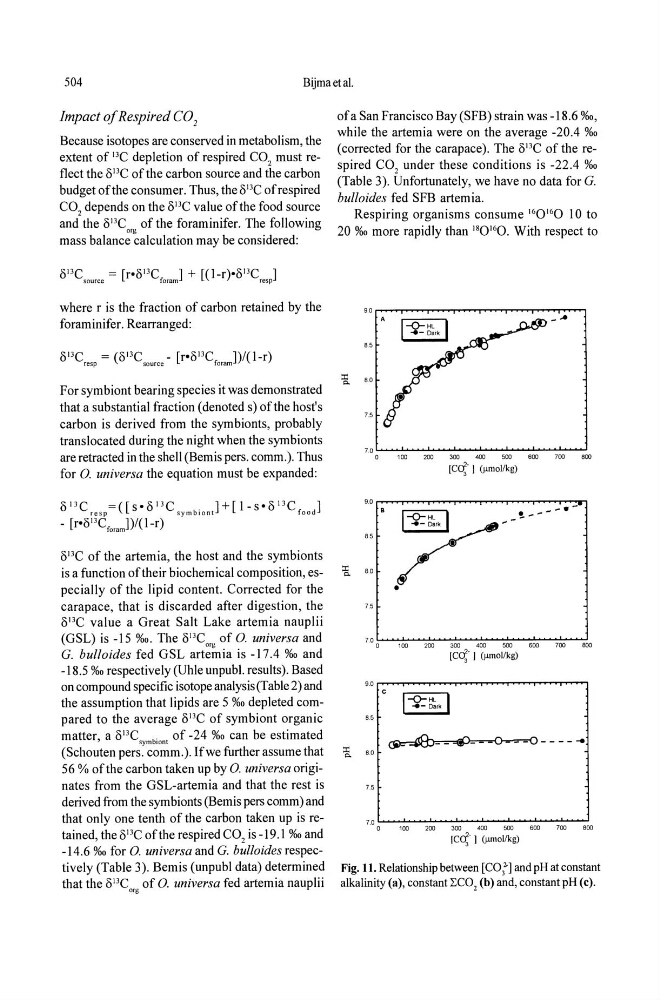
Fig. II. Relationship between [CO," 1 and pH at constant
alkalinity (a), constant l:C0 2 (b) and, constant pH (c).
Bijmaetal.
Impact of Respired CO 2
Because isotopes are conserved in metabolism, the
extent of l3C depletion of respired CO 2 must reflect the Ol3C of the carbon source and the carbon
budget ofthe consumer. Thus, the ODC of respired
CO 2 depends on the olJC value of the food source
and the ODC mg of the foraminifer. The following
mass balance calculation may be considered:
where r is the fraction of carbon retained by the
foraminifer. Rearranged:
For symbiont bearing species it was demonstrated
that a substantial fraction (denoted s) of the host's
carbon is derived from the symbionts, probably
translocated during the night when the symbionts
are retracted in the shell (Bemis pers. comm.). Thus
for 0. universa the equation must be expanded:
olJC of the artemia, the host and the symbionts
is a function oftheir biochemical composition, especially of the lipid content. Corrected for the
carapace, that is discarded after digestion, the
Ol3C value a Great Salt Lake artemia nauplii
(GSL) is -15 %0. The ODC",g of 0. universa and
G. bulloides fed GSL artemia is -17.4 %0 and
-18.5 %0 respectively (Uhle unpub\. results). Based
on compound specific isotope analysis (Table 2) and
the assumption that lipids are 5 %0 depleted compared to the average Ol3C of symbiont organic
matter, a olJC"ymbiont of -24 %0 can be estimated
(Schouten pers. comm.). If we further assume that
56 % of the carbon taken up by 0. universa originates from the GSL-artemia and that the rest is
derived from the symbionts (Bemis pers comm) and
that only one tenth of the carbon taken up is retained, the Ol3C ofthe respired CO 2 is -19.1 %0 and
-14.6 %0 for 0. universa and G. bulloides respectively (Table 3). Bemis (unpubl data) determined
that the ODC mg of 0. universa fed artemia nauplii
of a San Francisco Bay (SFB) strain was -18.6 %0,
while the artemia were on the average -20.4 %0
(corrected for the carapace). The ODC of the respired CO 2 under these conditions is -22.4 %0
(Table 3). Unfortunately, we have no data for G.
bulloides fed SFB artemia.
Respiring organisms consume 16 0 16 0 10 to
20 %0 more rapidly than 18 0 16 0. With respect to
_ ..
70~~~~~~~~~~~~~~~ o
@
D
D
G
_
_
~
_
[cd,' I ()lmol/kg)
75
70~~~~--~~~~~~~~~~
o
100
200
300
400
500
600
700
800
l cd,' 1 ()lffioUkg)
~-- __ -
7.5
7.0 O~~'00~"':2"':OO~"':'300':'---4~OO:---:50':'0~~60'::"O ~7~OO:--"'::'SOO
rcd,- I ()lInol/kg)
Fig. II. Relationship between [CO," 1 and pH at constant
alkalinity (a), constant l:C0 2 (b) and, constant pH (c).