

Reassessing Foraminiferal Stable Isotope Geochemistry
505
the metabolic fractionation during respiration a
fractionation factor ofl.O 16 has been proposed for
oxygen (Lane and Dole 1956). Others (Kiddon et
al. 1993), measured a respiratory isotope effect
between 14 %0 to 26 %0 for seven representative
unicellular marine organisms and estimate that the
average fractionation of the dominant marine
respirers is about 20 ± 3 %0. A generalized respiration equation is given by:
"free sterols"
o13e
cholest-5.22-dienol
-29.5 %0 ± 0.2 %0
cholesterol (~cholest-5-enol)
-28.7 %0 ± 0.2 %0
ergosta-5.22-dienol
-29.1 %, ± 0.1 %,
ergosta-5,24(28)-dienol
(-24.9 %0 ± 0.1 %0)
average
ca. -29 %,
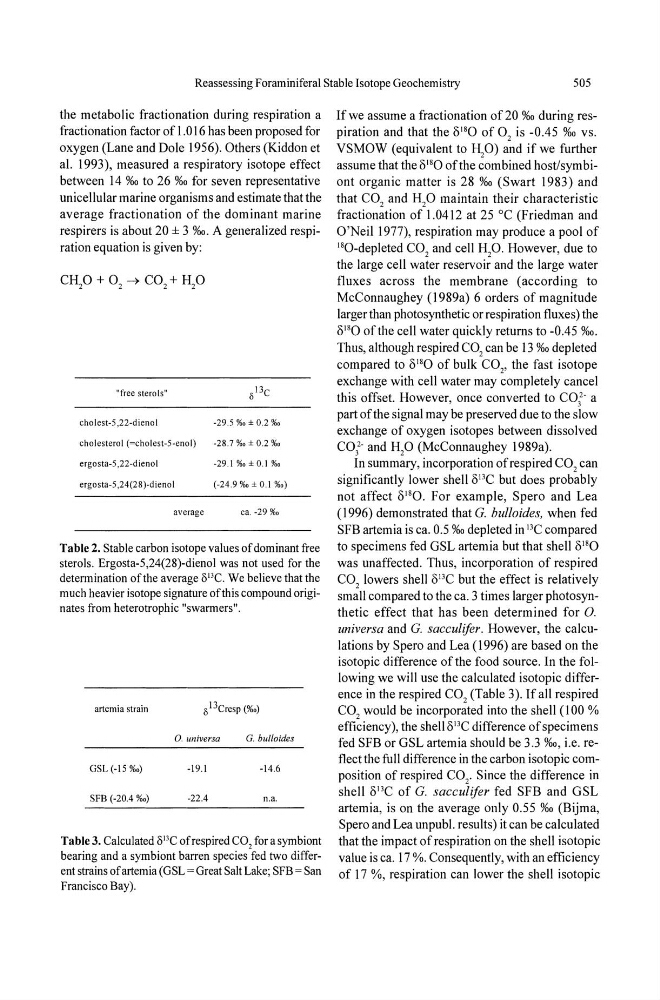
Table 2. Stable carbon isotope values of dominant free
sterols. Ergosta-5,24(28)-dienol was not used for the
determination of the average cS l3 C. We believe that the
much heavier isotope signature of this compound originates from heterotrophic "swarmers".
artemia strain
o. universa
G. bulloides
GSL (-15 %0)
-19.1
-14.6
SFB (-20.4 %0)
-22.4
n.3.
Table 3. Calculated cSIJC of respired CO 2 for a symbiont
bearing and a symbiont barren species fed two different strains of artemia (GSL = Great Salt Lake; SFB = San
Francisco Bay).
Ifwe assume a fractionation of20 %0 during respiration and that the 8 18 0 of 02 is -0.45 %0 vs.
VSMOW (equivalent to 1\0) and if we further
assume that the 8 18 0 of the combined host/symbiont organic matter is 28 0/00 (Swart 1983) and
that CO 2 and Hp maintain their characteristic
fractionation of 1.0412 at 25°C (Friedman and
O'Neil 1977), respiration may produce a pool of
180-depleted CO 2 and cell 1\0. However, due to
the large cell water reservoir and the large water
fluxes across the membrane (according to
McConnaughey (l989a) 6 orders of magnitude
larger than photosynthetic or respiration fluxes) the
8 18 0 of the cell water quickly returns to -0.450/00.
Thus, although respired CO 2 can be 13 %0 depleted
compared to 8 18 0 of bulk CO 2 , the fast isotope
exchange with cell water may completely cancel
this offset. However, once converted to cot a
part of the signal may be preserved due to the slow
exchange of oxygen isotopes between dissolved
COt and Hp (McConnaughey 1989a).
In summary, incorporation of respired CO 2 can
significantly lower she1l81lC but does probably
not affect 8 18 0. For example, Spero and Lea
(1996) demonstrated that G. bulloides, when fed
SFB artemia is ca. 0.5 %0 depleted in IlC compared
to specimens fed GSL artemia but that shell 8 18 0
was unaffected. Thus, incorporation of respired
CO 2 lowers shell 8 1l C but the effect is relatively
small compared to the ca. 3 times larger photosynthetic effect that has been determined for 0.
universa and G. sacculifer. However, the calculations by Spero and Lea (1996) are based on the
isotopic difference of the food source. In the following we will use the calculated isotopic difference in the respired CO 2 (Table 3). If all respired
CO 2 would be incorporated into the shell (100 %
efficiency), the she1l8 13 C difference of specimens
fed SFB or GSL artemia should be 3.3 %0, i.e. reflectthe full difference in the carbon isotopic composition of respired CO 2 ' Since the difference in
shell 8 1l C of G. sacculifer fed SFB and GSL
artemia, is on the average only 0.55 %0 (Bijma,
Spero and Lea unpubl. results) it can be calculated
that the impact of respiration on the shell isotopic
value is ca. 17 %. Consequently, with an efficiency
of 17 %, respiration can lower the shell isotopic
505
the metabolic fractionation during respiration a
fractionation factor ofl.O 16 has been proposed for
oxygen (Lane and Dole 1956). Others (Kiddon et
al. 1993), measured a respiratory isotope effect
between 14 %0 to 26 %0 for seven representative
unicellular marine organisms and estimate that the
average fractionation of the dominant marine
respirers is about 20 ± 3 %0. A generalized respiration equation is given by:
"free sterols"
o13e
cholest-5.22-dienol
-29.5 %0 ± 0.2 %0
cholesterol (~cholest-5-enol)
-28.7 %0 ± 0.2 %0
ergosta-5.22-dienol
-29.1 %, ± 0.1 %,
ergosta-5,24(28)-dienol
(-24.9 %0 ± 0.1 %0)
average
ca. -29 %,
Table 2. Stable carbon isotope values of dominant free
sterols. Ergosta-5,24(28)-dienol was not used for the
determination of the average cS l3 C. We believe that the
much heavier isotope signature of this compound originates from heterotrophic "swarmers".
artemia strain
o. universa
G. bulloides
GSL (-15 %0)
-19.1
-14.6
SFB (-20.4 %0)
-22.4
n.3.
Table 3. Calculated cSIJC of respired CO 2 for a symbiont
bearing and a symbiont barren species fed two different strains of artemia (GSL = Great Salt Lake; SFB = San
Francisco Bay).
Ifwe assume a fractionation of20 %0 during respiration and that the 8 18 0 of 02 is -0.45 %0 vs.
VSMOW (equivalent to 1\0) and if we further
assume that the 8 18 0 of the combined host/symbiont organic matter is 28 0/00 (Swart 1983) and
that CO 2 and Hp maintain their characteristic
fractionation of 1.0412 at 25°C (Friedman and
O'Neil 1977), respiration may produce a pool of
180-depleted CO 2 and cell 1\0. However, due to
the large cell water reservoir and the large water
fluxes across the membrane (according to
McConnaughey (l989a) 6 orders of magnitude
larger than photosynthetic or respiration fluxes) the
8 18 0 of the cell water quickly returns to -0.450/00.
Thus, although respired CO 2 can be 13 %0 depleted
compared to 8 18 0 of bulk CO 2 , the fast isotope
exchange with cell water may completely cancel
this offset. However, once converted to cot a
part of the signal may be preserved due to the slow
exchange of oxygen isotopes between dissolved
COt and Hp (McConnaughey 1989a).
In summary, incorporation of respired CO 2 can
significantly lower she1l81lC but does probably
not affect 8 18 0. For example, Spero and Lea
(1996) demonstrated that G. bulloides, when fed
SFB artemia is ca. 0.5 %0 depleted in IlC compared
to specimens fed GSL artemia but that shell 8 18 0
was unaffected. Thus, incorporation of respired
CO 2 lowers shell 8 1l C but the effect is relatively
small compared to the ca. 3 times larger photosynthetic effect that has been determined for 0.
universa and G. sacculifer. However, the calculations by Spero and Lea (1996) are based on the
isotopic difference of the food source. In the following we will use the calculated isotopic difference in the respired CO 2 (Table 3). If all respired
CO 2 would be incorporated into the shell (100 %
efficiency), the she1l8 13 C difference of specimens
fed SFB or GSL artemia should be 3.3 %0, i.e. reflectthe full difference in the carbon isotopic composition of respired CO 2 ' Since the difference in
shell 8 1l C of G. sacculifer fed SFB and GSL
artemia, is on the average only 0.55 %0 (Bijma,
Spero and Lea unpubl. results) it can be calculated
that the impact of respiration on the shell isotopic
value is ca. 17 %. Consequently, with an efficiency
of 17 %, respiration can lower the shell isotopic