

502
Bijmaetal.
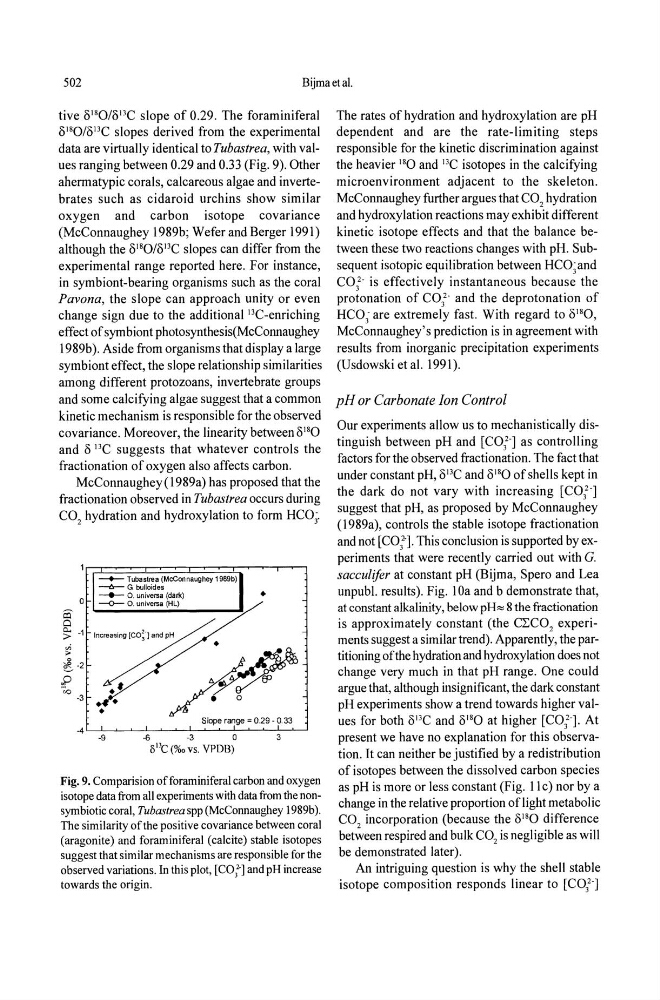
tive 8 18 0f81'C slope of 0.29. The foraminiferal
8 18 0/8 1 'C slopes derived from the experimental
data are virtually identical to Tubastrea, with values ranging between 0.29 and 0.33 (Fig. 9). Other
ahermatypic corals, calcareous algae and invertebrates such as cidaroid urchins show similar
oxygen and carbon isotope covariance
(McConnaughey I 989b; Wefer and Berger 1991)
although the 8 18 0/8 13 C slopes can differ from the
experimental range reported here. For instance,
in symbiont-bearing organisms such as the coral
Pavona, the slope can approach unity or even
change sign due to the additional I3C-enriching
effect of symbiont photosynthesis(McConnaughey
1989b). Aside from organisms that display a large
symbiont effect, the slope relationship similarities
among different protozoans, invertebrate groups
and some calcifying algae suggest that a common
kinetic mechanism is responsible for the observed
covariance. Moreover, the linearity between 8 18 0
and 8 I3C suggests that whatever controls the
fractionation of oxygen also affects carbon.
McConnaughey (I 989a) has proposed that the
fractionation observed in Tubastrea occurs during
CO 2 hydration and hydroxylation to form HCO;.
EO
o
---.- Tubastrea (McConnaughey 1989b)
~Gbulloides
-----e---- O. universa (dark)
--0-- O. unive~a (HL)
+
~ -1 Increasing [CO~-] and pH
~-2
/
p
";',0
·3
•
S lope range = 0.29 . 0.33
'4L-.L9~~-~L-~~.~3~~~0~~~~~
BIlC (%0 VS. VPDB)
Fig. 9. Comparision offoraminiferal carbon and oxygen
isotope data from all experiments with data from the nonsymbiotic coral, Tubastrea spp (McConnaughey 1989b).
The similarity ofthe positive covariance between coral
(aragonite) and foraminiferal (calcite) stable isotopes
suggest that similar mechanisms are responsible for the
observed variations. In this plot, [COn and pH increase
towards the origin.
The rates of hydration and hydroxylation are pH
dependent and are the rate-limiting steps
responsible for the kinetic discrimination against
the heavier 18 0 and I3C isotopes in the calcifying
microenvironment adjacent to the skeleton.
McConnaughey further argues that CO 2 hydration
and hydroxylation reactions may exhibit different
kinetic isotope effects and that the balance between these two reactions changes with pH. Subsequent isotopic equilibration between HCO;and
CO;' is effectively instantaneous because the
protonation of cot and the deprotonation of
HCO; are extremely fast. With regard to 8 18 0,
McConnaughey's prediction is in agreement with
results from inorganic precipitation experiments
(Usdowski et a\. 1991).
pH or Carbonate Ion Control
Our experiments allow us to mechanistically distinguish between pH and [CO,2.] as controlling
factors for the observed fractionation. The fact that
under constant pH, 8 13 C and 8 18 0 of shells kept in
the dark do not vary with increasing [COn
suggest that pH, as proposed by McConnaughey
(1989a), controls the stable isotope fractionation
and not [CO,2']. This conclusion is supported by experiments that were recently carried out with G.
sacculifer at constant pH (Bijma, Spero and Lea
unpub\. results). Fig. lOa and b demonstrate that,
at constant alkalinity, below pH"" 8 the fractionation
is approximately constant (the CLC0 2 experiments suggest a similar trend). Apparently, the partitioning ofthe hydration and hydroxylation does not
change very much in that pH range. One could
argue that, although insignificant, the dark constant
pH experiments show a trend towards higher values for both 8 13 C and 8 18 0 at higher [COn. At
present we have no explanation for this observation. It can neither be justified by a redistribution
of isotopes between the dissolved carbon species
as pH is more or less constant (Fig. Ilc) nor by a
change in the relative proportion of light metabolic
CO 2 incorporation (because the 8 18 0 difference
between respired and bulk CO 2 is negligible as will
be demonstrated later).
An intriguing question is why the shell stable
isotope composition responds linear to [CO,"]
Bijmaetal.
tive 8 18 0f81'C slope of 0.29. The foraminiferal
8 18 0/8 1 'C slopes derived from the experimental
data are virtually identical to Tubastrea, with values ranging between 0.29 and 0.33 (Fig. 9). Other
ahermatypic corals, calcareous algae and invertebrates such as cidaroid urchins show similar
oxygen and carbon isotope covariance
(McConnaughey I 989b; Wefer and Berger 1991)
although the 8 18 0/8 13 C slopes can differ from the
experimental range reported here. For instance,
in symbiont-bearing organisms such as the coral
Pavona, the slope can approach unity or even
change sign due to the additional I3C-enriching
effect of symbiont photosynthesis(McConnaughey
1989b). Aside from organisms that display a large
symbiont effect, the slope relationship similarities
among different protozoans, invertebrate groups
and some calcifying algae suggest that a common
kinetic mechanism is responsible for the observed
covariance. Moreover, the linearity between 8 18 0
and 8 I3C suggests that whatever controls the
fractionation of oxygen also affects carbon.
McConnaughey (I 989a) has proposed that the
fractionation observed in Tubastrea occurs during
CO 2 hydration and hydroxylation to form HCO;.
EO
o
---.- Tubastrea (McConnaughey 1989b)
~Gbulloides
-----e---- O. universa (dark)
--0-- O. unive~a (HL)
+
~ -1 Increasing [CO~-] and pH
~-2
/
p
";',0
·3
•
S lope range = 0.29 . 0.33
'4L-.L9~~-~L-~~.~3~~~0~~~~~
BIlC (%0 VS. VPDB)
Fig. 9. Comparision offoraminiferal carbon and oxygen
isotope data from all experiments with data from the nonsymbiotic coral, Tubastrea spp (McConnaughey 1989b).
The similarity ofthe positive covariance between coral
(aragonite) and foraminiferal (calcite) stable isotopes
suggest that similar mechanisms are responsible for the
observed variations. In this plot, [COn and pH increase
towards the origin.
The rates of hydration and hydroxylation are pH
dependent and are the rate-limiting steps
responsible for the kinetic discrimination against
the heavier 18 0 and I3C isotopes in the calcifying
microenvironment adjacent to the skeleton.
McConnaughey further argues that CO 2 hydration
and hydroxylation reactions may exhibit different
kinetic isotope effects and that the balance between these two reactions changes with pH. Subsequent isotopic equilibration between HCO;and
CO;' is effectively instantaneous because the
protonation of cot and the deprotonation of
HCO; are extremely fast. With regard to 8 18 0,
McConnaughey's prediction is in agreement with
results from inorganic precipitation experiments
(Usdowski et a\. 1991).
pH or Carbonate Ion Control
Our experiments allow us to mechanistically distinguish between pH and [CO,2.] as controlling
factors for the observed fractionation. The fact that
under constant pH, 8 13 C and 8 18 0 of shells kept in
the dark do not vary with increasing [COn
suggest that pH, as proposed by McConnaughey
(1989a), controls the stable isotope fractionation
and not [CO,2']. This conclusion is supported by experiments that were recently carried out with G.
sacculifer at constant pH (Bijma, Spero and Lea
unpub\. results). Fig. lOa and b demonstrate that,
at constant alkalinity, below pH"" 8 the fractionation
is approximately constant (the CLC0 2 experiments suggest a similar trend). Apparently, the partitioning ofthe hydration and hydroxylation does not
change very much in that pH range. One could
argue that, although insignificant, the dark constant
pH experiments show a trend towards higher values for both 8 13 C and 8 18 0 at higher [COn. At
present we have no explanation for this observation. It can neither be justified by a redistribution
of isotopes between the dissolved carbon species
as pH is more or less constant (Fig. Ilc) nor by a
change in the relative proportion of light metabolic
CO 2 incorporation (because the 8 18 0 difference
between respired and bulk CO 2 is negligible as will
be demonstrated later).
An intriguing question is why the shell stable
isotope composition responds linear to [CO,"]