

Reassessing Foraminiferal Stable Isotope Geochemistry
501
between ambient and high [Can (Fig. 8). Consequently, if the fractionation is controlled by the
calcification rate, the light/dark effect on 0 18 0
should be larger than the [Can effect. On the
contrary, the light/dark shift ino l8 0 is on the average -0.35 %0 for 0. universa and constant across
the full range of the experimental [COi'] while the
depletion is approximately 1.5 %0 over a [COi']
range of ca. 600 and 700 J.lmol/kg at constant
alk, and constant LC0 2 , respectively. Shells of
G. bulloides are depleted by 1.4 %0 across a
[Can range of only 333 J.lmol/kg (at constant
LCO). Again, this suggests that the calcification
rate does not control 18 0 incorporation. 3) Finally,
the final shell weight of 0. universa, ranging between 10 to 70 J.lg, is very variable between and
within treatments (Fig. 8). Thus, ifthe calcification
rate is the controlling factor, the correlation between the oxygen isotopic composition of the shell
and the percentage carbonate ion in solution (Fig.
7) should be very low. At this stage we therefore
have to conclude that the 0180:[CO;-J relationship
for inorganic and biological precipitates is probably
not a function of calcification rate as proposed by
McCrea. However, because we find it difficult to
believe that the rate at which a calcifying organism accretes CaCO) is not a fundamental factor
for isotope fractionation, additional experiments will
have to be carried out to confirm this hypothesis.
It should also be noted that although the similarity
in life span of 0. universa between and within
treatments can be used to roughly quantify calcification rate (because spherical chamber formation
is a continuous process) it cannot be applied toG.
bulloides because chambers are formed discretely.
More importantly, the similarity between our
investigation and the inorganic precipitate study of
McCrea implies a kinetic mechanism which would
affect all calcifying organisms and inorganic
precipitates. Evidence for a common kinetic fractionation mechanism exists in corals and other invertebrate groups. For instance, McConnaughey
(1989b) demonstrated that the carbon and oxygen
isotopic composition of symbiotic and nonsymbiotic coral skeletons can vary significantly
across skeletal surfaces that were presumably
secreted synchronously. In the non-photosynthetic
species, Tubastrea, the values covary with a posi, J!' ,' . .
.. ~_ . __
1§ -.
-IS- • -' :"' -:"'-:"'- :"'-:"'-:"-:"_:"_:':::.._::..'
~ ·6
~
l! ·9
»0
-", -12
. . . . . . . ~ - \R ,~~ (l u..
• - . - -W!\'Cl» (Oalk)
- 15 L.:====:==!~~~~-L_~
o
20
40
,. 60
80
100
Percentage CO, in solution
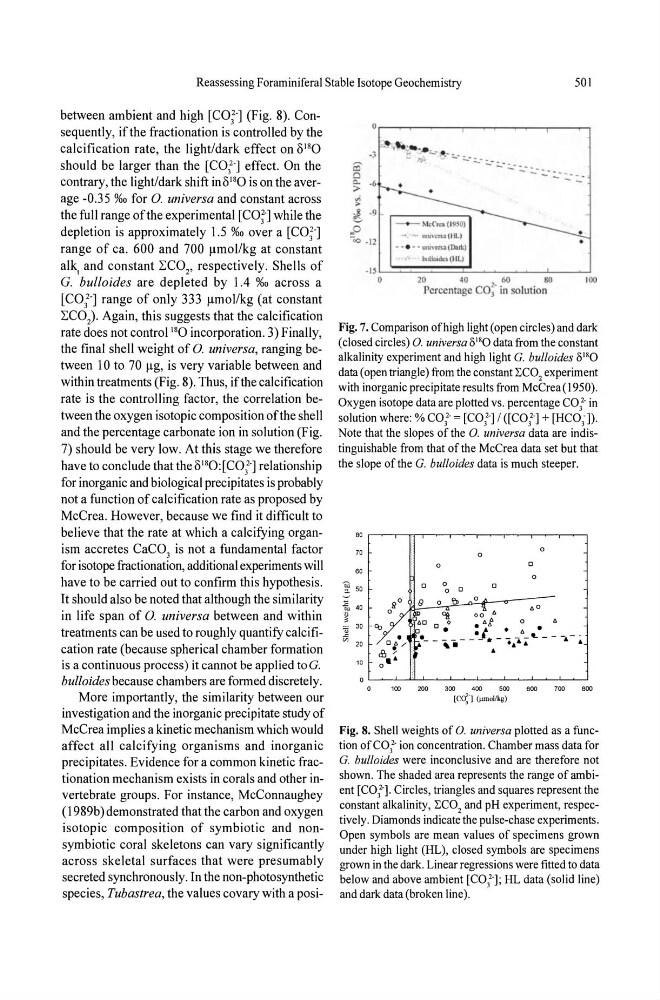
Fig. 7. Comparison of high light (open circles) and dark
(closed circles) 0. universa 8 1 '0 data from the constant
alkalinity experiment and high light G. bulloides 8 1 '0
data (open triangle) from the constant ~C02 experiment
with inorganic precipitate results from McCrea (1950).
Oxygen isotope data are plotted vs. percentage CO)'" in
solution where: % C0 3 2. = [COn / ([COn + [HCO;]).
Note that the slopes of the 0. universa data are indistinguishable from that ofthe McCrea data set but that
the slope of the G. bulloides data is much steeper.
70
60
~ 50
~ 40
' ~
1:5 30
6i 20
10
o
o
o
o
o
100
200
300
400
500
600
700
800
[CO:"] ("mul/kg)
Fig. 8. Shell weights of 0. universa plotted as a function of cot ion concentration. Chamber mass data for
G. bulloides were inconclusive and are therefore not
shown. The shaded area represents the range of ambient [Cot]. Circles, triangles and squares represent the
constant alkalinity, ~C02 and pH experiment, respectively. Diamonds indicate the pulse-chase experiments.
Open symbols are mean values of specimens grown
under high light (HL), closed symbols are specimens
grown in the dark. Linear regressions were fitted to data
below and above ambient [COn; HL data (solid line)
and dark data (broken line).
501
between ambient and high [Can (Fig. 8). Consequently, if the fractionation is controlled by the
calcification rate, the light/dark effect on 0 18 0
should be larger than the [Can effect. On the
contrary, the light/dark shift ino l8 0 is on the average -0.35 %0 for 0. universa and constant across
the full range of the experimental [COi'] while the
depletion is approximately 1.5 %0 over a [COi']
range of ca. 600 and 700 J.lmol/kg at constant
alk, and constant LC0 2 , respectively. Shells of
G. bulloides are depleted by 1.4 %0 across a
[Can range of only 333 J.lmol/kg (at constant
LCO). Again, this suggests that the calcification
rate does not control 18 0 incorporation. 3) Finally,
the final shell weight of 0. universa, ranging between 10 to 70 J.lg, is very variable between and
within treatments (Fig. 8). Thus, ifthe calcification
rate is the controlling factor, the correlation between the oxygen isotopic composition of the shell
and the percentage carbonate ion in solution (Fig.
7) should be very low. At this stage we therefore
have to conclude that the 0180:[CO;-J relationship
for inorganic and biological precipitates is probably
not a function of calcification rate as proposed by
McCrea. However, because we find it difficult to
believe that the rate at which a calcifying organism accretes CaCO) is not a fundamental factor
for isotope fractionation, additional experiments will
have to be carried out to confirm this hypothesis.
It should also be noted that although the similarity
in life span of 0. universa between and within
treatments can be used to roughly quantify calcification rate (because spherical chamber formation
is a continuous process) it cannot be applied toG.
bulloides because chambers are formed discretely.
More importantly, the similarity between our
investigation and the inorganic precipitate study of
McCrea implies a kinetic mechanism which would
affect all calcifying organisms and inorganic
precipitates. Evidence for a common kinetic fractionation mechanism exists in corals and other invertebrate groups. For instance, McConnaughey
(1989b) demonstrated that the carbon and oxygen
isotopic composition of symbiotic and nonsymbiotic coral skeletons can vary significantly
across skeletal surfaces that were presumably
secreted synchronously. In the non-photosynthetic
species, Tubastrea, the values covary with a posi, J!' ,' . .
.. ~_ . __
1§ -.
-IS- • -' :"' -:"'-:"'- :"'-:"'-:"-:"_:"_:':::.._::..'
~ ·6
~
l! ·9
»0
-", -12
. . . . . . . ~ - \R ,~~ (l u..
• - . - -W!\'Cl» (Oalk)
- 15 L.:====:==!~~~~-L_~
o
20
40
,. 60
80
100
Percentage CO, in solution
Fig. 7. Comparison of high light (open circles) and dark
(closed circles) 0. universa 8 1 '0 data from the constant
alkalinity experiment and high light G. bulloides 8 1 '0
data (open triangle) from the constant ~C02 experiment
with inorganic precipitate results from McCrea (1950).
Oxygen isotope data are plotted vs. percentage CO)'" in
solution where: % C0 3 2. = [COn / ([COn + [HCO;]).
Note that the slopes of the 0. universa data are indistinguishable from that ofthe McCrea data set but that
the slope of the G. bulloides data is much steeper.
70
60
~ 50
~ 40
' ~
1:5 30
6i 20
10
o
o
o
o
o
100
200
300
400
500
600
700
800
[CO:"] ("mul/kg)
Fig. 8. Shell weights of 0. universa plotted as a function of cot ion concentration. Chamber mass data for
G. bulloides were inconclusive and are therefore not
shown. The shaded area represents the range of ambient [Cot]. Circles, triangles and squares represent the
constant alkalinity, ~C02 and pH experiment, respectively. Diamonds indicate the pulse-chase experiments.
Open symbols are mean values of specimens grown
under high light (HL), closed symbols are specimens
grown in the dark. Linear regressions were fitted to data
below and above ambient [COn; HL data (solid line)
and dark data (broken line).