

500
Bijmaetal.
The experiments carried out with the symbiont
barren G. bulloides as well as the dark experiments with 0. universa clearly demonstrate that
whatever controls the stable isotope:carbonate
chemistry relationship is independent of symbiont
activity. Experiments carried out at a 5°C lower
temperature further suggest that this relationship
is also independent oftemperature. In addition, an
unexpected stable oxygen isotope: [CO;·] relationship (also independent of symbiont activity and temperature) was found that cannot be explained
in terms of known "vital effects". These observations force us to reassess previously proposed
fractionation mechanisms.
In the following sections we will first discuss
inorganic equilibrium and kinetic fractionation
mechanisms. We will then discuss the influence of
respiration and photosynthesis and finally propose
a combination of mechanisms that control the isotopic composition of symbiont barren and symbiont bearing foraminifers.
Equilibrium and Kinetic Fractionation
Mass balance calculations (Mook et al. 1974;
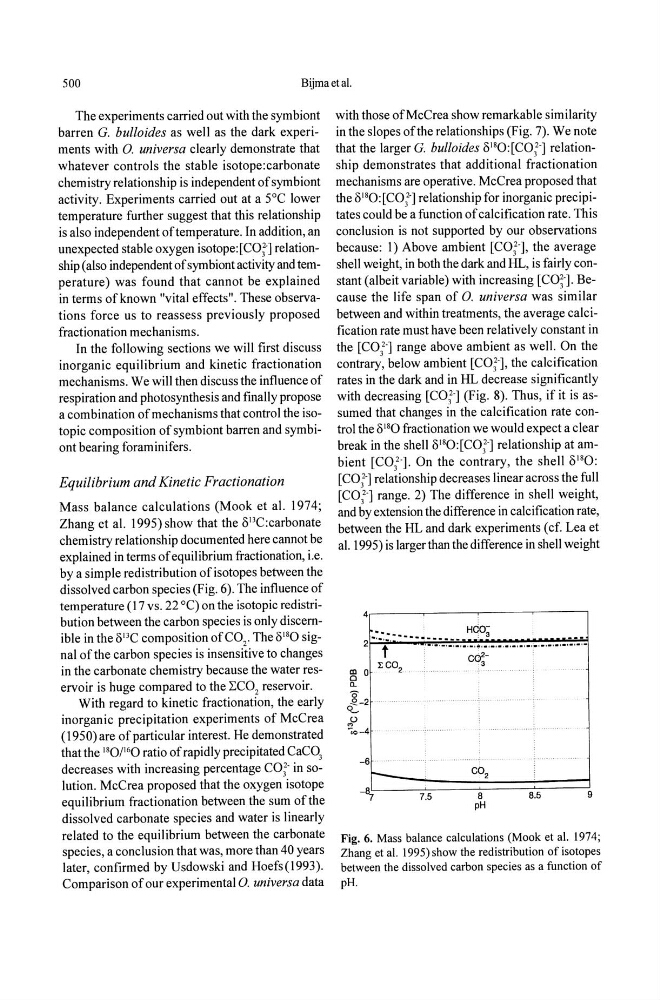
Zhang et al. 1995) show that the 8 13 C:carbonate
chemistry relationship documented here cannot be
explained in terms of equilibrium fractionation, i.e.
by a simple redistribution of isotopes between the
dissolved carbon species (Fig. 6). The influence of
temperature (17 vs. 22 0C) on the isotopic redistribution between the carbon species is only discernible in the 8 13 C composition of CO 2 ' The 8 18 0 signal of the carbon species is insensitive to changes
in the carbonate chemistry because the water reservoir is huge compared to the 2:C0 2 reservoir.
With regard to kinetic fractionation, the early
inorganic precipitation experiments of McCrea
(1950) are of particular interest. He demonstrated
that the 180fi60 ratio of rapidly precipitated CaC0 3
decreases with increasing percentage cot in solution. McCrea proposed that the oxygen isotope
equilibrium fractionation between the sum of the
dissolved carbonate species and water is linearly
related to the equilibrium between the carbonate
species, a conclusion that was, more than 40 years
later, confirmed by Usdowski and Hoefs (l993).
Comparison of our experimental 0. universa data
with those of McCrea show remarkable similarity
in the slopes ofthe relationships (Fig. 7). We note
that the larger G. bulloides 8180:[COn relationship demonstrates that additional fractionation
mechanisms are operative. McCrea proposed that
the 8 18 0: [COn relationship for inorganic precipitates could be a function of calcification rate. This
conclusion is not supported by our observations
because: I) Above ambient [CO;"], the average
shell weight, in both the dark and HL, is fairly constant (albeit variable) with increasing [CO;} Because the life span of O. universa was similar
between and within treatments, the average calcification rate must have been relatively constant in
the [COn range above ambient as well. On the
contrary, below ambient [CO;·], the calcification
rates in the dark and in HL decrease significantly
with decreasing [COn (Fig. 8). Thus, if it is assumed that changes in the calcification rate control the 8 18 0 fractionation we would expect a clear
break in the she1l8 18 0:[CO;-J relationship at ambient [COn. On the contrary, the shell 8 18 0:
[Cot] relationship decreases linear across the full
[COn range. 2) The difference in shell weight,
and by extension the difference in calcification rate,
between the HL and dark experiments (cf. Lea et
al. 1995) is larger than the difference in shell weight
4.-----~------~----~------,
.~.~: _ •••••••••••• HOD;
' .. , .. , .. , .. , ..... , .. , ~'''''''''''''''''''''' ,-, ..... , .. , .. , .. , .. , ...
-6 r-CO2
-~~==:::7~.5~=====8;======8~.5;:=====i9
pH
Fig. 6. Mass balance calculations (Mook et al. 1974;
Zhang et al. 1995) show the redistribution of isotopes
between the dissolved carbon species as a function of
pH.
Bijmaetal.
The experiments carried out with the symbiont
barren G. bulloides as well as the dark experiments with 0. universa clearly demonstrate that
whatever controls the stable isotope:carbonate
chemistry relationship is independent of symbiont
activity. Experiments carried out at a 5°C lower
temperature further suggest that this relationship
is also independent oftemperature. In addition, an
unexpected stable oxygen isotope: [CO;·] relationship (also independent of symbiont activity and temperature) was found that cannot be explained
in terms of known "vital effects". These observations force us to reassess previously proposed
fractionation mechanisms.
In the following sections we will first discuss
inorganic equilibrium and kinetic fractionation
mechanisms. We will then discuss the influence of
respiration and photosynthesis and finally propose
a combination of mechanisms that control the isotopic composition of symbiont barren and symbiont bearing foraminifers.
Equilibrium and Kinetic Fractionation
Mass balance calculations (Mook et al. 1974;
Zhang et al. 1995) show that the 8 13 C:carbonate
chemistry relationship documented here cannot be
explained in terms of equilibrium fractionation, i.e.
by a simple redistribution of isotopes between the
dissolved carbon species (Fig. 6). The influence of
temperature (17 vs. 22 0C) on the isotopic redistribution between the carbon species is only discernible in the 8 13 C composition of CO 2 ' The 8 18 0 signal of the carbon species is insensitive to changes
in the carbonate chemistry because the water reservoir is huge compared to the 2:C0 2 reservoir.
With regard to kinetic fractionation, the early
inorganic precipitation experiments of McCrea
(1950) are of particular interest. He demonstrated
that the 180fi60 ratio of rapidly precipitated CaC0 3
decreases with increasing percentage cot in solution. McCrea proposed that the oxygen isotope
equilibrium fractionation between the sum of the
dissolved carbonate species and water is linearly
related to the equilibrium between the carbonate
species, a conclusion that was, more than 40 years
later, confirmed by Usdowski and Hoefs (l993).
Comparison of our experimental 0. universa data
with those of McCrea show remarkable similarity
in the slopes ofthe relationships (Fig. 7). We note
that the larger G. bulloides 8180:[COn relationship demonstrates that additional fractionation
mechanisms are operative. McCrea proposed that
the 8 18 0: [COn relationship for inorganic precipitates could be a function of calcification rate. This
conclusion is not supported by our observations
because: I) Above ambient [CO;"], the average
shell weight, in both the dark and HL, is fairly constant (albeit variable) with increasing [CO;} Because the life span of O. universa was similar
between and within treatments, the average calcification rate must have been relatively constant in
the [COn range above ambient as well. On the
contrary, below ambient [CO;·], the calcification
rates in the dark and in HL decrease significantly
with decreasing [COn (Fig. 8). Thus, if it is assumed that changes in the calcification rate control the 8 18 0 fractionation we would expect a clear
break in the she1l8 18 0:[CO;-J relationship at ambient [COn. On the contrary, the shell 8 18 0:
[Cot] relationship decreases linear across the full
[COn range. 2) The difference in shell weight,
and by extension the difference in calcification rate,
between the HL and dark experiments (cf. Lea et
al. 1995) is larger than the difference in shell weight
4.-----~------~----~------,
.~.~: _ •••••••••••• HOD;
' .. , .. , .. , .. , ..... , .. , ~'''''''''''''''''''''' ,-, ..... , .. , .. , .. , .. , ...
-6 r-CO2
-~~==:::7~.5~=====8;======8~.5;:=====i9
pH
Fig. 6. Mass balance calculations (Mook et al. 1974;
Zhang et al. 1995) show the redistribution of isotopes
between the dissolved carbon species as a function of
pH.