

Reconstruction of Surface Ocean Nitrate Utilization
455
S'5N (o/oovs . air)
4 ~ 8 101214165 6 7 8 9 109 10 11 12 13 144 6 8 10 12 14
6
8
10
12
0
L0
•
•
•
' . •
•
•
•
•
10
1000
•
•
•
• 20 •
:§: 2000
•
•
•
•
30
.t=
a.
40
•
Gl 3000
•
3925
•
0
~
3908
50
~
•
ell
4000
60
S
•
•
70
•
SOOO
•
•
3907
80
3906
•
6000
90
•
Southwest Atla ntic
Namibian
Shelf
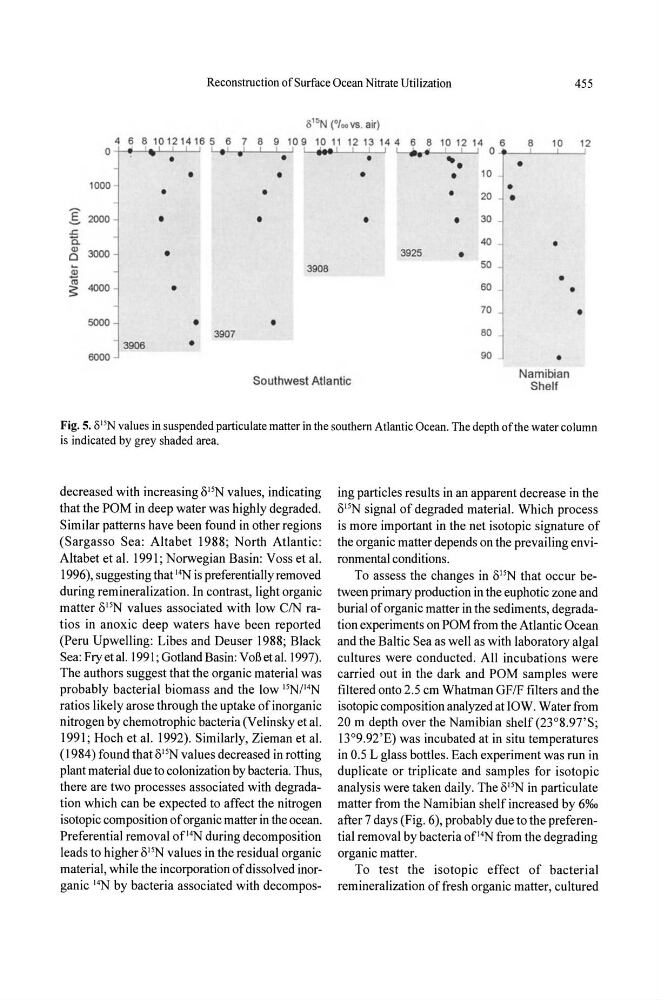
Fig. 5. cS "N values in suspended particulate matter in the southern Atlantic Ocean. The depth of the water column
is indicated by grey shaded area.
decreased with increasing 8 1s N values, indicating
that the POM in deep water was highly degraded.
Similar patterns have been found in other regions
(Sargasso Sea: Altabet 1988; North Atlantic:
Altabet et al. 1991 ; Norwegian Basin: Voss et al.
1996), suggesting that 14N is preferentially removed
during remineralization. In contrast, light organic
matter 8 1s N values associated with low e/N ratios in anoxic deep waters have been reported
(Peru Upwelling: Libes and Deuser 1988; Black
Sea: Fry et al. 1991 ; Gotland Basin: VoB et al. 1997).
The authors suggest that the organic material was
probably bacterial biomass and the low 'SN/I4N
ratios likely arose through the uptake of inorganic
nitrogen by chemotrophic bacteria (Velinsky et al.
1991 ; Hoch et al. 1992). Si milarly, Zieman et al.
(1984) found that 81~ values decreased in rotting
plant material due to colonization by bacteria. Thus,
there are two processes associated with degradation which can be expected to affect the nitrogen
isotopic composition of organic matter in the ocean.
Preferential removal of'4N during decomposition
leads to higher 8 15 N values in the residual organic
material, while the incorporation of dissolved inorganic 14N by bacteria associated with decomposing particles results in an apparent decrease in the
8 1s N signal of degraded material. Which process
is more important in the net isotopic signature of
the organic matter depends on the prevailing environmental conditions.
To assess the changes in 8 1s N that occur between primary production in the euphotic zone and
burial of organic matter in the sediments, degradation experiments on POM from the Atlantic Ocean
and the Baltic Sea as well as with laboratory algal
cultures were conducted. All incubations were
carried out in the dark and POM samples were
filtered onto 2.5 cm Whatman GFIF filters and the
isotopic composition analyzed at row. Water from
20 m depth over the Namibian shelf (23°8 .97'S ;
13°9.92 ' E) was incubated at in situ temperatures
in 0.5 L glass bottles. Each experiment was run in
duplicate or triplicate and samples for isotopic
analysis were taken daily. The 8 1s N in particulate
matter from the Namibian shelf increased by 6%0
after 7 days (Fig. 6), probably due to the preferential removal by bacteria of'4N from the degrading
organic matter.
To test the isotopic effect of bacterial
remineralization offresh organic matter, cultured
455
S'5N (o/oovs . air)
4 ~ 8 101214165 6 7 8 9 109 10 11 12 13 144 6 8 10 12 14
6
8
10
12
0
L0
•
•
•
' . •
•
•
•
•
10
1000
•
•
•
• 20 •
:§: 2000
•
•
•
•
30
.t=
a.
40
•
Gl 3000
•
3925
•
0
~
3908
50
~
•
ell
4000
60
S
•
•
70
•
SOOO
•
•
3907
80
3906
•
6000
90
•
Southwest Atla ntic
Namibian
Shelf
Fig. 5. cS "N values in suspended particulate matter in the southern Atlantic Ocean. The depth of the water column
is indicated by grey shaded area.
decreased with increasing 8 1s N values, indicating
that the POM in deep water was highly degraded.
Similar patterns have been found in other regions
(Sargasso Sea: Altabet 1988; North Atlantic:
Altabet et al. 1991 ; Norwegian Basin: Voss et al.
1996), suggesting that 14N is preferentially removed
during remineralization. In contrast, light organic
matter 8 1s N values associated with low e/N ratios in anoxic deep waters have been reported
(Peru Upwelling: Libes and Deuser 1988; Black
Sea: Fry et al. 1991 ; Gotland Basin: VoB et al. 1997).
The authors suggest that the organic material was
probably bacterial biomass and the low 'SN/I4N
ratios likely arose through the uptake of inorganic
nitrogen by chemotrophic bacteria (Velinsky et al.
1991 ; Hoch et al. 1992). Si milarly, Zieman et al.
(1984) found that 81~ values decreased in rotting
plant material due to colonization by bacteria. Thus,
there are two processes associated with degradation which can be expected to affect the nitrogen
isotopic composition of organic matter in the ocean.
Preferential removal of'4N during decomposition
leads to higher 8 15 N values in the residual organic
material, while the incorporation of dissolved inorganic 14N by bacteria associated with decomposing particles results in an apparent decrease in the
8 1s N signal of degraded material. Which process
is more important in the net isotopic signature of
the organic matter depends on the prevailing environmental conditions.
To assess the changes in 8 1s N that occur between primary production in the euphotic zone and
burial of organic matter in the sediments, degradation experiments on POM from the Atlantic Ocean
and the Baltic Sea as well as with laboratory algal
cultures were conducted. All incubations were
carried out in the dark and POM samples were
filtered onto 2.5 cm Whatman GFIF filters and the
isotopic composition analyzed at row. Water from
20 m depth over the Namibian shelf (23°8 .97'S ;
13°9.92 ' E) was incubated at in situ temperatures
in 0.5 L glass bottles. Each experiment was run in
duplicate or triplicate and samples for isotopic
analysis were taken daily. The 8 1s N in particulate
matter from the Namibian shelf increased by 6%0
after 7 days (Fig. 6), probably due to the preferential removal by bacteria of'4N from the degrading
organic matter.
To test the isotopic effect of bacterial
remineralization offresh organic matter, cultured