

454
Holmesetal.
temperatures at this time and again during winter
(July/August) indicate that recently upwelled water was not in the region near the trap, implying that
dissolved inorganic nitrogen concentrations in the
euphotic zone were low. Therefore, the nitrate was
quickly depleted and the nitrate that the
phytoplankton took up was relatively enriched in
15N, resulting in high ol5N from March to April/
May and low productivity as indicated by low flux
rates. The 2%0 ol5N decrease in late fall was accompanied by a temperature drop to values as low
as l7.3°C. Another SST decrease was observed
in spring, when the lowest observed values (14.6 -
14.9°C) occurred. The data ofServain et al. (1985)
and Lutjeharms and Meeuwis (1987) suggest that
the intensity of coastal upwelling increases during
spring and fall due to stronger southeast trade
winds. Satellite photos taken in 1984 show that
upwelling filaments were advected seaward during spring and fall under the influence of these trade
winds (Lutjeharrns and Stockton 1987). The seaward extension of the filamentous mixing zone over
the Walvis Ridge was likely the cause oflowered
SST in May/June and September - November. The
elevated nutrient content in the cold upwelled water is reflected in the lower ol5N (higher nitrate
availability with relatively less utilization) and increased productivity (higher flux rate). The appearance of elevated nitrate concentrations should precede lowered ol5N since it takes time for the ol5N
in the bulk of the plankton to decrease. The fact
that temperature and ol5N in the Walvis Ridge
samples are not offset probably reflects the 18 day
trapping interval which integrates the signal of the
sinking particles. The good correlation between
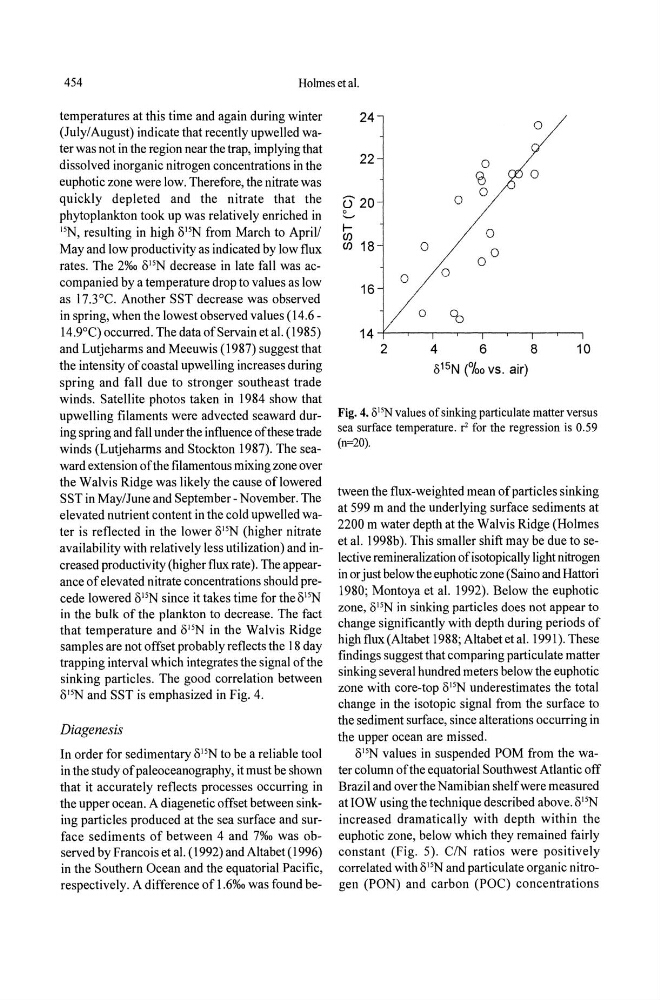
ol5N and SST is emphasized in Fig. 4.
Diagenesis
In order for sedimentary ol5N to be a reliable tool
in the study of paleoceanography, it must be shown
that it accurately reflects processes occurring in
the upper ocean. A diagenetic offset between sinking particles produced at the sea surface and surface sediments of between 4 and 7%0 was observed by Francois et al. (1992) and Altabet (1996)
in the Southern Ocean and the equatorial Pacific,
respectively. A difference of 1.6%0 was found be24
0
22
0
~
0
020
0
0
0
~
I0
(f)
(f) 18
0
0
0
0
0
16
o
c::o
14~~--r-~-.--.--.--r-~
2
4
6
8
10
015N (%0 VS. air)
Fig. 4. 8 15 N values of sinking particulate matter versus
sea surface temperature. r' for the regression is 0.59
(n=20).
tween the flux-weighted mean of particles sinking
at 599 m and the underlying surface sediments at
2200 m water depth at the Walvis Ridge (Holmes
et al. 1998b). This smaller shift may be due to selective remineralization of isotopically light nitrogen
in or just below the euphotic zone (Saino and Hattori
1980; Montoya et al. 1992). Below the euphotic
zone, ol5N in sinking particles does not appear to
change significantly with depth during periods of
high flux (Altabet 1988; Altabetetal. 1991). These
findings suggest that comparing particulate matter
sinking several hundred meters below the euphotic
zone with core-top 8 15 N underestimates the total
change in the isotopic signal from the surface to
the sediment surface, since alterations occurring in
the upper ocean are missed.
8 15 N values in suspended POM from the water column ofthe equatorial Southwest Atlantic off
Brazil and over the Namibian shelf were measured
at lOW using the technique described above. 8 15 N
increased dramatically with depth within the
euphotic zone, below which they remained fairly
constant (Fig. 5). C/N ratios were positively
correlated with 8 15 N and particulate organic nitrogen (PON) and carbon (POC) concentrations
Holmesetal.
temperatures at this time and again during winter
(July/August) indicate that recently upwelled water was not in the region near the trap, implying that
dissolved inorganic nitrogen concentrations in the
euphotic zone were low. Therefore, the nitrate was
quickly depleted and the nitrate that the
phytoplankton took up was relatively enriched in
15N, resulting in high ol5N from March to April/
May and low productivity as indicated by low flux
rates. The 2%0 ol5N decrease in late fall was accompanied by a temperature drop to values as low
as l7.3°C. Another SST decrease was observed
in spring, when the lowest observed values (14.6 -
14.9°C) occurred. The data ofServain et al. (1985)
and Lutjeharms and Meeuwis (1987) suggest that
the intensity of coastal upwelling increases during
spring and fall due to stronger southeast trade
winds. Satellite photos taken in 1984 show that
upwelling filaments were advected seaward during spring and fall under the influence of these trade
winds (Lutjeharrns and Stockton 1987). The seaward extension of the filamentous mixing zone over
the Walvis Ridge was likely the cause oflowered
SST in May/June and September - November. The
elevated nutrient content in the cold upwelled water is reflected in the lower ol5N (higher nitrate
availability with relatively less utilization) and increased productivity (higher flux rate). The appearance of elevated nitrate concentrations should precede lowered ol5N since it takes time for the ol5N
in the bulk of the plankton to decrease. The fact
that temperature and ol5N in the Walvis Ridge
samples are not offset probably reflects the 18 day
trapping interval which integrates the signal of the
sinking particles. The good correlation between
ol5N and SST is emphasized in Fig. 4.
Diagenesis
In order for sedimentary ol5N to be a reliable tool
in the study of paleoceanography, it must be shown
that it accurately reflects processes occurring in
the upper ocean. A diagenetic offset between sinking particles produced at the sea surface and surface sediments of between 4 and 7%0 was observed by Francois et al. (1992) and Altabet (1996)
in the Southern Ocean and the equatorial Pacific,
respectively. A difference of 1.6%0 was found be24
0
22
0
~
0
020
0
0
0
~
I0
(f)
(f) 18
0
0
0
0
0
16
o
c::o
14~~--r-~-.--.--.--r-~
2
4
6
8
10
015N (%0 VS. air)
Fig. 4. 8 15 N values of sinking particulate matter versus
sea surface temperature. r' for the regression is 0.59
(n=20).
tween the flux-weighted mean of particles sinking
at 599 m and the underlying surface sediments at
2200 m water depth at the Walvis Ridge (Holmes
et al. 1998b). This smaller shift may be due to selective remineralization of isotopically light nitrogen
in or just below the euphotic zone (Saino and Hattori
1980; Montoya et al. 1992). Below the euphotic
zone, ol5N in sinking particles does not appear to
change significantly with depth during periods of
high flux (Altabet 1988; Altabetetal. 1991). These
findings suggest that comparing particulate matter
sinking several hundred meters below the euphotic
zone with core-top 8 15 N underestimates the total
change in the isotopic signal from the surface to
the sediment surface, since alterations occurring in
the upper ocean are missed.
8 15 N values in suspended POM from the water column ofthe equatorial Southwest Atlantic off
Brazil and over the Namibian shelf were measured
at lOW using the technique described above. 8 15 N
increased dramatically with depth within the
euphotic zone, below which they remained fairly
constant (Fig. 5). C/N ratios were positively
correlated with 8 15 N and particulate organic nitrogen (PON) and carbon (POC) concentrations