

436
Mulitza et al.
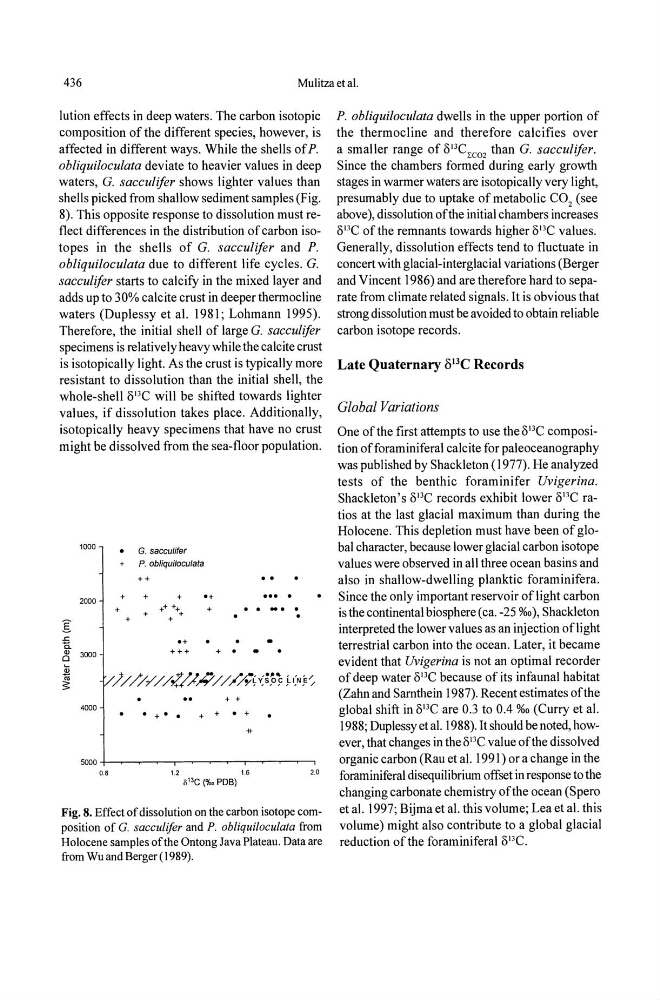
lution effects in deep waters. The carbon isotopic
composition ofthe different species, however, is
affected in different ways. While the shells of P.
obliquiloculata deviate to heavier values in deep
waters, G. sacculifer shows lighter values than
shells picked from shallow sediment samples (Fig.
8). This opposite response to dissolution must reflect differences in the distribution of carbon isotopes in the shells of G. sacculifer and P.
obliquiloculata due to different life cycles. G.
sacculifer starts to calcify in the mixed layer and
adds up to 30% calcite crust in deeper thermocline
waters (Duplessy et al. 1981; Lohmann 1995).
Therefore, the initial shell of large G. sacculifer
specimens is relatively heavy while the calcite crust
is isotopically light. As the crust is typically more
resistant to dissolution than the initial shell, the
whole-shell Ol3C will be shifted towards lighter
values, if dissolution takes place. Additionally,
isotopically heavy specimens that have no crust
might be dissolved from the sea-floor population.
1000
2000
:[
~
Q)
3000
0
~
:s:
4000
0.8
o
G. sacculifer
+
P. obliquiloculata
++
+
+
+
0+
+
+
++ +++
+
+
+
0+
+++
+ 0
+ +
_+_. + + e +
*
1.2
1.6
a13c (%0 PDB)
... .
o
o
2.0
Fig. 8. Effect of dissolution on the carbon isotope composition of G. sacculifer and P. obliquiloculata from
Holocene samples of the Ontong Java Plateau. Data are
from Wu and Berger (1989).
P. obliquiloculata dwells in the upper portion of
the thermocline and therefore calcifies over
a smaller range of 0l3C EC02 than G. sacculifer.
Since the chambers formed during early growth
stages in warmer waters are isotopically very light,
presumably due to uptake of metabolic CO 2 (see
above), dissolution of the initial chambers increases
Cl3C of the remnants towards higher Cl3C values.
Generally, dissolution effects tend to fluctuate in
concert with glacial-interglacial variations (Berger
and Vincent 1986) and are therefore hard to separate from climate related signals. It is obvious that
strong dissolution must be avoided to obtain reliable
carbon isotope records.
Late Quaternary cS i3 e Records
Global Variations
One of the first attempts to use the Cl3C composition of foraminiferal calcite for paleoceanography
was published by Shackleton (1977). He analyzed
tests of the benthic foraminifer Uvigerina.
Shackleton's Cl3C records exhibit lower Cl3C ratios at the last glacial maximum than during the
Holocene. This depletion must have been of global character, because lower glacial carbon isotope
values were observed in all three ocean basins and
also in shallow-dwelling planktic foraminifera.
Since the only important reservoir oflight carbon
is the continental biosphere (ca. -25 %0), Shackleton
interpreted the lower values as an injection oflight
terrestrial carbon into the ocean. Later, it became
evident that Uvigerina is not an optimal recorder
of deep water Cl3C because of its infaunal habitat
(Zahn and Sarnthein 1987). Recent estimates of the
global shift in Cl3C are 0.3 to 0.4 %0 (Curry et al.
1988; Duplessy et al. 1988). It should be noted, however, that changes in the Ol3C value of the dissolved
organic carbon (Rau et al. 1991) or a change in the
foraminiferal disequilibrium offset in response to the
changing carbonate chemistry ofthe ocean (Spero
etal.1997;Bijmaetal. this volume; Leaetal. this
volume) might also contribute to a global glacial
reduction of the foraminiferalc l3 C.
Mulitza et al.
lution effects in deep waters. The carbon isotopic
composition ofthe different species, however, is
affected in different ways. While the shells of P.
obliquiloculata deviate to heavier values in deep
waters, G. sacculifer shows lighter values than
shells picked from shallow sediment samples (Fig.
8). This opposite response to dissolution must reflect differences in the distribution of carbon isotopes in the shells of G. sacculifer and P.
obliquiloculata due to different life cycles. G.
sacculifer starts to calcify in the mixed layer and
adds up to 30% calcite crust in deeper thermocline
waters (Duplessy et al. 1981; Lohmann 1995).
Therefore, the initial shell of large G. sacculifer
specimens is relatively heavy while the calcite crust
is isotopically light. As the crust is typically more
resistant to dissolution than the initial shell, the
whole-shell Ol3C will be shifted towards lighter
values, if dissolution takes place. Additionally,
isotopically heavy specimens that have no crust
might be dissolved from the sea-floor population.
1000
2000
:[
~
Q)
3000
0
~
:s:
4000
0.8
o
G. sacculifer
+
P. obliquiloculata
++
+
+
+
0+
+
+
++ +++
+
+
+
0+
+++
+ 0
+ +
_+_. + + e +
*
1.2
1.6
a13c (%0 PDB)
... .
o
o
2.0
Fig. 8. Effect of dissolution on the carbon isotope composition of G. sacculifer and P. obliquiloculata from
Holocene samples of the Ontong Java Plateau. Data are
from Wu and Berger (1989).
P. obliquiloculata dwells in the upper portion of
the thermocline and therefore calcifies over
a smaller range of 0l3C EC02 than G. sacculifer.
Since the chambers formed during early growth
stages in warmer waters are isotopically very light,
presumably due to uptake of metabolic CO 2 (see
above), dissolution of the initial chambers increases
Cl3C of the remnants towards higher Cl3C values.
Generally, dissolution effects tend to fluctuate in
concert with glacial-interglacial variations (Berger
and Vincent 1986) and are therefore hard to separate from climate related signals. It is obvious that
strong dissolution must be avoided to obtain reliable
carbon isotope records.
Late Quaternary cS i3 e Records
Global Variations
One of the first attempts to use the Cl3C composition of foraminiferal calcite for paleoceanography
was published by Shackleton (1977). He analyzed
tests of the benthic foraminifer Uvigerina.
Shackleton's Cl3C records exhibit lower Cl3C ratios at the last glacial maximum than during the
Holocene. This depletion must have been of global character, because lower glacial carbon isotope
values were observed in all three ocean basins and
also in shallow-dwelling planktic foraminifera.
Since the only important reservoir oflight carbon
is the continental biosphere (ca. -25 %0), Shackleton
interpreted the lower values as an injection oflight
terrestrial carbon into the ocean. Later, it became
evident that Uvigerina is not an optimal recorder
of deep water Cl3C because of its infaunal habitat
(Zahn and Sarnthein 1987). Recent estimates of the
global shift in Cl3C are 0.3 to 0.4 %0 (Curry et al.
1988; Duplessy et al. 1988). It should be noted, however, that changes in the Ol3C value of the dissolved
organic carbon (Rau et al. 1991) or a change in the
foraminiferal disequilibrium offset in response to the
changing carbonate chemistry ofthe ocean (Spero
etal.1997;Bijmaetal. this volume; Leaetal. this
volume) might also contribute to a global glacial
reduction of the foraminiferalc l3 C.