

The South Atlantic Carbon Isotope Record of Planktic Foraminifera
437
Regional Variations in the Tropical Atlantic
and the Southern Ocean
Although the recording of (iI3C in planktic
foraminifera is yet not fully understood, deviations
from the global signal may provide hints about regional changes in the carbon isotope chemistry of
surface waters. This approach requires that disequilibrium effects are invariant through time, which
might be unrealistic in the light of the studies which
use the extent of the vital effect as a proxy itself
(see Bjima et al. and Lea et al. this volume). However, two main strategies to deal with carbon isotope records of planktic foraminifera can be found
in the literature. The first is to use carbon isotope
differences of different foraminiferal species (in
most cases benthic and planktic) in the same core
(e.g. Shackleton and Pisias 1985; Steens et al. 1992;
Schneider et al. 1994; Wefer et al. 1996). Because
global effects should be cancelled out, this method
can provide information about the vertical or seasonal differences in the carbon isotope composition of water masses. The other strategy, applied
to both benthic and planktic records, is to compare
carbon isotope records from different sites, e.g.
from high and low latitudes within the same time
frame (e.g. Labeyrie and Duplessy 1985; Oppo and
Fairbanks 1987; Ninnemann and Charles 1997;
Duplessy et al. 1988). This method should allow to
differentiate relative changes between water
masses of different regions. Following the latter
strategy, we will now present four high-resolution
(> 1 0 cm/ka), 14C-dated planktic (i13C records from
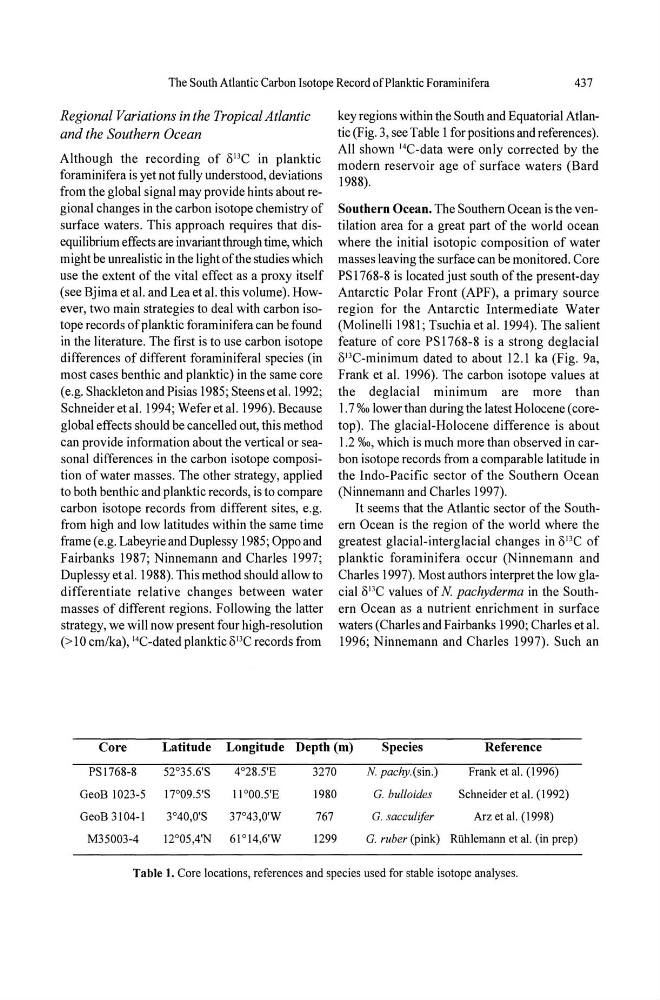
key regions within the South and Equatorial Atlantic (Fig. 3, see Table 1 for positions and references).
All shown 14C-data were only corrected by the
modern reservoir age of surface waters (Bard
1988).
Southern Ocean. The Southern Ocean is the ventilation area for a great part of the world ocean
where the initial isotopic composition of water
masses leaving the surface can be monitored. Core
PS1768-8 is located just south of the present-day
Antarctic Polar Front (APF), a primary source
region for the Antarctic Intermediate Water
(Molinelli 1981; Tsuchia et al. 1994). The salient
feature of core PS1768-8 is a strong deglacial
(iI3C-minimum dated to about 12.1 ka (Fig. 9a,
Frank et al. 1996). The carbon isotope values at
the deglacial minimum are more than
1.7%0 lower than during the latest Holocene (coretop). The glacial-Holocene difference is about
1.2 %0, which is much more than observed in carbon isotope records from a comparable latitude in
the Indo-Pacific sector of the Southern Ocean
(Ninnemann and Charles 1997).
It seems that the Atlantic sector ofthe Southern Ocean is the region of the world where the
greatest glacial-interglacial changes in (iI3C of
planktic foraminifera occur (Ninnemann and
Charles 1997). Most authors interpret the low glacial (iI3C values of N pachyderma in the Southern Ocean as a nutrient enrichment in surface
waters (Charles and Fairbanks 1990; Charles et al.
1996; Ninnemann and Charles 1997). Such an
Core
Latitude Longitude Depth (m)
Species
Reference
PS1768-8
52°35.6'S
4°28.5'E
3270
N. pachy.(sin.)
Frank et al. (1996)
GeoB 1023-5 17°09.5'S
Il o OO.5'E
1980
G. bulloides
Schneider et al. (1992)
GeoB 3104-1
3°40,O'S
37°43,0'W
767
G. sacculifer
Arz et al. (1998)
M35003-4
12°05,4'N 61°14,6'W
1299
G. ruber (pink) Riihlemann et al. (in prep)
Table 1. Core locations, references and species used for stable isotope analyses.
437
Regional Variations in the Tropical Atlantic
and the Southern Ocean
Although the recording of (iI3C in planktic
foraminifera is yet not fully understood, deviations
from the global signal may provide hints about regional changes in the carbon isotope chemistry of
surface waters. This approach requires that disequilibrium effects are invariant through time, which
might be unrealistic in the light of the studies which
use the extent of the vital effect as a proxy itself
(see Bjima et al. and Lea et al. this volume). However, two main strategies to deal with carbon isotope records of planktic foraminifera can be found
in the literature. The first is to use carbon isotope
differences of different foraminiferal species (in
most cases benthic and planktic) in the same core
(e.g. Shackleton and Pisias 1985; Steens et al. 1992;
Schneider et al. 1994; Wefer et al. 1996). Because
global effects should be cancelled out, this method
can provide information about the vertical or seasonal differences in the carbon isotope composition of water masses. The other strategy, applied
to both benthic and planktic records, is to compare
carbon isotope records from different sites, e.g.
from high and low latitudes within the same time
frame (e.g. Labeyrie and Duplessy 1985; Oppo and
Fairbanks 1987; Ninnemann and Charles 1997;
Duplessy et al. 1988). This method should allow to
differentiate relative changes between water
masses of different regions. Following the latter
strategy, we will now present four high-resolution
(> 1 0 cm/ka), 14C-dated planktic (i13C records from
key regions within the South and Equatorial Atlantic (Fig. 3, see Table 1 for positions and references).
All shown 14C-data were only corrected by the
modern reservoir age of surface waters (Bard
1988).
Southern Ocean. The Southern Ocean is the ventilation area for a great part of the world ocean
where the initial isotopic composition of water
masses leaving the surface can be monitored. Core
PS1768-8 is located just south of the present-day
Antarctic Polar Front (APF), a primary source
region for the Antarctic Intermediate Water
(Molinelli 1981; Tsuchia et al. 1994). The salient
feature of core PS1768-8 is a strong deglacial
(iI3C-minimum dated to about 12.1 ka (Fig. 9a,
Frank et al. 1996). The carbon isotope values at
the deglacial minimum are more than
1.7%0 lower than during the latest Holocene (coretop). The glacial-Holocene difference is about
1.2 %0, which is much more than observed in carbon isotope records from a comparable latitude in
the Indo-Pacific sector of the Southern Ocean
(Ninnemann and Charles 1997).
It seems that the Atlantic sector ofthe Southern Ocean is the region of the world where the
greatest glacial-interglacial changes in (iI3C of
planktic foraminifera occur (Ninnemann and
Charles 1997). Most authors interpret the low glacial (iI3C values of N pachyderma in the Southern Ocean as a nutrient enrichment in surface
waters (Charles and Fairbanks 1990; Charles et al.
1996; Ninnemann and Charles 1997). Such an
Core
Latitude Longitude Depth (m)
Species
Reference
PS1768-8
52°35.6'S
4°28.5'E
3270
N. pachy.(sin.)
Frank et al. (1996)
GeoB 1023-5 17°09.5'S
Il o OO.5'E
1980
G. bulloides
Schneider et al. (1992)
GeoB 3104-1
3°40,O'S
37°43,0'W
767
G. sacculifer
Arz et al. (1998)
M35003-4
12°05,4'N 61°14,6'W
1299
G. ruber (pink) Riihlemann et al. (in prep)
Table 1. Core locations, references and species used for stable isotope analyses.