

The South Atlantic Carbon Isotope Record of Planktic Foraminifera
435
SO·W
50
40
30
20
10
0
10
20· E
10· N
10· N
0
0
10
10
20
20
30· S
0
30·S
,--'
SO·W
50
40
30
20
10
0
10
20· E
60·W
50
40
30
20
10
0
10
20· E
10· N
10· N
0
. 13
, . o7j
0
(0
CO .
• •
.-. ~ .. ",
10
10
1,0
... ~~
20
'-0
.. r. .j
20
/'
~
30· S
~ .. )
30· S
60·W
50
40
30
20
10
0
10
20· E
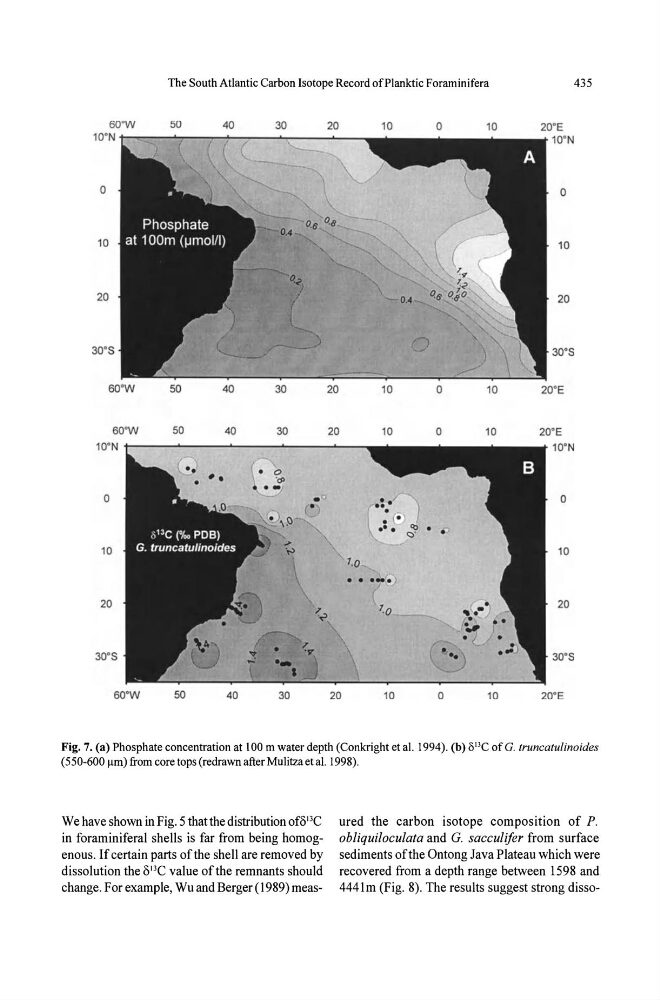
Fig. 7. (a) Phosphate concentration at 100 m water depth (Conkright et al. 1994). (b) O" C of G. truncatulinoides
(550-600 11m) from core tops (redrawn after Mulitza et al. 1998).
We have shown in Fig. 5 thatthe distribution oni 13 C
in foraminiferal shells is far from being homogenous. If certain parts of the shell are removed by
dissolution the SI3C value ofthe remnants should
change. For example, Wu and Berger (1989) measured the carbon isotope compositIOn of P.
obliquiloculata and G. sacculifer from surface
sediments ofthe Ontong Java Plateau which were
recovered from a depth range between 1598 and
444lm (Fig. 8). The results suggest strong disso-
435
SO·W
50
40
30
20
10
0
10
20· E
10· N
10· N
0
0
10
10
20
20
30· S
0
30·S
,--'
SO·W
50
40
30
20
10
0
10
20· E
60·W
50
40
30
20
10
0
10
20· E
10· N
10· N
0
. 13
, . o7j
0
(0
CO .
• •
.-. ~ .. ",
10
10
1,0
... ~~
20
'-0
.. r. .j
20
/'
~
30· S
~ .. )
30· S
60·W
50
40
30
20
10
0
10
20· E
Fig. 7. (a) Phosphate concentration at 100 m water depth (Conkright et al. 1994). (b) O" C of G. truncatulinoides
(550-600 11m) from core tops (redrawn after Mulitza et al. 1998).
We have shown in Fig. 5 thatthe distribution oni 13 C
in foraminiferal shells is far from being homogenous. If certain parts of the shell are removed by
dissolution the SI3C value ofthe remnants should
change. For example, Wu and Berger (1989) measured the carbon isotope compositIOn of P.
obliquiloculata and G. sacculifer from surface
sediments ofthe Ontong Java Plateau which were
recovered from a depth range between 1598 and
444lm (Fig. 8). The results suggest strong disso-