

434
Mulitza et ai.
between 8 13 C and 8 18 0. The time for oxygen and
carbon isotopic equilibration is in the order of minutes, close to the time for calcite precipitation in
foraminifera (Ortiz et al. 1996). Thus, the extent
of disequilibrium may be a function ofthe organisms' calcification rate. Another parameter possibly affecting the kinetic disequilibrium was recently
discovered by Spero et al. (1997) (see also Bijma
et al. this volume). They found that the 8 13 C and
8 18 0 of foraminiferal calcite decreases with increasing seawater [CO/l The proportional decrease in 8 18 0 and 8 13 C also suggests a kinetic
origin. The exact mechanism is still unknown.
Habitat Effects
It is clear from the last paragraph that vital effects
play an important part in controlling the carbon isotope value of planktic foraminifera. In order to use
the carbon isotopic composition of planktic
foraminifera as a paleoceanographic tool, we must
also know where and when the species under study
calcified (i.e. the water depth or the season of
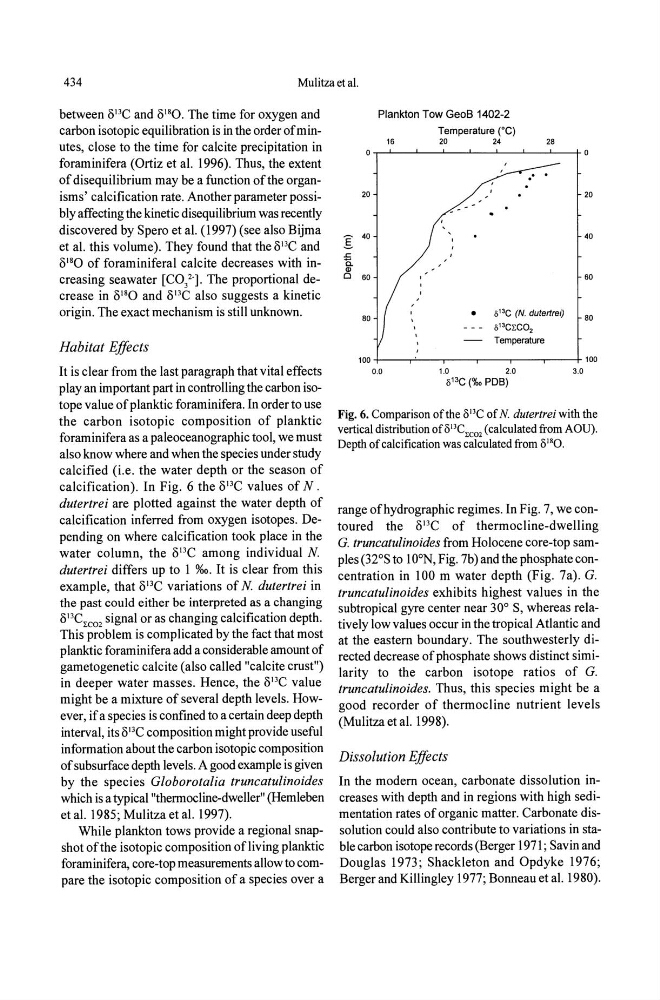
calcification). In Fig. 6 the 8 13 C values of N .
dutertrei are plotted against the water depth of
calcification inferred from oxygen isotopes. Depending on where calcification took place in the
water column, the 8 13 C among individual N.
dutertrei differs up to I %0. It is clear from this
example, that 8 13 C variations of N. dutertrei in
the past could either be interpreted as a changing
8I3Cl:C02 signal or as changing calcification depth.
This problem is complicated by the fact that most
planktic foraminifera add a considerable amount of
gametogenetic calcite (also called "calcite crust")
in deeper water masses. Hence, the 8 13 C value
might be a mixture of several depth levels. However, if a species is confined to a certain deep depth
interval, its 8 13 C composition might provide useful
information about the carbon isotopic composition
of subsurface depth levels. A good example is given
by the species Globorotalia truncatulinoides
which is a typical "thermocline-dweller" (Hemleben
et al. 1985; Mulitza et al. 1997).
While plankton tows provide a regional snapshot of the isotopic composition ofliving planktic
foraminifera, core-top measurements allow to compare the isotopic composition of a species over a
Plankton Tow GeoB 1402-2
Temperature (0G)
16
20
24
28
,
.
20
20
40
40
% .,
o 60
60
80
• I; 13C (N. duter/rei) 80
o13CLCO,
Temperature
100
100
0.0
1.0
2.0
3.0
1)13C (%0 PDB)
Fig. 6. Comparison of the ODC of N dutertrei with the
vertical distribution of ODCl:C02 (calculated from AOU).
Depth of calcification was calculated from 0 18 0.
range of hydrographic regimes. In Fig. 7, we contoured the 8 13 C of thermocline-dwelling
G. truncatulinoides from Holocene core-top samples (32°S to lOON, Fig. 7b) and the phosphate concentration in 100 m water depth (Fig. 7a). G.
truncatulinoides exhibits highest values in the
subtropical gyre center near 30° S, whereas relatively low values occur in the tropical Atlantic and
at the eastern boundary. The southwesterly directed decrease of phosphate shows distinct similarity to the carbon isotope ratios of G.
truncatulinoides. Thus, this species might be a
good recorder of thermocline nutrient levels
(Mulitza et al. 1998).
Dissolution Effects
In the modern ocean, carbonate dissolution increases with depth and in regions with high sedimentation rates of organic matter. Carbonate dissolution could also contribute to variations in stable carbon isotope records (Berger 1971; Savin and
Douglas 1973; Shackleton and Opdyke 1976;
Berger and Killingley 1977; Bonneau et al. 1980).
Mulitza et ai.
between 8 13 C and 8 18 0. The time for oxygen and
carbon isotopic equilibration is in the order of minutes, close to the time for calcite precipitation in
foraminifera (Ortiz et al. 1996). Thus, the extent
of disequilibrium may be a function ofthe organisms' calcification rate. Another parameter possibly affecting the kinetic disequilibrium was recently
discovered by Spero et al. (1997) (see also Bijma
et al. this volume). They found that the 8 13 C and
8 18 0 of foraminiferal calcite decreases with increasing seawater [CO/l The proportional decrease in 8 18 0 and 8 13 C also suggests a kinetic
origin. The exact mechanism is still unknown.
Habitat Effects
It is clear from the last paragraph that vital effects
play an important part in controlling the carbon isotope value of planktic foraminifera. In order to use
the carbon isotopic composition of planktic
foraminifera as a paleoceanographic tool, we must
also know where and when the species under study
calcified (i.e. the water depth or the season of
calcification). In Fig. 6 the 8 13 C values of N .
dutertrei are plotted against the water depth of
calcification inferred from oxygen isotopes. Depending on where calcification took place in the
water column, the 8 13 C among individual N.
dutertrei differs up to I %0. It is clear from this
example, that 8 13 C variations of N. dutertrei in
the past could either be interpreted as a changing
8I3Cl:C02 signal or as changing calcification depth.
This problem is complicated by the fact that most
planktic foraminifera add a considerable amount of
gametogenetic calcite (also called "calcite crust")
in deeper water masses. Hence, the 8 13 C value
might be a mixture of several depth levels. However, if a species is confined to a certain deep depth
interval, its 8 13 C composition might provide useful
information about the carbon isotopic composition
of subsurface depth levels. A good example is given
by the species Globorotalia truncatulinoides
which is a typical "thermocline-dweller" (Hemleben
et al. 1985; Mulitza et al. 1997).
While plankton tows provide a regional snapshot of the isotopic composition ofliving planktic
foraminifera, core-top measurements allow to compare the isotopic composition of a species over a
Plankton Tow GeoB 1402-2
Temperature (0G)
16
20
24
28
,
.
20
20
40
40
% .,
o 60
60
80
• I; 13C (N. duter/rei) 80
o13CLCO,
Temperature
100
100
0.0
1.0
2.0
3.0
1)13C (%0 PDB)
Fig. 6. Comparison of the ODC of N dutertrei with the
vertical distribution of ODCl:C02 (calculated from AOU).
Depth of calcification was calculated from 0 18 0.
range of hydrographic regimes. In Fig. 7, we contoured the 8 13 C of thermocline-dwelling
G. truncatulinoides from Holocene core-top samples (32°S to lOON, Fig. 7b) and the phosphate concentration in 100 m water depth (Fig. 7a). G.
truncatulinoides exhibits highest values in the
subtropical gyre center near 30° S, whereas relatively low values occur in the tropical Atlantic and
at the eastern boundary. The southwesterly directed decrease of phosphate shows distinct similarity to the carbon isotope ratios of G.
truncatulinoides. Thus, this species might be a
good recorder of thermocline nutrient levels
(Mulitza et al. 1998).
Dissolution Effects
In the modern ocean, carbonate dissolution increases with depth and in regions with high sedimentation rates of organic matter. Carbonate dissolution could also contribute to variations in stable carbon isotope records (Berger 1971; Savin and
Douglas 1973; Shackleton and Opdyke 1976;
Berger and Killingley 1977; Bonneau et al. 1980).