

The South Atlantic Carbon Isotope Record of Planktic Foraminifera
433
considerable amount of respired light carbon.
Spero and Lea (1996) concluded from a feeding
experiment that the planktic foraminifera
Globigerina bulloides contains about 8% respired
CO 2 , lfwe assume an organic carbon composition
of -20%0 and a 013C LC02 of 1.5, we can easily shift
the foraminiferalo 13 C by more than -1.8 %0 relative to equilibrium calcite. Therefore, the incorporation of metabolic carbon into the shells could be
one explanation for the observed vital effects.
Apparently, the deviations from equilibrium
values are temperature-dependent in P. obliquiloculata. The isotopic disequilibrium inP. obliquiloculata increases with increasing temperature.
This strongly suggests that, in this species, the respiration rate and hence the amount of incorporated
metabolic CO 2 increases with increasing temperature as previously hypothesized for other species
(Ravelo and Fairbanks 1995; Ortiz et al. 1996;
Spero and Lea 1996). Interestingly, the slope of
t.o 13 C:T in P. obliquiloculata is very close to that
observed by Ortiz et al. (1996) using different species. However, the shells of N dutertrei were also
calcified over a comparable large temperature
range and exhibit no temperature-dependent offset. This shows that the concept of temperaturedependent "metabolic" vital effects does not hold
for all species.
Besides metabolic effects, fractionation can
also be due to photosynthesis. Some spinose
foraminifera (e.g. G. sacculifer) harbor symbiontic
algae. Photosynthesis of symbiontic algae preferentially utilizes 12C and should leave the ambient
environment enriched in Ol3C. Therefore, symbiont activity increases the shello 13 C. The photosynthetic effect on the Ol3C of G. sacculifer has been
demonstrated in culture experiments (Spero and
Lea 1993). Chambers secreted under higher light
levels were enriched by l.1 to 1.7 %0 relative to
chambers grown in the dark. As small tests usually grow under lower light levels than large tests
(Spero and Lea 1993) and because symbiont density increases with increasing chamber irradiance,
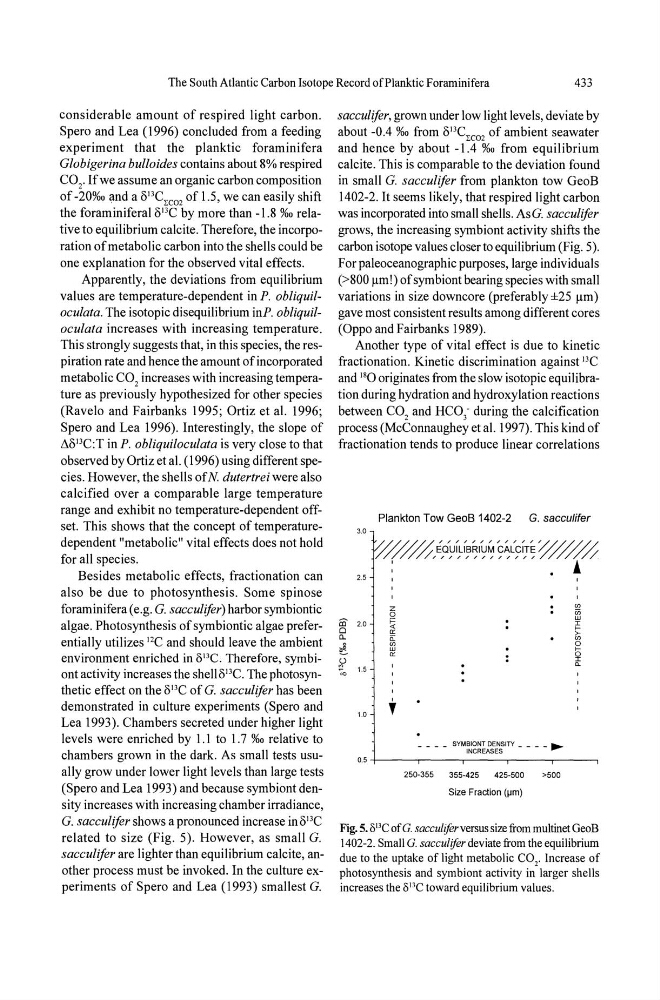
G. sacculifer shows a pronounced increase in ol3C
related to size (Fig. 5). However, as small G.
sacculifer are lighter than equilibrium calcite, another process must be invoked. In the culture experiments of Spero and Lea (1993) smallest G.
sacculifer, grown under low light levels, deviate by
about -0.4 %0 from OI3C LC02 of ambient seawater
and hence by about -1.4 %0 from equilibrium
calcite. This is comparable to the deviation found
in small G. sacculifer from plankton tow GeoB
1402-2. It seems likely, that respired light carbon
was incorporated into small shells. AsG. sacculifer
grows, the increasing symbiont activity shifts the
carbon isotope values closer to equilibrium (Fig. 5).
For paleoceanographic purposes, large individuals
(>800 ~m!) of symbiont bearing species with small
variations in size downcore (preferably ±25 ~m)
gave most consistent results among different cores
(Oppo and Fairbanks 1989).
Another type of vital effect is due to kinetic
fractionation. Kinetic discrimination against "C
and ISO originates from the slow isotopic equilibration during hydration and hydroxylation reactions
between CO 2 and HC0 3 ' during the calcification
process (McConnaughey et al. 1997). This kind of
fractionation tends to produce linear correlations
iii'
0
a.
~
;,?
<.0
3.0
2.5
2.0
1.5
1.0
Plankton Tow GeoB 1402-2 G. sacculifer
z
0
F
«
' "
n:
U)
w
'"
,
,
,
U)
U)
W
I
!;:
U)
5 I
0.
0.5 +---,----,--------,----r----,
250-355
355-425
425-500
>500
Size Fraction (~m)
Fig. 5. Ol3C of G. saccultfor versus size from multinet GeoB
1402-2. Small G. sacculifer deviate from the equilibrium
due to the uptake of light metabolic CO 2 , Increase of
photosynthesis and symbiont activity in larger shells
increases the Oi3C toward equilibrium values.
433
considerable amount of respired light carbon.
Spero and Lea (1996) concluded from a feeding
experiment that the planktic foraminifera
Globigerina bulloides contains about 8% respired
CO 2 , lfwe assume an organic carbon composition
of -20%0 and a 013C LC02 of 1.5, we can easily shift
the foraminiferalo 13 C by more than -1.8 %0 relative to equilibrium calcite. Therefore, the incorporation of metabolic carbon into the shells could be
one explanation for the observed vital effects.
Apparently, the deviations from equilibrium
values are temperature-dependent in P. obliquiloculata. The isotopic disequilibrium inP. obliquiloculata increases with increasing temperature.
This strongly suggests that, in this species, the respiration rate and hence the amount of incorporated
metabolic CO 2 increases with increasing temperature as previously hypothesized for other species
(Ravelo and Fairbanks 1995; Ortiz et al. 1996;
Spero and Lea 1996). Interestingly, the slope of
t.o 13 C:T in P. obliquiloculata is very close to that
observed by Ortiz et al. (1996) using different species. However, the shells of N dutertrei were also
calcified over a comparable large temperature
range and exhibit no temperature-dependent offset. This shows that the concept of temperaturedependent "metabolic" vital effects does not hold
for all species.
Besides metabolic effects, fractionation can
also be due to photosynthesis. Some spinose
foraminifera (e.g. G. sacculifer) harbor symbiontic
algae. Photosynthesis of symbiontic algae preferentially utilizes 12C and should leave the ambient
environment enriched in Ol3C. Therefore, symbiont activity increases the shello 13 C. The photosynthetic effect on the Ol3C of G. sacculifer has been
demonstrated in culture experiments (Spero and
Lea 1993). Chambers secreted under higher light
levels were enriched by l.1 to 1.7 %0 relative to
chambers grown in the dark. As small tests usually grow under lower light levels than large tests
(Spero and Lea 1993) and because symbiont density increases with increasing chamber irradiance,
G. sacculifer shows a pronounced increase in ol3C
related to size (Fig. 5). However, as small G.
sacculifer are lighter than equilibrium calcite, another process must be invoked. In the culture experiments of Spero and Lea (1993) smallest G.
sacculifer, grown under low light levels, deviate by
about -0.4 %0 from OI3C LC02 of ambient seawater
and hence by about -1.4 %0 from equilibrium
calcite. This is comparable to the deviation found
in small G. sacculifer from plankton tow GeoB
1402-2. It seems likely, that respired light carbon
was incorporated into small shells. AsG. sacculifer
grows, the increasing symbiont activity shifts the
carbon isotope values closer to equilibrium (Fig. 5).
For paleoceanographic purposes, large individuals
(>800 ~m!) of symbiont bearing species with small
variations in size downcore (preferably ±25 ~m)
gave most consistent results among different cores
(Oppo and Fairbanks 1989).
Another type of vital effect is due to kinetic
fractionation. Kinetic discrimination against "C
and ISO originates from the slow isotopic equilibration during hydration and hydroxylation reactions
between CO 2 and HC0 3 ' during the calcification
process (McConnaughey et al. 1997). This kind of
fractionation tends to produce linear correlations
iii'
0
a.
~
;,?
<.0
3.0
2.5
2.0
1.5
1.0
Plankton Tow GeoB 1402-2 G. sacculifer
z
0
F
«
' "
n:
U)
w
'"
,
,
,
U)
U)
W
I
!;:
U)
5 I
0.
0.5 +---,----,--------,----r----,
250-355
355-425
425-500
>500
Size Fraction (~m)
Fig. 5. Ol3C of G. saccultfor versus size from multinet GeoB
1402-2. Small G. sacculifer deviate from the equilibrium
due to the uptake of light metabolic CO 2 , Increase of
photosynthesis and symbiont activity in larger shells
increases the Oi3C toward equilibrium values.