

382
W
20°
10°
Romeroetal.
10°
E
20°
+-----~~~----~----~----~~~----~----~7°N
1037
•
AFRICA
0°
10°
Angola
Basin
20°
30° S
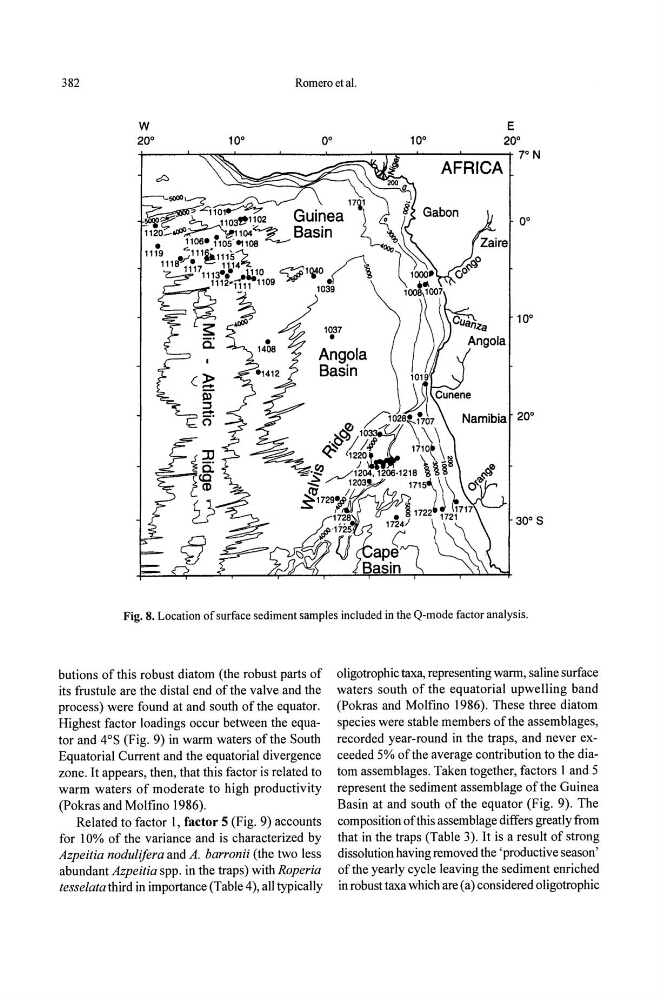
Fig. 8. Location of surface sediment samples included in the Q-mode factor analysis.
butions of this robust diatom (the robust parts of
its frustule are the distal end of the valve and the
process) were found at and south of the equator.
Highest factor loadings occur between the equator and 4°S (Fig. 9) in warm waters of the South
Equatorial Current and the equatorial divergence
zone. It appears, then, that this factor is related to
warm waters of moderate to high productivity
(Pokras and Molfino 1986).
Related to factor I, factor 5 (Fig. 9) accounts
for 10% of the variance and is characterized by
Azpeitia nodulifera and A. barronii (the two less
abundant Azpeitia spp. in the traps) with Roperia
tesselatathird in importance (Table 4), all typically
oligotrophic taxa, representing warm, saline surface
waters south of the equatorial upwelling band
(Pokras and Molfino 1986). These three diatom
species were stable members of the assemblages,
recorded year-round in the traps, and never exceeded 5% ofthe average contribution to the diatom assemblages. Taken together, factors I and 5
represent the sediment assemblage of the Guinea
Basin at and south of the equator (Fig. 9). The
composition of this assemblage differs greatly from
that in the traps (Table 3). It is a result of strong
dissolution having removed the 'productive season'
of the yearly cycle leaving the sediment enriched
in robust taxa which are (a) considered oligotrophic
W
20°
10°
Romeroetal.
10°
E
20°
+-----~~~----~----~----~~~----~----~7°N
1037
•
AFRICA
0°
10°
Angola
Basin
20°
30° S
Fig. 8. Location of surface sediment samples included in the Q-mode factor analysis.
butions of this robust diatom (the robust parts of
its frustule are the distal end of the valve and the
process) were found at and south of the equator.
Highest factor loadings occur between the equator and 4°S (Fig. 9) in warm waters of the South
Equatorial Current and the equatorial divergence
zone. It appears, then, that this factor is related to
warm waters of moderate to high productivity
(Pokras and Molfino 1986).
Related to factor I, factor 5 (Fig. 9) accounts
for 10% of the variance and is characterized by
Azpeitia nodulifera and A. barronii (the two less
abundant Azpeitia spp. in the traps) with Roperia
tesselatathird in importance (Table 4), all typically
oligotrophic taxa, representing warm, saline surface
waters south of the equatorial upwelling band
(Pokras and Molfino 1986). These three diatom
species were stable members of the assemblages,
recorded year-round in the traps, and never exceeded 5% ofthe average contribution to the diatom assemblages. Taken together, factors I and 5
represent the sediment assemblage of the Guinea
Basin at and south of the equator (Fig. 9). The
composition of this assemblage differs greatly from
that in the traps (Table 3). It is a result of strong
dissolution having removed the 'productive season'
of the yearly cycle leaving the sediment enriched
in robust taxa which are (a) considered oligotrophic