

Variability in Export Production Documented by Downward Fluxes and Species Composition
381
Site
Oceanographic
Productivity Biogenic opal contri- Seasonsls of highest Most abundant diatom species
Most abundant species in the
regime
regime
burion to total flux
diatom flux
inthctraps
surface sediments
(%. annual average)
Cape Blanc
Coastal with
high
6-12
S-Su
Thalassionema nitzschioides Val.
T. nitzschioides var. n;/zn:hioidcs
open.-ocC3n influence
nitzschioides and Chactoceros
Chaetoceros resting spores
resting spores
Cape Verde
Open-ocean with
high
6·12
F·W
Nitzschia bicopita'a group,
Freshwater taxa
minor coastal influence
N. inte,mpte.s,riata and
Acttnocyclus sJlhlilis
T. nituchioides var. parva
Nor1h
Open-ocean with
moderate
6·12
S-Su
N. bicapitata group, T. nitzschioides
Rhizosolenia bergenii
Guinea Basin moderate coastal influence
var. parva and N. ;nterruptestriata
Azpeitia spp.
South
N. bicapitala group, Pseudosolcnia
R. bcrgonii
Guinea Basin
Open-ocean
moderate
4·7
calcar-av;s and T. nitzschioides
Azpcitiospp.
to low
var.parva
Western
Open-ocean
low
4·7
No trend
N. bicapitata group, N. intcrmp'c:rtriala,
Azpeitia spp.
Equatorial
N. sp. cf. sieu/a, N. capll/uspaJae and
RJJizosolcnia hcrgonii
Azpeiia spp.
Walvis
Open-ocean with
high
6·12
S andF
T. nitzschioides var. nilZschioidcs
Chacloccros resting spores
Ridge
strong coastal influence
(Ianceolate form), Guinan/ia cylindms.
Fragilariopsis dolio/lls
Amphora ostrearia, R. hcrgonii.
Azpcitia spp.
Pseudo-nitzschia spP. and N. bicapilala
group
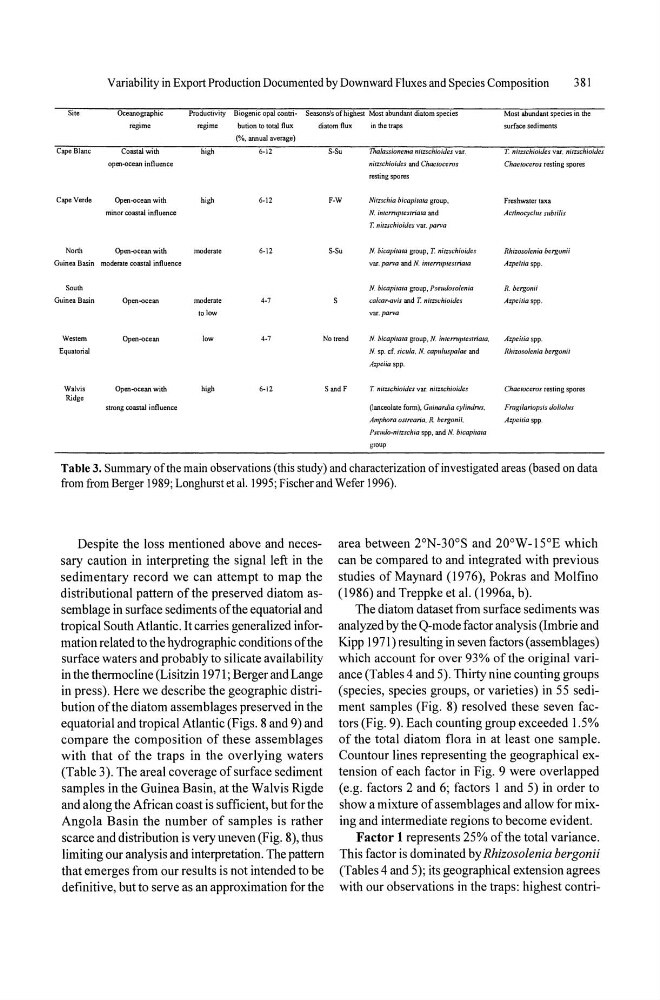
Table 3. Summary of the main observations (this study) and characterization of investigated areas (based on data
from from Berger 1989; Longhurst et al. 1995; Fischer and Wefer 1996).
Despite the loss mentioned above and necessary caution in interpreting the signal left in the
sedimentary record we can attempt to map the
distributional pattern of the preserved diatom assemblage in surface sediments of the equatorial and
tropical South Atlantic. It carries generalized information related to the hydrographic conditions of the
surface waters and probably to silicate availability
in the thennocline (Lisitzin 1971; Berger and Lange
in press). Here we describe the geographic distribution of the diatom assemblages preserved in the
equatorial and tropical Atlantic (Figs. 8 and 9) and
compare the composition of these assemblages
with that of the traps in the overlying waters
(Table 3). The areal coverage of surface sediment
samples in the Guinea Basin, at the Walvis Rigde
and along the African coast is sufficient, but for the
Angola Basin the number of samples is rather
scarce and distribution is very uneven (Fig. 8), thus
limiting our analysis and interpretation. The pattern
that emerges from our results is not intended to be
definitive, but to serve as an approximation for the
area between 2°N-30oS and 200W-15°E which
can be compared to and integrated with previous
studies of Maynard (1976), Pokras and Molfino
(1986) and Treppke et al. (1996a, b).
The diatom dataset from surface sediments was
analyzed by the Q-mode factor analysis (Imbrie and
Kipp 1971) resulting in seven factors ( assemblages)
which account for over 93% ofthe original variance (Tables 4 and 5). Thirty nine counting groups
(species, species groups, or varieties) in 55 sediment samples (Fig. 8) resolved these seven factors (Fig. 9). Each counting group exceeded 1.5%
of the total diatom flora in at least one sample.
Countour lines representing the geographical extension of each factor in Fig. 9 were overlapped
(e.g. factors 2 and 6; factors 1 and 5) in order to
show a mixture of assemblages and allow for mixing and intennediate regions to become evident.
Factor 1 represents 25% ofthe total variance.
This factor is dominated by Rhizosolenia bergonii
(Tables 4 and 5); its geographical extension agrees
with our observations in the traps: highest contri-
381
Site
Oceanographic
Productivity Biogenic opal contri- Seasonsls of highest Most abundant diatom species
Most abundant species in the
regime
regime
burion to total flux
diatom flux
inthctraps
surface sediments
(%. annual average)
Cape Blanc
Coastal with
high
6-12
S-Su
Thalassionema nitzschioides Val.
T. nitzschioides var. n;/zn:hioidcs
open.-ocC3n influence
nitzschioides and Chactoceros
Chaetoceros resting spores
resting spores
Cape Verde
Open-ocean with
high
6·12
F·W
Nitzschia bicopita'a group,
Freshwater taxa
minor coastal influence
N. inte,mpte.s,riata and
Acttnocyclus sJlhlilis
T. nituchioides var. parva
Nor1h
Open-ocean with
moderate
6·12
S-Su
N. bicapitata group, T. nitzschioides
Rhizosolenia bergenii
Guinea Basin moderate coastal influence
var. parva and N. ;nterruptestriata
Azpeitia spp.
South
N. bicapitala group, Pseudosolcnia
R. bcrgonii
Guinea Basin
Open-ocean
moderate
4·7
calcar-av;s and T. nitzschioides
Azpcitiospp.
to low
var.parva
Western
Open-ocean
low
4·7
No trend
N. bicapitata group, N. intcrmp'c:rtriala,
Azpeitia spp.
Equatorial
N. sp. cf. sieu/a, N. capll/uspaJae and
RJJizosolcnia hcrgonii
Azpeiia spp.
Walvis
Open-ocean with
high
6·12
S andF
T. nitzschioides var. nilZschioidcs
Chacloccros resting spores
Ridge
strong coastal influence
(Ianceolate form), Guinan/ia cylindms.
Fragilariopsis dolio/lls
Amphora ostrearia, R. hcrgonii.
Azpcitia spp.
Pseudo-nitzschia spP. and N. bicapilala
group
Table 3. Summary of the main observations (this study) and characterization of investigated areas (based on data
from from Berger 1989; Longhurst et al. 1995; Fischer and Wefer 1996).
Despite the loss mentioned above and necessary caution in interpreting the signal left in the
sedimentary record we can attempt to map the
distributional pattern of the preserved diatom assemblage in surface sediments of the equatorial and
tropical South Atlantic. It carries generalized information related to the hydrographic conditions of the
surface waters and probably to silicate availability
in the thennocline (Lisitzin 1971; Berger and Lange
in press). Here we describe the geographic distribution of the diatom assemblages preserved in the
equatorial and tropical Atlantic (Figs. 8 and 9) and
compare the composition of these assemblages
with that of the traps in the overlying waters
(Table 3). The areal coverage of surface sediment
samples in the Guinea Basin, at the Walvis Rigde
and along the African coast is sufficient, but for the
Angola Basin the number of samples is rather
scarce and distribution is very uneven (Fig. 8), thus
limiting our analysis and interpretation. The pattern
that emerges from our results is not intended to be
definitive, but to serve as an approximation for the
area between 2°N-30oS and 200W-15°E which
can be compared to and integrated with previous
studies of Maynard (1976), Pokras and Molfino
(1986) and Treppke et al. (1996a, b).
The diatom dataset from surface sediments was
analyzed by the Q-mode factor analysis (Imbrie and
Kipp 1971) resulting in seven factors ( assemblages)
which account for over 93% ofthe original variance (Tables 4 and 5). Thirty nine counting groups
(species, species groups, or varieties) in 55 sediment samples (Fig. 8) resolved these seven factors (Fig. 9). Each counting group exceeded 1.5%
of the total diatom flora in at least one sample.
Countour lines representing the geographical extension of each factor in Fig. 9 were overlapped
(e.g. factors 2 and 6; factors 1 and 5) in order to
show a mixture of assemblages and allow for mixing and intennediate regions to become evident.
Factor 1 represents 25% ofthe total variance.
This factor is dominated by Rhizosolenia bergonii
(Tables 4 and 5); its geographical extension agrees
with our observations in the traps: highest contri-