

Variability in Export Production Documented by Downward Fluxes and Species Composition
383
E
20 0
~ ____ ~~ ________ ~ ____ ~~ ____ ~~1 00N
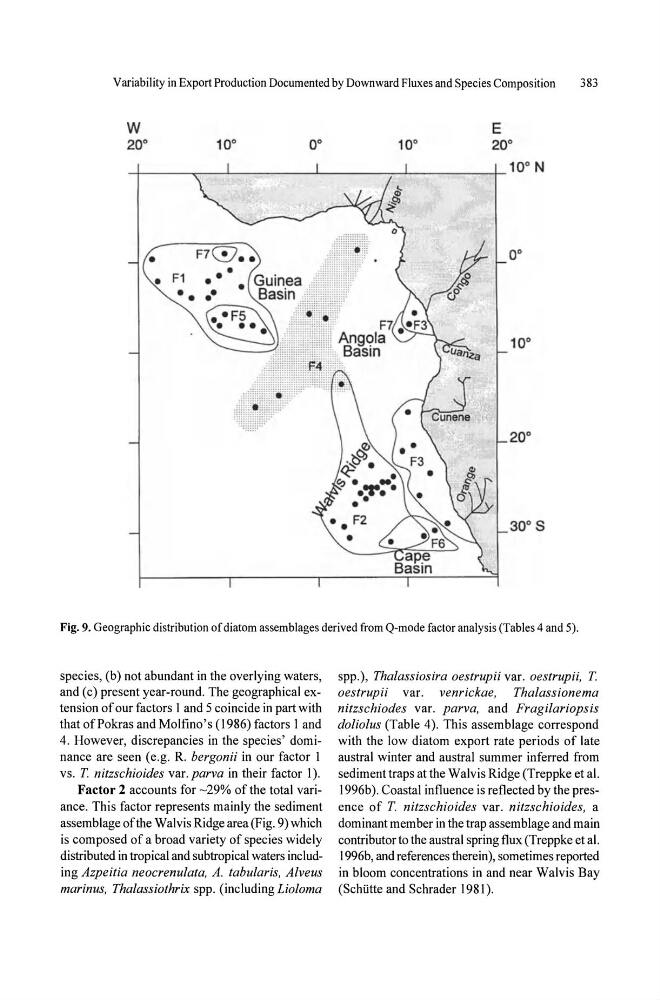
Fig. 9. Geographic distribution of diatom assemblages derived from Q-mode factor analysis (Tables 4 and 5).
species, (b) not abundant in the overlying waters,
and (c) present year-round. The geographical extension of our factors I and 5 coincide in part with
that ofPokras and Molfino's (1986) factors 1 and
4. However, discrepancies in the species' dominance are seen (e.g. R. bergonii in our factor I
vs. T nitzschioides vaT. parva in their factor 1).
Factor 2 accounts for -29% of the total variance. This factor represents mainly the sediment
assemblage of the Walvis Ridge area (Fig. 9) which
is composed of a broad variety of species widely
distributed in tropical and subtropical waters including Azpeitia neocrenulata, A. tabularis, Alveus
marin us, Thalassiothrix spp. (i ncluding Lioloma
spp.), Thalassiosira oestrupii vaT. oestrupii, T.
oestrupii vaT. venrickae, Thalassionema
nitzschiodes var. parva, and Fragilariopsis
doliolus (Table 4). This assemblage correspond
with the low diatom export rate periods of late
austral winter and austral summer inferred from
sediment traps at the Walvis Ridge (Treppke et al.
1996b). Coastal influence is reflected by the presence of T. nitzschioides vaT. nitzschioides, a
dominant member in the trap assemblage and main
contributor to the austral spring flux (Treppke et al.
I 996b, and references therein), sometimes reported
in bloom concentrations in and near Walvis Bay
(SchUtte and Schrader 1981).
383
E
20 0
~ ____ ~~ ________ ~ ____ ~~ ____ ~~1 00N
Fig. 9. Geographic distribution of diatom assemblages derived from Q-mode factor analysis (Tables 4 and 5).
species, (b) not abundant in the overlying waters,
and (c) present year-round. The geographical extension of our factors I and 5 coincide in part with
that ofPokras and Molfino's (1986) factors 1 and
4. However, discrepancies in the species' dominance are seen (e.g. R. bergonii in our factor I
vs. T nitzschioides vaT. parva in their factor 1).
Factor 2 accounts for -29% of the total variance. This factor represents mainly the sediment
assemblage of the Walvis Ridge area (Fig. 9) which
is composed of a broad variety of species widely
distributed in tropical and subtropical waters including Azpeitia neocrenulata, A. tabularis, Alveus
marin us, Thalassiothrix spp. (i ncluding Lioloma
spp.), Thalassiosira oestrupii vaT. oestrupii, T.
oestrupii vaT. venrickae, Thalassionema
nitzschiodes var. parva, and Fragilariopsis
doliolus (Table 4). This assemblage correspond
with the low diatom export rate periods of late
austral winter and austral summer inferred from
sediment traps at the Walvis Ridge (Treppke et al.
1996b). Coastal influence is reflected by the presence of T. nitzschioides vaT. nitzschioides, a
dominant member in the trap assemblage and main
contributor to the austral spring flux (Treppke et al.
I 996b, and references therein), sometimes reported
in bloom concentrations in and near Walvis Bay
(SchUtte and Schrader 1981).