

378
Romeroetal.
w
SO·
40'
Atlantic
CX:ean
30'
-S~mme~p;um;-------------E
30'
10'
TEA1
--------------EA3~~ -- - ----TEM ,
TWA7
TEAS,"
" "
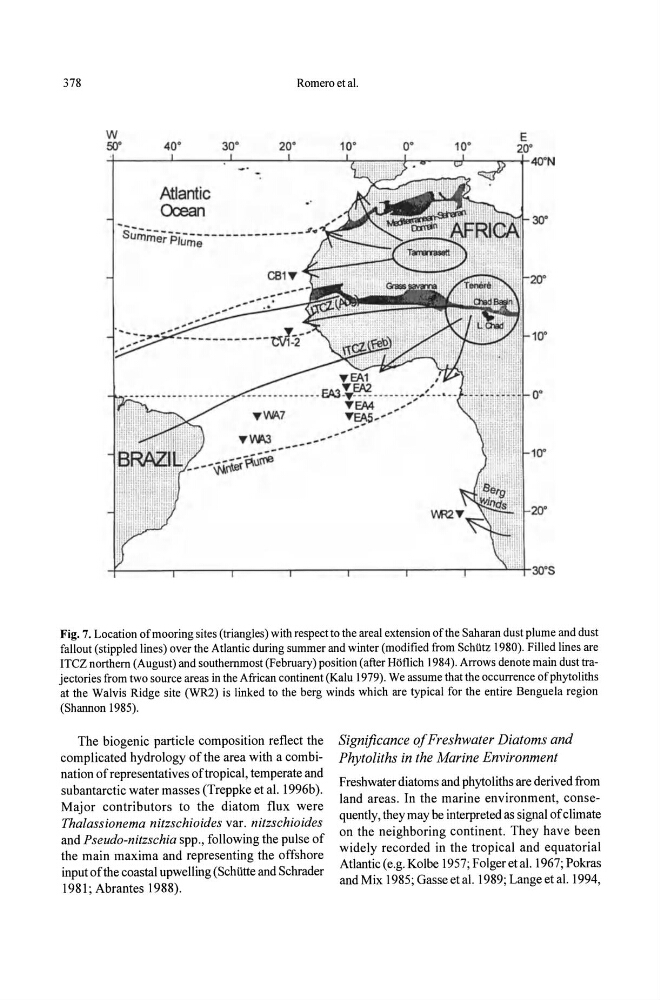
Fig. 7. Location of mooring sites (triangles) with respect to the areal extension of the Saharan dust plume and dust
fallout (stippled lines) over the Atlantic during summer and winter (modified from Schiitz 1980). Filled lines are
ITCZ northern (August) and southernmost (February) position (after Hoflich 1984). Arrows denote main dust trajectories from two source areas in the African continent (Kalu 1979). We assume thatthe occurrence ofphytoliths
at the Walvis Ridge site (WR2) is linked to the berg winds which are typical for the entire Benguela region
(Shannon 1985).
The biogenic particle composition reflect the
complicated hydrology of the area with a combination of representatives of tropical, temperate and
subantarctic water masses (Treppke et al. 1996b).
Major contributors to the diatom flux were
Thalassionema nitzschioides var. nitzschioides
and Pseudo-nitzschia spp., following the pulse of
the main maxima and representing the offshore
input of the coastal upwelling (Schiitte and Schrader
J 981; Abrantes 1988).
Significance of Freshwater Diatoms and
Phytoliths in the Marine Environment
Freshwater diatoms and phytoliths are derived from
land areas. In the marine environment, consequently, they may be interpreted as signal of climate
on the neighboring continent. They have been
widely recorded in the tropical and equatorial
Atlantic (e.g. Kolbe 1957; Folgeret al. 1967; Pokras
and Mix 1985; Gasse et al. 1989; Lange et al. 1994,
Romeroetal.
w
SO·
40'
Atlantic
CX:ean
30'
-S~mme~p;um;-------------E
30'
10'
TEA1
--------------EA3~~ -- - ----TEM ,
TWA7
TEAS,"
" "
Fig. 7. Location of mooring sites (triangles) with respect to the areal extension of the Saharan dust plume and dust
fallout (stippled lines) over the Atlantic during summer and winter (modified from Schiitz 1980). Filled lines are
ITCZ northern (August) and southernmost (February) position (after Hoflich 1984). Arrows denote main dust trajectories from two source areas in the African continent (Kalu 1979). We assume thatthe occurrence ofphytoliths
at the Walvis Ridge site (WR2) is linked to the berg winds which are typical for the entire Benguela region
(Shannon 1985).
The biogenic particle composition reflect the
complicated hydrology of the area with a combination of representatives of tropical, temperate and
subantarctic water masses (Treppke et al. 1996b).
Major contributors to the diatom flux were
Thalassionema nitzschioides var. nitzschioides
and Pseudo-nitzschia spp., following the pulse of
the main maxima and representing the offshore
input of the coastal upwelling (Schiitte and Schrader
J 981; Abrantes 1988).
Significance of Freshwater Diatoms and
Phytoliths in the Marine Environment
Freshwater diatoms and phytoliths are derived from
land areas. In the marine environment, consequently, they may be interpreted as signal of climate
on the neighboring continent. They have been
widely recorded in the tropical and equatorial
Atlantic (e.g. Kolbe 1957; Folgeret al. 1967; Pokras
and Mix 1985; Gasse et al. 1989; Lange et al. 1994,