

Biogenic Barium as a Proxy for Paleoproductivity
359
Sierra Leone Rise
0,50
18
~
.1 0,25
U
0
IMOIe ,.tal. (t983)
0,00
1000
GeoB 2910-1
E a.
~
E SOO
:::J
. ~
CD
0
1000
GeoB 2910-1
E a.
~
E SOO
:::J
. ~
CD
0
0
100
200
300
400
SOO
600
700
Age [ka)
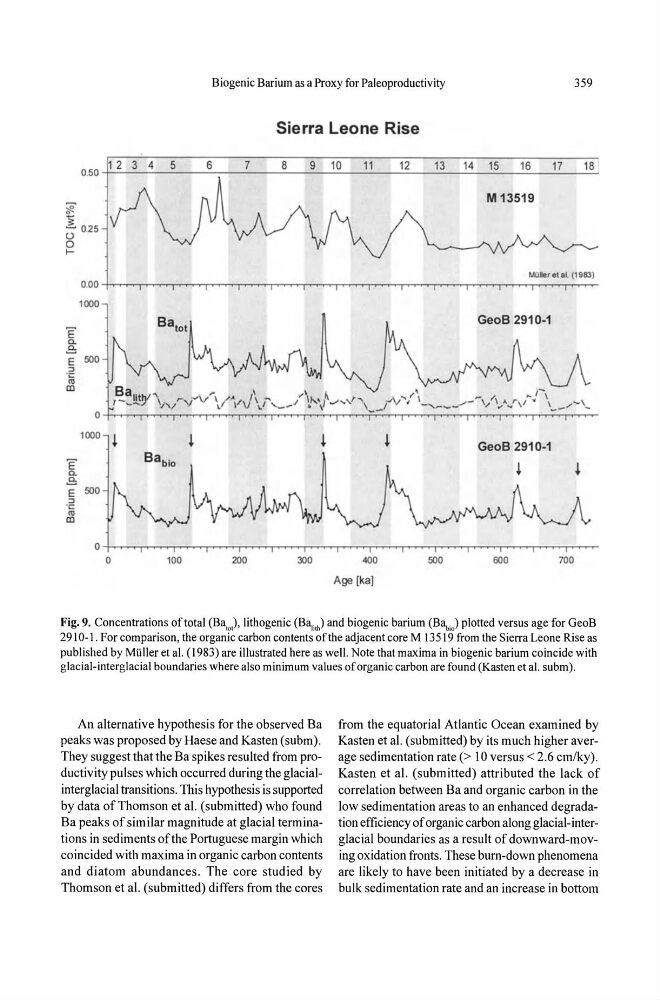
Fig. 9. Concentrations of total (Ba to ')' lithogenic (BaUd,) and biogenic barium (B~;) plotted versus age for GeoB
291 0-1. For comparison, the organic carbon contents of the adjacent core M 13519 from the Sierra Leone Rise as
published by Miiller et aL (1983) are illustrated here as well. Note that maxima in biogenic barium coincide with
glacial-interglacial boundaries where also minimum values of organic carbon are found (Kasten et al. subm),
An alternative hypothesis for the observed Ba
peaks was proposed by Haese and Kasten (subm).
They suggest that the Ba spikes resulted from productivity pulses which occurred during the glacialinterglacial transitions, This hypothesis is supported
by data of Thomson et al. (submitted) who found
Ba peaks of similar magnitude at glacial terminations in sediments of the Portuguese margin which
coincided with maxima in organic carbon contents
and diatom abundances , The core studied by
Thomson et al. (submitted) differs from the cores
from the equatorial Atlantic Ocean examined by
Kasten et al. (submitted) by its much higher average sedimentation rate (> 10 versus < 2.6 cm/ky).
Kasten et al. (submitted) attributed the lack of
correlation between Ba and organic carbon in the
low sedimentation areas to an enhanced degradation efficiency of organic carbon along glacial-interglacial boundaries as a result of downward-moving oxidation fronts. These burn-down phenomena
are likely to have been initiated by a decrease in
bulk sedimentation rate and an increase in bottom
359
Sierra Leone Rise
0,50
18
~
.1 0,25
U
0
IMOIe ,.tal. (t983)
0,00
1000
GeoB 2910-1
E a.
~
E SOO
:::J
. ~
CD
0
1000
GeoB 2910-1
E a.
~
E SOO
:::J
. ~
CD
0
0
100
200
300
400
SOO
600
700
Age [ka)
Fig. 9. Concentrations of total (Ba to ')' lithogenic (BaUd,) and biogenic barium (B~;) plotted versus age for GeoB
291 0-1. For comparison, the organic carbon contents of the adjacent core M 13519 from the Sierra Leone Rise as
published by Miiller et aL (1983) are illustrated here as well. Note that maxima in biogenic barium coincide with
glacial-interglacial boundaries where also minimum values of organic carbon are found (Kasten et al. subm),
An alternative hypothesis for the observed Ba
peaks was proposed by Haese and Kasten (subm).
They suggest that the Ba spikes resulted from productivity pulses which occurred during the glacialinterglacial transitions, This hypothesis is supported
by data of Thomson et al. (submitted) who found
Ba peaks of similar magnitude at glacial terminations in sediments of the Portuguese margin which
coincided with maxima in organic carbon contents
and diatom abundances , The core studied by
Thomson et al. (submitted) differs from the cores
from the equatorial Atlantic Ocean examined by
Kasten et al. (submitted) by its much higher average sedimentation rate (> 10 versus < 2.6 cm/ky).
Kasten et al. (submitted) attributed the lack of
correlation between Ba and organic carbon in the
low sedimentation areas to an enhanced degradation efficiency of organic carbon along glacial-interglacial boundaries as a result of downward-moving oxidation fronts. These burn-down phenomena
are likely to have been initiated by a decrease in
bulk sedimentation rate and an increase in bottom