

360
Gingele et al.
water oxygen content during the transition from
glacial to interglacial conditions. Moving downward
into the previously suboxic sediments, the oxidation
fronts led to an oxidation of the degradable organic
carbon -leaving the solid phase distribution ofBa
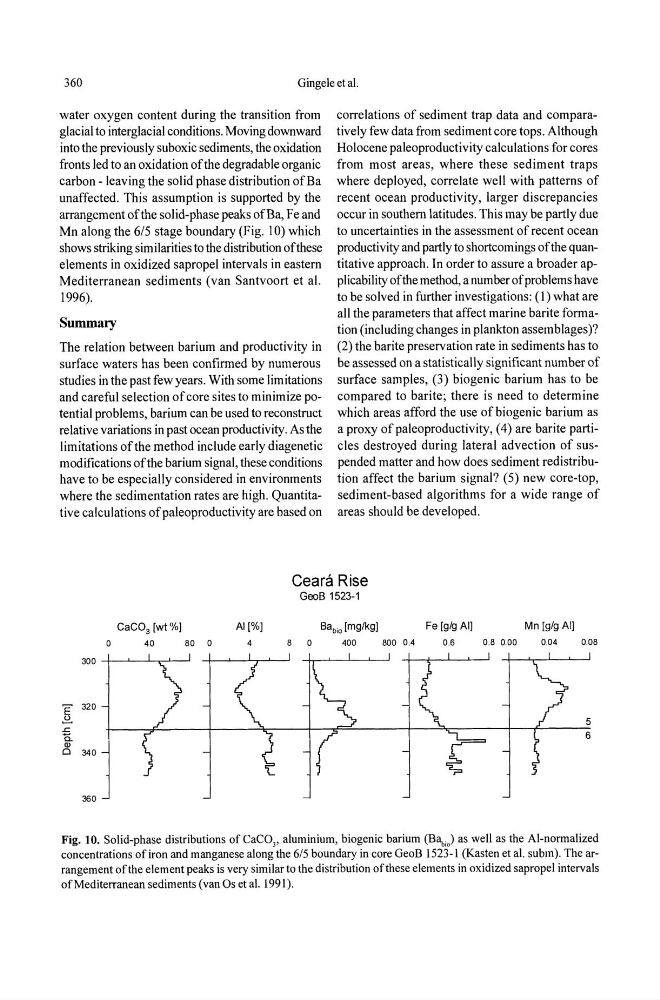
unaffected. This assumption is supported by the
arrangcment ofthe solid-phase peaks ofBa, Fe and
Mn along the 6/5 stage boundary (Fig. 10) which
shows striking similarities to the distribution of these
elements in oxidized sapropel intervals in eastern
Mediterranean sediments (van Santvoort et al.
1996).
Summary
The relation between barium and productivity in
surface waters has been confirmed by numerous
studies in the past few years. With some limitations
and careful selection of core sites to minimize potential problems, barium can be used to reconstruct
relative variations in past ocean productivity. As the
limitations of the method include early diagenetic
modifications of the barium signal, these conditions
have to be especially considered in environments
where the sedimentation rates are high. Quantitative calculations of paleoproductivity are based on
correlations of sediment trap data and comparatively few data from sediment core tops. Although
Holocene paleoproductivity calculations for cores
from most areas, where these sediment traps
where deployed, correlate well with patterns of
recent ocean productivity, larger discrepancies
occur in southern latitudes. This may be partly due
to uncertainties in the assessment of recent ocean
productivity and partly to shortcomings of the quantitative approach. In order to assure a broader applicability ofthe method, a number of problems have
to be solved in further investigations: (I) what are
all the parameters that affect marine barite formation (including changes in plankton assemblages)?
(2) the barite preservation rate in sediments has to
be assessed on a statistically significant number of
surface samples, (3) biogenic barium has to be
compared to barite; there is need to determine
which areas afford the use of biogenic barium as
a proxy of paleoproductivity, (4) are barite particles destroyed during lateral advection of suspended matter and how does sediment redistribution affect the barium signal? (5) new core-top,
sediment-based algorithms for a wide range of
areas should be developed.
Ceara Rise
GeeS 1523-1
CaC0 3 [wt%)
40
80
0
300 +----'--'----,~---'
E 320
~
.r::
a.
Q)
o 340
360
AI[%)
4
Ba bia [mg/kg)
o
400
800 0.4
Fe [gig AI)
0.6
0.8 0.00
Mn [gig AI)
004
0.08
Fig. 10. Solid-phase distributions of CaCO J , aluminium, biogenic barium (Ba"i) as well as the AI-normalized
concentrations of iron and manganese along the 6/5 boundary in core GeoB 1523-1 (Kasten et al. subm). The arrangement of the element peaks is very similar to the distribution ofthese elements in oxidized sapropel intervals
of Mediterranean sediments (van Os et al. 1991).
Gingele et al.
water oxygen content during the transition from
glacial to interglacial conditions. Moving downward
into the previously suboxic sediments, the oxidation
fronts led to an oxidation of the degradable organic
carbon -leaving the solid phase distribution ofBa
unaffected. This assumption is supported by the
arrangcment ofthe solid-phase peaks ofBa, Fe and
Mn along the 6/5 stage boundary (Fig. 10) which
shows striking similarities to the distribution of these
elements in oxidized sapropel intervals in eastern
Mediterranean sediments (van Santvoort et al.
1996).
Summary
The relation between barium and productivity in
surface waters has been confirmed by numerous
studies in the past few years. With some limitations
and careful selection of core sites to minimize potential problems, barium can be used to reconstruct
relative variations in past ocean productivity. As the
limitations of the method include early diagenetic
modifications of the barium signal, these conditions
have to be especially considered in environments
where the sedimentation rates are high. Quantitative calculations of paleoproductivity are based on
correlations of sediment trap data and comparatively few data from sediment core tops. Although
Holocene paleoproductivity calculations for cores
from most areas, where these sediment traps
where deployed, correlate well with patterns of
recent ocean productivity, larger discrepancies
occur in southern latitudes. This may be partly due
to uncertainties in the assessment of recent ocean
productivity and partly to shortcomings of the quantitative approach. In order to assure a broader applicability ofthe method, a number of problems have
to be solved in further investigations: (I) what are
all the parameters that affect marine barite formation (including changes in plankton assemblages)?
(2) the barite preservation rate in sediments has to
be assessed on a statistically significant number of
surface samples, (3) biogenic barium has to be
compared to barite; there is need to determine
which areas afford the use of biogenic barium as
a proxy of paleoproductivity, (4) are barite particles destroyed during lateral advection of suspended matter and how does sediment redistribution affect the barium signal? (5) new core-top,
sediment-based algorithms for a wide range of
areas should be developed.
Ceara Rise
GeeS 1523-1
CaC0 3 [wt%)
40
80
0
300 +----'--'----,~---'
E 320
~
.r::
a.
Q)
o 340
360
AI[%)
4
Ba bia [mg/kg)
o
400
800 0.4
Fe [gig AI)
0.6
0.8 0.00
Mn [gig AI)
004
0.08
Fig. 10. Solid-phase distributions of CaCO J , aluminium, biogenic barium (Ba"i) as well as the AI-normalized
concentrations of iron and manganese along the 6/5 boundary in core GeoB 1523-1 (Kasten et al. subm). The arrangement of the element peaks is very similar to the distribution ofthese elements in oxidized sapropel intervals
of Mediterranean sediments (van Os et al. 1991).