

358
Gingele et al.
for recent surface productivity in that area does not
allow an evaluation of either method.
Ba Spikes at Glacial Terminations
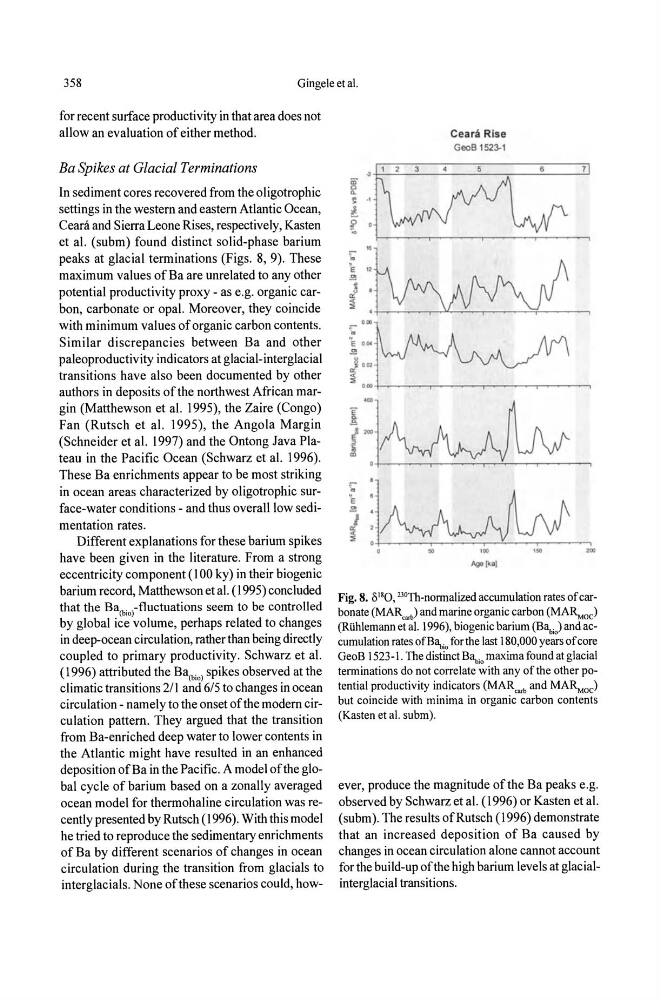
In sediment cores recovered from the oligotrophic
settings in the western and eastern Atlantic Ocean,
Ceara and Sierra Leone Rises, respectively, Kasten
et al. (subm) found distinct solid-phase barium
peaks at glacial terminations (Figs. 8, 9). These
maximum values of Ba are unrelated to any other
potential productivity proxy - as e.g. organic carbon, carbonate or opal. Moreover, they coincide
with minimum values of organic carbon contents.
Similar discrepancies between Ba and other
paleoproductivity indicators at glacial-interglacial
transitions have also been documented by other
authors in deposits ofthe northwest African margin (Matthewson et al. 1995), the Zaire (Congo)
Fan (Rutsch et al. 1995), the Angola Margin
(Schneider et al. 1997) and the Ontong Java Plateau in the Pacific Ocean (Schwarz et al. 1996).
These Ba enrichments appear to be most striking
in ocean areas characterized by oligotrophic surface-water conditions - and thus overall low sedimentation rates.
Different explanations for these barium spikes
have been given in the literature. From a strong
eccentricity component (100 ky) in their biogenic
barium record, Matthewson et al. (1995) concluded
that the Ba(b;O)-fluctuations seem to be controlled
by global ice volume, perhaps related to changes
in deep-ocean circulation, rather than being directly
coupled to primary productivity. Schwarz et al.
(1996) attributed the Ba(b;O) spikes observed at the
climatic transitions 2/1 and 6/5 to changes in ocean
circulation - namely to the onset ofthe modern circulation pattern. They argued that the transition
from Ba-enriched deep water to lower contents in
the Atlantic might have resulted in an enhanced
deposition ofBa in the Pacific. A model ofthe global cycle of barium based on a zonally averaged
ocean model for thermohaline circulation was recently presented by Rutsch (\ 996). With this model
he tried to reproduce the sedimentary enrichments
of Ba by different scenarios of changes in ocean
circulation during the transition from glacials to
interglacials. None of these scenarios could, howCeara Rise
GeoB 1523-1
r~ "
~~b;t0/
-.
~ 006
~o.,
- ... ~
~ o~+------'-------r----________ -.
i ~l
. .
jj
. E
.5!
I
~
.
,..,
Fig. 8. 0"0, 230Th-nonnalized accumulation rates of carbonate (MAR",") and marine organic carbon (MA~oc)
(Riihlemann et al. 1996), biogenic barium (Ba b ;) and accumulation rates ofB~;o for the last 180,000 years of core
GeoB 1523-1. The distinct Bab;o maxima found at glacial
tenninations do not correlate with any of the other potential productivity indicators (MAR"'b and MA~oc)
but coincide with minima in organic carbon contents
(Kasten et al. subm).
ever, produce the magnitude of the Ba peaks e.g.
observed by Schwarz et al. (\ 996) or Kasten et al.
(subm). The results ofRutsch (\ 996) demonstrate
that an increased deposition of Ba caused by
changes in ocean circulation alone cannot account
for the build-up ofthe high barium levels at glacialinterglacial transitions.
Gingele et al.
for recent surface productivity in that area does not
allow an evaluation of either method.
Ba Spikes at Glacial Terminations
In sediment cores recovered from the oligotrophic
settings in the western and eastern Atlantic Ocean,
Ceara and Sierra Leone Rises, respectively, Kasten
et al. (subm) found distinct solid-phase barium
peaks at glacial terminations (Figs. 8, 9). These
maximum values of Ba are unrelated to any other
potential productivity proxy - as e.g. organic carbon, carbonate or opal. Moreover, they coincide
with minimum values of organic carbon contents.
Similar discrepancies between Ba and other
paleoproductivity indicators at glacial-interglacial
transitions have also been documented by other
authors in deposits ofthe northwest African margin (Matthewson et al. 1995), the Zaire (Congo)
Fan (Rutsch et al. 1995), the Angola Margin
(Schneider et al. 1997) and the Ontong Java Plateau in the Pacific Ocean (Schwarz et al. 1996).
These Ba enrichments appear to be most striking
in ocean areas characterized by oligotrophic surface-water conditions - and thus overall low sedimentation rates.
Different explanations for these barium spikes
have been given in the literature. From a strong
eccentricity component (100 ky) in their biogenic
barium record, Matthewson et al. (1995) concluded
that the Ba(b;O)-fluctuations seem to be controlled
by global ice volume, perhaps related to changes
in deep-ocean circulation, rather than being directly
coupled to primary productivity. Schwarz et al.
(1996) attributed the Ba(b;O) spikes observed at the
climatic transitions 2/1 and 6/5 to changes in ocean
circulation - namely to the onset ofthe modern circulation pattern. They argued that the transition
from Ba-enriched deep water to lower contents in
the Atlantic might have resulted in an enhanced
deposition ofBa in the Pacific. A model ofthe global cycle of barium based on a zonally averaged
ocean model for thermohaline circulation was recently presented by Rutsch (\ 996). With this model
he tried to reproduce the sedimentary enrichments
of Ba by different scenarios of changes in ocean
circulation during the transition from glacials to
interglacials. None of these scenarios could, howCeara Rise
GeoB 1523-1
r~ "
~~b;t0/
-.
~ 006
~o.,
- ... ~
~ o~+------'-------r----________ -.
i ~l
. .
jj
. E
.5!
I
~
.
,..,
Fig. 8. 0"0, 230Th-nonnalized accumulation rates of carbonate (MAR",") and marine organic carbon (MA~oc)
(Riihlemann et al. 1996), biogenic barium (Ba b ;) and accumulation rates ofB~;o for the last 180,000 years of core
GeoB 1523-1. The distinct Bab;o maxima found at glacial
tenninations do not correlate with any of the other potential productivity indicators (MAR"'b and MA~oc)
but coincide with minima in organic carbon contents
(Kasten et al. subm).
ever, produce the magnitude of the Ba peaks e.g.
observed by Schwarz et al. (\ 996) or Kasten et al.
(subm). The results ofRutsch (\ 996) demonstrate
that an increased deposition of Ba caused by
changes in ocean circulation alone cannot account
for the build-up ofthe high barium levels at glacialinterglacial transitions.