

Biogenic Barium as a Proxy for Paleoproductivity
349
Station
Latitude
Lougitude
water depth TOClBa(bio)
refractory
org.carbon
GeoB 1008
06°35.6'S
10019.1'E
GeoB 1023
17°09.7"S
11"00.6'E
GeoB 1035
21°34.7'S
05°01.4'E
GeoB 1041
03°28.2'S
07°35.5'W
GeoB 1117
03°48.5'S
W43.2'W
GeoB 1013
11°47.9'S
13°26.8'E
GeoB 1014
11°47.2'S
13°18.3'E
GeoB 1016
11 °35.2'S
11°41.8'E
GeoB 1028
20 0 06.6'S
09°11.1'E
GeoB 1030
21°04.6'S
07°46.7'E
GeoB 1218
25°10.1'S
05°55.1'E
GeoB 1214
24°41.4'S
07°14.5'E
GeoB 1710
23°25.8'S
11°42.2'E
GeoB 1514
05°08.4'N
46°34.6'W
GeoB 1523
03°49.9'N
41°37.3'W
GeoB 2110
28°38.9'S
45°31.2'W
(m)
3115
2047
4453
4034
3984
249
700
3410
2215
1326
1023
3220
2987
3509
3292
3008
37.83
114.19
3.04
13.78
10.82
118.52
137.23
12.77
17.18
21.16
7.43
1.2
5.06
llO.81
32.67
46.27
x
x
x
x
x
xx
x
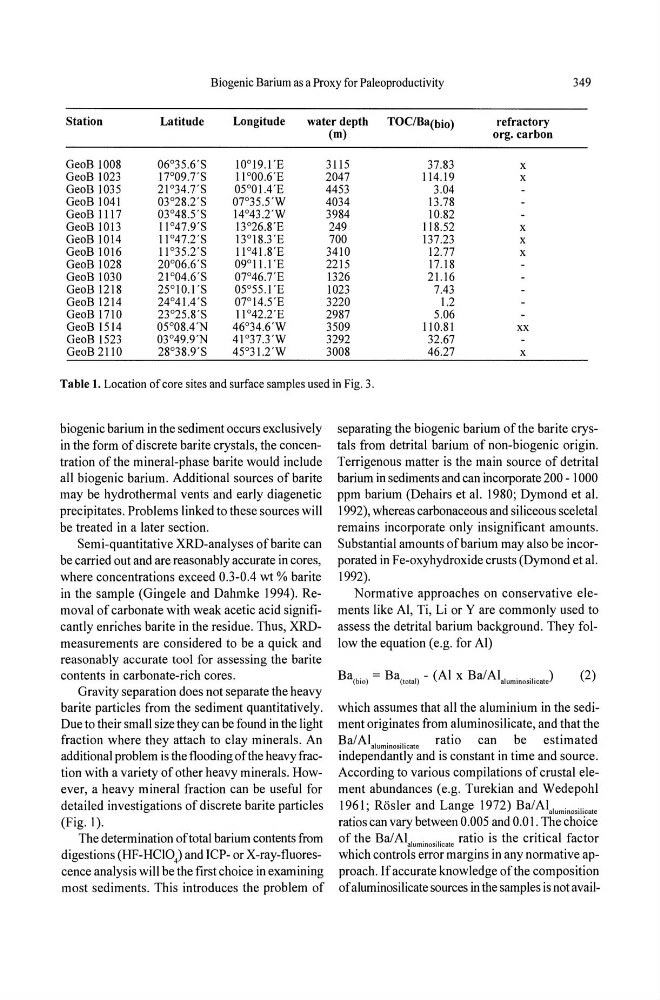
Table 1. Location of core sites and surface samples used in Fig. 3.
biogenic barium in the sediment occurs exclusively
in the form of discrete barite crystals, the concentration of the mineral-phase barite would include
all biogenic barium. Additional sources of barite
may be hydrothermal vents and early diagenetic
precipitates. Problems linked to these sources will
be treated in a later section.
Semi-quantitative XRD-analyses of barite can
be carried out and are reasonably accurate in cores,
where concentrations exceed 0.3-0.4 wt % barite
in the sample (Gingele and Dahmke 1994). Removal of carbonate with weak acetic acid significantly enriches barite in the residue. Thus, XRDmeasurements are considered to be a quick and
reasonably accurate tool for assessing the barite
contents in carbonate-rich cores.
Gravity separation does not separate the heavy
barite particles from the sediment quantitatively.
Due to their small size they can be found in the light
fraction where they attach to clay minerals. An
additional problem is the flooding of the heavy fraction with a variety of other heavy minerals. However, a heavy mineral fraction can be useful for
detailed investigations of discrete barite particles
(Fig. I).
The determination oftotal barium contents from
digestions (HF-HCI0 4 ) and ICP- or X-ray-fluorescence analysis will be the first choice in examining
most sediments. This introduces the problem of
separating the biogenic barium ofthe barite crystals from detrital barium of non-biogenic origin.
Terrigenous matter is the main source of detrital
barium in sediments and can incorporate 200 - 1000
ppm barium (Dehairs et al. 1980; Dymond et al.
1992), whereas carbonaceous and siliceous sceletal
remains incorporate only insignificant amounts.
Substantial amounts of barium may also be incorporated in Fe-oxyhydroxide crusts (Dymond et al.
1992).
Normative approaches on conservative elements like AI, Ti, Li or Yare commonly used to
assess the detrital barium background. They follow the equation (e.g. for AI)
which assumes that all the aluminium in the sediment originates from aluminosilicate, and that the
BaJ Alaluminosilicate ratio can be estimated
independantly and is constant in time and source.
According to various compilations of crustal element abundances (e.g. Turekian and Wedepohl
1961; Rosier and Lange 1972) BaJ Alaluminosilica,.
ratios can vary between 0.005 and 0.0 1. The choice
of the BaJ Alaluminosnioa,. ratio is the critical factor
which controls error margins in any normative approach. If accurate knowledge of the composition
of aluminosilicate sources in the samples is not avail-
349
Station
Latitude
Lougitude
water depth TOClBa(bio)
refractory
org.carbon
GeoB 1008
06°35.6'S
10019.1'E
GeoB 1023
17°09.7"S
11"00.6'E
GeoB 1035
21°34.7'S
05°01.4'E
GeoB 1041
03°28.2'S
07°35.5'W
GeoB 1117
03°48.5'S
W43.2'W
GeoB 1013
11°47.9'S
13°26.8'E
GeoB 1014
11°47.2'S
13°18.3'E
GeoB 1016
11 °35.2'S
11°41.8'E
GeoB 1028
20 0 06.6'S
09°11.1'E
GeoB 1030
21°04.6'S
07°46.7'E
GeoB 1218
25°10.1'S
05°55.1'E
GeoB 1214
24°41.4'S
07°14.5'E
GeoB 1710
23°25.8'S
11°42.2'E
GeoB 1514
05°08.4'N
46°34.6'W
GeoB 1523
03°49.9'N
41°37.3'W
GeoB 2110
28°38.9'S
45°31.2'W
(m)
3115
2047
4453
4034
3984
249
700
3410
2215
1326
1023
3220
2987
3509
3292
3008
37.83
114.19
3.04
13.78
10.82
118.52
137.23
12.77
17.18
21.16
7.43
1.2
5.06
llO.81
32.67
46.27
x
x
x
x
x
xx
x
Table 1. Location of core sites and surface samples used in Fig. 3.
biogenic barium in the sediment occurs exclusively
in the form of discrete barite crystals, the concentration of the mineral-phase barite would include
all biogenic barium. Additional sources of barite
may be hydrothermal vents and early diagenetic
precipitates. Problems linked to these sources will
be treated in a later section.
Semi-quantitative XRD-analyses of barite can
be carried out and are reasonably accurate in cores,
where concentrations exceed 0.3-0.4 wt % barite
in the sample (Gingele and Dahmke 1994). Removal of carbonate with weak acetic acid significantly enriches barite in the residue. Thus, XRDmeasurements are considered to be a quick and
reasonably accurate tool for assessing the barite
contents in carbonate-rich cores.
Gravity separation does not separate the heavy
barite particles from the sediment quantitatively.
Due to their small size they can be found in the light
fraction where they attach to clay minerals. An
additional problem is the flooding of the heavy fraction with a variety of other heavy minerals. However, a heavy mineral fraction can be useful for
detailed investigations of discrete barite particles
(Fig. I).
The determination oftotal barium contents from
digestions (HF-HCI0 4 ) and ICP- or X-ray-fluorescence analysis will be the first choice in examining
most sediments. This introduces the problem of
separating the biogenic barium ofthe barite crystals from detrital barium of non-biogenic origin.
Terrigenous matter is the main source of detrital
barium in sediments and can incorporate 200 - 1000
ppm barium (Dehairs et al. 1980; Dymond et al.
1992), whereas carbonaceous and siliceous sceletal
remains incorporate only insignificant amounts.
Substantial amounts of barium may also be incorporated in Fe-oxyhydroxide crusts (Dymond et al.
1992).
Normative approaches on conservative elements like AI, Ti, Li or Yare commonly used to
assess the detrital barium background. They follow the equation (e.g. for AI)
which assumes that all the aluminium in the sediment originates from aluminosilicate, and that the
BaJ Alaluminosilicate ratio can be estimated
independantly and is constant in time and source.
According to various compilations of crustal element abundances (e.g. Turekian and Wedepohl
1961; Rosier and Lange 1972) BaJ Alaluminosilica,.
ratios can vary between 0.005 and 0.0 1. The choice
of the BaJ Alaluminosnioa,. ratio is the critical factor
which controls error margins in any normative approach. If accurate knowledge of the composition
of aluminosilicate sources in the samples is not avail-