

Organic Carbon and Carbonate as Paleoproductivity Proxies
331
The most crucial point upon estimating paleoproductivity from flux proxies in general is the determination of the sedimentation rate. Several studies have shown that linearly interpolated sedimentation rates may introduce serious errors in the determination of accumulation rates (e.g. Lyle 1988;
Verardo and McIntyre 1994). These errors may
drastically influence the paleoceanographic interpretation. We therefore estimated sedimentation
rates for the last 180 ka in core GeoB 1523-1 by
normalizing to excess 230Th ex activity (Rtihlemann
et al. 1996; Frank et al. this volume). This method
allows a point-by-point estimation of sedimentation
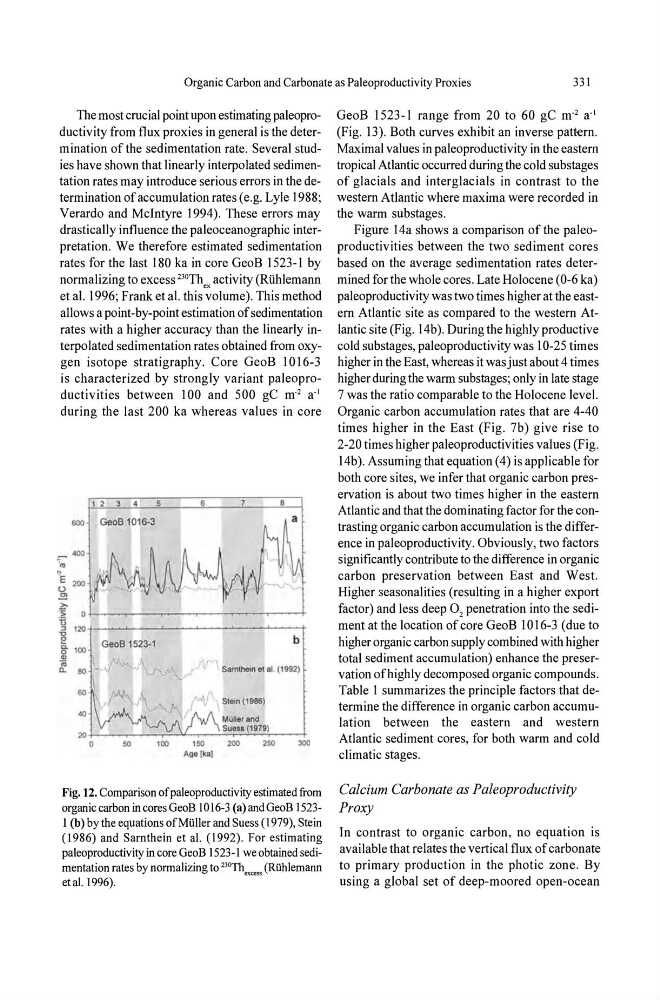
rates with a higher accuracy than the linearly interpolated sedimentation rates obtained from oxygen isotope stratigraphy . Core GeoB 1016-3
is characterized by strongly variant paleo productivities between 100 and 500 gC m· 2 a· 1
during the last 200 ka whereas values in core
1 2 3
4
5
8
600
_ 400
"to
~E
200
()
2!
. ~
0
. ~
1:1
:> 120
"8
GeoB 1523· 1
b
g. 100
S1
l.t._.~ .•
'"
-: .; Sam'hein", a l. (1 992)
a.
S1ein (1 986)
40
MOller and
20
5.0 .. (1979)
50
100
150
200
250
300
Age [ka)
Fig. 12. Comparison of paleoproductivity estimated from
organic carbon in cores GeoB 1016-3 (a) and GeoB 1523I (b) by the equations of MUller and Suess (1979), Stein
(1986) and Sarnthein et al. (1992). For estimating
paleoproductivity in core GeoB 1523-1 we obtained sedimentation rates by normalizing to 210Th ex "", (RUh lemann
eta\. 1996).
GeoB 1523-1 range from 20 to 60 gC m· 2 a·'
(Fig. 13). Both curves exhibit an inverse pattern.
Maximal values in paleoproductivity in the eastern
tropical Atlantic occurred during the cold substages
of glacials and interglacials in contrast to the
western Atlantic where maxima were recorded in
the warm substages.
Figure 14a shows a comparison of the paleoproductivities between the two sediment cores
based on the average sedimentation rates determined for the whole cores. Late Holocene (0-6 ka)
paleoproductivity was two times higher at the eastern Atlantic site as compared to the western Atlantic site (Fig. 14b). During the highly productive
cold substages, paleoproductivity was 10-25 times
higher in the East, whereas it was just about 4 times
higher during the warm substages; only in late stage
7 was the ratio comparable to the Holocene level.
Organic carbon accumulation rates that are 4-40
times higher in the East (Fig. 7b) give rise to
2-20 times higher paleoproductivities values (Fig.
14b). Assuming that equation (4) is applicable for
both core sites, we infer that organic carbon preservation is about two times higher in the eastern
Atlantic and that the dominating factor for the contrasting organic carbon accumulation is the difference in paleoproductivity. Obviously, two factors
significantly contribute to the difference in organic
carbon preservation between East and West.
Higher seasonalities (resulting in a higher export
factor) and less deep 02 penetration into the sediment at the location of core GeoB 1016-3 (due to
higher organic carbon supply combined with higher
total sediment accumulation) enhance the preservation of highly decomposed organic compounds.
Table I summarizes the principle factors that determine the difference in organic carbon accumulation between the eastern and western
Atlantic sediment cores, for both warm and cold
climatic stages.
Calcium Carbonate as Paleoproductivity
Proxy
In contrast to organic carbon, no equation is
available that relates the vertical flux of carbonate
to primary production in the photic zone. By
using a global set of deep-moored open-ocean
331
The most crucial point upon estimating paleoproductivity from flux proxies in general is the determination of the sedimentation rate. Several studies have shown that linearly interpolated sedimentation rates may introduce serious errors in the determination of accumulation rates (e.g. Lyle 1988;
Verardo and McIntyre 1994). These errors may
drastically influence the paleoceanographic interpretation. We therefore estimated sedimentation
rates for the last 180 ka in core GeoB 1523-1 by
normalizing to excess 230Th ex activity (Rtihlemann
et al. 1996; Frank et al. this volume). This method
allows a point-by-point estimation of sedimentation
rates with a higher accuracy than the linearly interpolated sedimentation rates obtained from oxygen isotope stratigraphy . Core GeoB 1016-3
is characterized by strongly variant paleo productivities between 100 and 500 gC m· 2 a· 1
during the last 200 ka whereas values in core
1 2 3
4
5
8
600
_ 400
"to
~E
200
()
2!
. ~
0
. ~
1:1
:> 120
"8
GeoB 1523· 1
b
g. 100
S1
l.t._.~ .•
'"
-: .; Sam'hein", a l. (1 992)
a.
S1ein (1 986)
40
MOller and
20
5.0 .. (1979)
50
100
150
200
250
300
Age [ka)
Fig. 12. Comparison of paleoproductivity estimated from
organic carbon in cores GeoB 1016-3 (a) and GeoB 1523I (b) by the equations of MUller and Suess (1979), Stein
(1986) and Sarnthein et al. (1992). For estimating
paleoproductivity in core GeoB 1523-1 we obtained sedimentation rates by normalizing to 210Th ex "", (RUh lemann
eta\. 1996).
GeoB 1523-1 range from 20 to 60 gC m· 2 a·'
(Fig. 13). Both curves exhibit an inverse pattern.
Maximal values in paleoproductivity in the eastern
tropical Atlantic occurred during the cold substages
of glacials and interglacials in contrast to the
western Atlantic where maxima were recorded in
the warm substages.
Figure 14a shows a comparison of the paleoproductivities between the two sediment cores
based on the average sedimentation rates determined for the whole cores. Late Holocene (0-6 ka)
paleoproductivity was two times higher at the eastern Atlantic site as compared to the western Atlantic site (Fig. 14b). During the highly productive
cold substages, paleoproductivity was 10-25 times
higher in the East, whereas it was just about 4 times
higher during the warm substages; only in late stage
7 was the ratio comparable to the Holocene level.
Organic carbon accumulation rates that are 4-40
times higher in the East (Fig. 7b) give rise to
2-20 times higher paleoproductivities values (Fig.
14b). Assuming that equation (4) is applicable for
both core sites, we infer that organic carbon preservation is about two times higher in the eastern
Atlantic and that the dominating factor for the contrasting organic carbon accumulation is the difference in paleoproductivity. Obviously, two factors
significantly contribute to the difference in organic
carbon preservation between East and West.
Higher seasonalities (resulting in a higher export
factor) and less deep 02 penetration into the sediment at the location of core GeoB 1016-3 (due to
higher organic carbon supply combined with higher
total sediment accumulation) enhance the preservation of highly decomposed organic compounds.
Table I summarizes the principle factors that determine the difference in organic carbon accumulation between the eastern and western
Atlantic sediment cores, for both warm and cold
climatic stages.
Calcium Carbonate as Paleoproductivity
Proxy
In contrast to organic carbon, no equation is
available that relates the vertical flux of carbonate
to primary production in the photic zone. By
using a global set of deep-moored open-ocean