

332
Ruhlemann et al.
2:
~
'"
' .,.
"E
0
£!
'" ..;,
§
aJ
0
.,
(!)
a. .,.
a.
·2
·1
0
2
500
400
300
200
100
0
0
50
100
Age IkaJ
150
sediment traps, however, Brummer and van Eijden
(1992), and van Kreveld et a!. (1996) showed
that a high positive correlation between modern
carbonate and organic carbon fluxes existed in
the relatively oligotrophic water masses of the
pelagic environment (Fig. 15). Thus, Brummer
and van Eijden (1992) proposed to estimate
paleoproductivity in oligotrophic open-ocean areas
on the basis of calcium carbonate accumulation.
Because carbonate accumulation rates in ancient sediments - deposited well above the calcite
lysocline - reflect paleo-carbonate fluxes through
the water column, Brummer and van Eijden (1992)
suggested to estimate the paleo-organic carbon flux
on the basis of carbonate accumulation by applying the modern carbonate-to-organic carbon flux
ratio reported from the sediment traps (Fig. 16). Van
Kreveld et al . (1996) recalculated and extended the
data set of Brummer and van Eijden (1992) and
devised equation (8) to convert the carbonate accumulation to paleo-organic carbon fluxes
[mg m" day" ]:
PF CO ," = MARc",b . 0.043 + 0.353
(8)
where MARc" b [mg m" day" ] is the carbonate
accumulation rate above the lysocline calculated
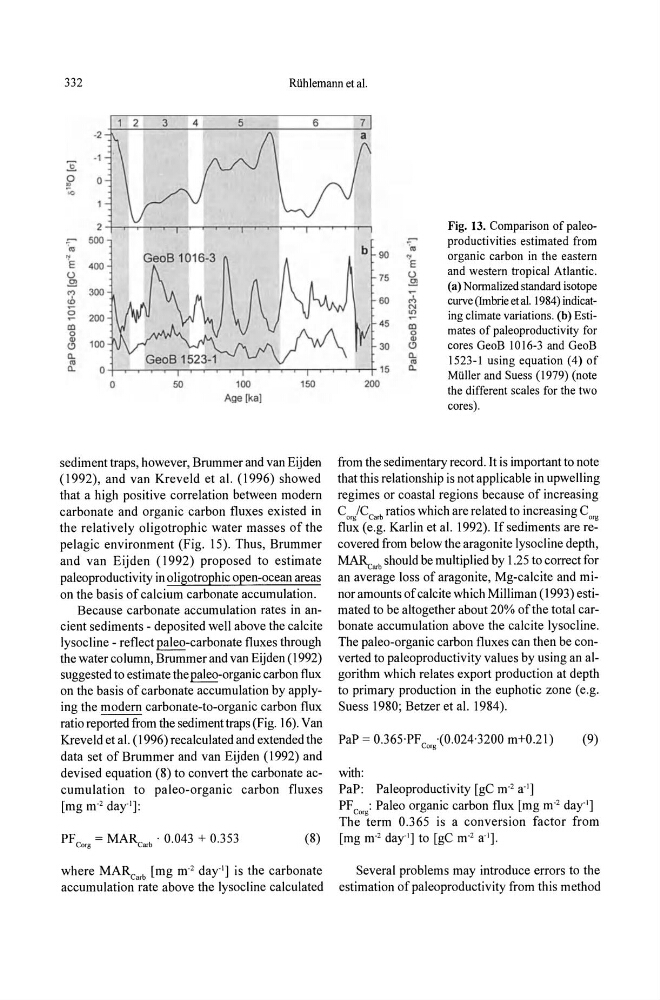
Fig. 13. Comparison of paleob
' .,.
productivities estimated from
90
"
organic carbon in the eastern
E
75
0
and western tropical Atlantic.
£!
(a) Normalized standard isotope
60
r?
N
curve (Jmbrie et al. 1984)indicatIf)
ing climate variations. (b) Esti45
aJ
mates of paleoproductivity for
0
Q)
30
(!)
cores GeoB 1016-3 and GeoB
a.
1523-1 using equation (4) of
. .
a.
Muller and Suess (1979) (note
the different scales for the two
cores).
from the sedimentary record. It is important to note
that this relationship is not applicable in upwelling
regimes or coastal regions because of increasing
C m/Cc",b ratios which are related to increasing CO ,"
flux (e.g. Karlin et a!. 1992). If sediments are recovered from below the aragonite lysocline depth,
MARcru-b should be multiplied by 1.25 to correct for
an average loss of aragonite, Mg-calcite and minor amounts of calcite which Milliman (1993) estimated to be altogether about 20% of the total carbonate accumulation above the calcite lysocline.
The paleo-organic carbon fluxes can then be converted to paleoproductivity values by using an algorithm which relates export production at depth
to primary production in the euphotic zone (e.g.
Suess 1980; Betzer et al. 1984).
PaP = 0.365·PF co,;(0.024·3200 m+0.21)
(9)
with:
PaP: Paleoproductivity [gC m" a"]
PF emg: Paleo organic carbon flux [mg m" day-']
The term 0.365 is a conversion factor from
[mg m" day-'] to [gC m" a" ].
Several problems may introduce errors to the
estimation of paleoproductivity from this method
Ruhlemann et al.
2:
~
'"
' .,.
"E
0
£!
'" ..;,
§
aJ
0
.,
(!)
a. .,.
a.
·2
·1
0
2
500
400
300
200
100
0
0
50
100
Age IkaJ
150
sediment traps, however, Brummer and van Eijden
(1992), and van Kreveld et a!. (1996) showed
that a high positive correlation between modern
carbonate and organic carbon fluxes existed in
the relatively oligotrophic water masses of the
pelagic environment (Fig. 15). Thus, Brummer
and van Eijden (1992) proposed to estimate
paleoproductivity in oligotrophic open-ocean areas
on the basis of calcium carbonate accumulation.
Because carbonate accumulation rates in ancient sediments - deposited well above the calcite
lysocline - reflect paleo-carbonate fluxes through
the water column, Brummer and van Eijden (1992)
suggested to estimate the paleo-organic carbon flux
on the basis of carbonate accumulation by applying the modern carbonate-to-organic carbon flux
ratio reported from the sediment traps (Fig. 16). Van
Kreveld et al . (1996) recalculated and extended the
data set of Brummer and van Eijden (1992) and
devised equation (8) to convert the carbonate accumulation to paleo-organic carbon fluxes
[mg m" day" ]:
PF CO ," = MARc",b . 0.043 + 0.353
(8)
where MARc" b [mg m" day" ] is the carbonate
accumulation rate above the lysocline calculated
Fig. 13. Comparison of paleob
' .,.
productivities estimated from
90
"
organic carbon in the eastern
E
75
0
and western tropical Atlantic.
£!
(a) Normalized standard isotope
60
r?
N
curve (Jmbrie et al. 1984)indicatIf)
ing climate variations. (b) Esti45
aJ
mates of paleoproductivity for
0
Q)
30
(!)
cores GeoB 1016-3 and GeoB
a.
1523-1 using equation (4) of
. .
a.
Muller and Suess (1979) (note
the different scales for the two
cores).
from the sedimentary record. It is important to note
that this relationship is not applicable in upwelling
regimes or coastal regions because of increasing
C m/Cc",b ratios which are related to increasing CO ,"
flux (e.g. Karlin et a!. 1992). If sediments are recovered from below the aragonite lysocline depth,
MARcru-b should be multiplied by 1.25 to correct for
an average loss of aragonite, Mg-calcite and minor amounts of calcite which Milliman (1993) estimated to be altogether about 20% of the total carbonate accumulation above the calcite lysocline.
The paleo-organic carbon fluxes can then be converted to paleoproductivity values by using an algorithm which relates export production at depth
to primary production in the euphotic zone (e.g.
Suess 1980; Betzer et al. 1984).
PaP = 0.365·PF co,;(0.024·3200 m+0.21)
(9)
with:
PaP: Paleoproductivity [gC m" a"]
PF emg: Paleo organic carbon flux [mg m" day-']
The term 0.365 is a conversion factor from
[mg m" day-'] to [gC m" a" ].
Several problems may introduce errors to the
estimation of paleoproductivity from this method