

Organic Carbon and Carbonate as Paleoproductivity Proxies
329
(product of sedimentation rate, dry bulk density, and
organic carbon content) in the underlying
sediments. Most widely used are the equations of
Muller and Suess (1979), Stein (1986) and
Sarnthein et a!. (1987,1988,1992). The equation
of Sam the in et a!. (1992) is an updated version of
Samthein eta!. (1987, 1988) and will be compared
with the paleoproductivity equations of Muller and
Suess (1979) and Stein (1986) under low and high
productivity conditions.
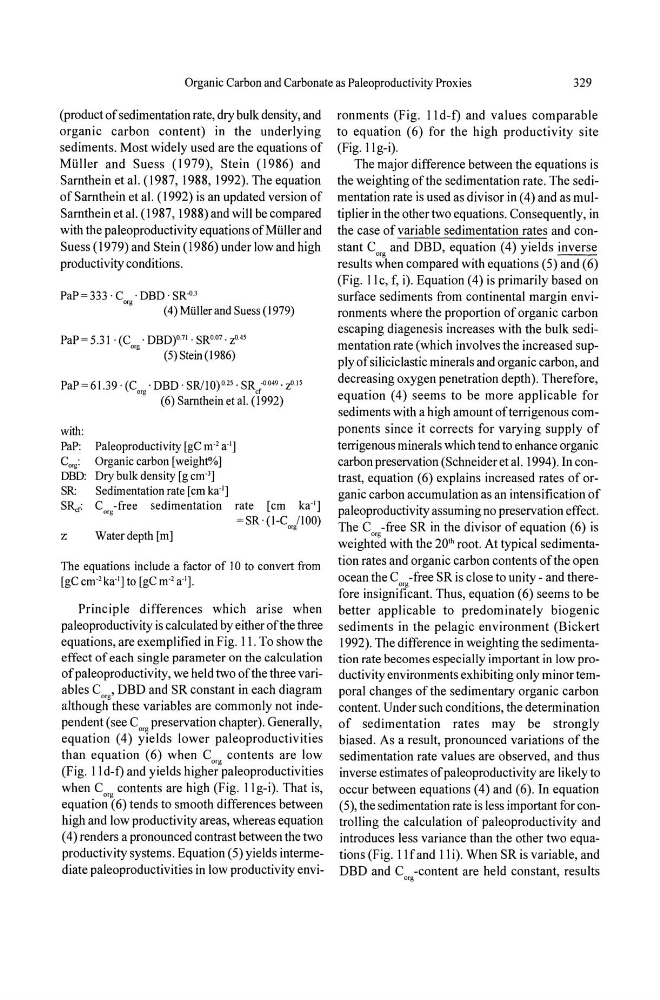
PaP=333' C . DBD· SR-OJ
0"
(4) MUller and Suess (1979)
PaP = 5.31· (Co,; DBD)o.71· SRo.o 7 • z"AS
(5) Stein (1986)
PaP = 61.39· (Co,!! . DBD· SRllO)o.2s. SRcf"°49. z".IS
(6) Samthein et al. (1992)
with:
PaP: Paleoproductivity [gC m· 2 a-I]
Co'!!: Organic carbon [weigh!"lo]
DBD: Dry bulk density [g cm"]
SR:
Sedimentation rate [cm ka· l ]
SR,,: Co,.-free sedimentation rate [cm ka- I ]
=SR' (1-Coi100)
z:
Water depth [m]
The equations include a factor of 10 to convert from
[gC cm· 2 ka· l ] to [gC m· 2 a· I ].
Principle differences which arise when
paleoproductivity is calculated by either of the three
equations, are exemplified in Fig. 11. To show the
effect of each single parameter on the calculation
of paleoproductivity, we held two of the threevariabies Co,.' DBD and SR constant in each diagram
although these variables are commonly not independent (see C 0'1< preservation chapter). Generally,
equation (4) yields lower paleoproductivities
than equation (6) when Co,. contents are low
(Fig. lId-±) and yields higher paleoproductivities
when CO,g contents are high (Fig. 1Ig-i). That is,
equation (6) tends to smooth differences between
high and low productivity areas, whereas equation
(4) renders a pronounced contrast between the two
productivity systems. Equation (5) yields intermediate paleoproductivities in low productivity environments (Fig. lId-±) and values comparable
to equation (6) for the high productivity site
(Fig. Ilg-i).
The major difference between the equations is
the weighting of the sedimentation rate. The sedimentation rate is used as divisor in (4) and as multiplier in the other two equations. Consequently, in
the case of variable sedimentation rates and constant Co,. and DBD, equation (4) yields inverse
results when compared with equations (5) and (6)
(Fig. llc, f, i). Equation (4) is primarily based on
surface sediments from continental margin environments where the proportion of organic carbon
escaping diagenesis increases with the bulk sedimentation rate (which involves the increased supply of siliciclastic minerals and organic carbon, and
decreasing oxygen penetration depth). Therefore,
equation (4) seems to be more applicable for
sediments with a high amount ofterrigenous components since it corrects for varying supply of
terrigenous minerals which tend to enhance organic
carbon preservation (Schneider et aI. 1994). In contrast, equation (6) explains increased rates of organic carbon accumulation as an intensification of
paleoproductivity assuming no preservation effect.
The Co,.-free SR in the divisor of equation (6) is
weighted with the 20 th root. At typical sedimentation rates and organic carbon contents ofthe open
ocean the CO'l<-free SRis close to unity- and therefore insignificant. Thus, equation (6) seems to be
better applicable to predominately biogenic
sediments in the pelagic environment (Bickert
1992). The difference in weighting the sedimentation rate becomes especially important in low productivity environments exhibiting only minor temporal changes of the sedimentary organic carbon
content. Under such conditions, the determination
of sedimentation rates may be strongly
biased. As a result, pronounced variations of the
sedimentation rate values are observed, and thus
inverse estimates of paleoproductivity are likely to
occur between equations (4) and (6). In equation
(5), the sedimentation rate is less important for controlling the calculation of paleoproductivity and
introduces less variance than the other two equations (Fig. Ilf and 11 i). When SR is variable, and
DBD and CO,g-content are held constant, results
329
(product of sedimentation rate, dry bulk density, and
organic carbon content) in the underlying
sediments. Most widely used are the equations of
Muller and Suess (1979), Stein (1986) and
Sarnthein et a!. (1987,1988,1992). The equation
of Sam the in et a!. (1992) is an updated version of
Samthein eta!. (1987, 1988) and will be compared
with the paleoproductivity equations of Muller and
Suess (1979) and Stein (1986) under low and high
productivity conditions.
PaP=333' C . DBD· SR-OJ
0"
(4) MUller and Suess (1979)
PaP = 5.31· (Co,; DBD)o.71· SRo.o 7 • z"AS
(5) Stein (1986)
PaP = 61.39· (Co,!! . DBD· SRllO)o.2s. SRcf"°49. z".IS
(6) Samthein et al. (1992)
with:
PaP: Paleoproductivity [gC m· 2 a-I]
Co'!!: Organic carbon [weigh!"lo]
DBD: Dry bulk density [g cm"]
SR:
Sedimentation rate [cm ka· l ]
SR,,: Co,.-free sedimentation rate [cm ka- I ]
=SR' (1-Coi100)
z:
Water depth [m]
The equations include a factor of 10 to convert from
[gC cm· 2 ka· l ] to [gC m· 2 a· I ].
Principle differences which arise when
paleoproductivity is calculated by either of the three
equations, are exemplified in Fig. 11. To show the
effect of each single parameter on the calculation
of paleoproductivity, we held two of the threevariabies Co,.' DBD and SR constant in each diagram
although these variables are commonly not independent (see C 0'1< preservation chapter). Generally,
equation (4) yields lower paleoproductivities
than equation (6) when Co,. contents are low
(Fig. lId-±) and yields higher paleoproductivities
when CO,g contents are high (Fig. 1Ig-i). That is,
equation (6) tends to smooth differences between
high and low productivity areas, whereas equation
(4) renders a pronounced contrast between the two
productivity systems. Equation (5) yields intermediate paleoproductivities in low productivity environments (Fig. lId-±) and values comparable
to equation (6) for the high productivity site
(Fig. Ilg-i).
The major difference between the equations is
the weighting of the sedimentation rate. The sedimentation rate is used as divisor in (4) and as multiplier in the other two equations. Consequently, in
the case of variable sedimentation rates and constant Co,. and DBD, equation (4) yields inverse
results when compared with equations (5) and (6)
(Fig. llc, f, i). Equation (4) is primarily based on
surface sediments from continental margin environments where the proportion of organic carbon
escaping diagenesis increases with the bulk sedimentation rate (which involves the increased supply of siliciclastic minerals and organic carbon, and
decreasing oxygen penetration depth). Therefore,
equation (4) seems to be more applicable for
sediments with a high amount ofterrigenous components since it corrects for varying supply of
terrigenous minerals which tend to enhance organic
carbon preservation (Schneider et aI. 1994). In contrast, equation (6) explains increased rates of organic carbon accumulation as an intensification of
paleoproductivity assuming no preservation effect.
The Co,.-free SR in the divisor of equation (6) is
weighted with the 20 th root. At typical sedimentation rates and organic carbon contents ofthe open
ocean the CO'l<-free SRis close to unity- and therefore insignificant. Thus, equation (6) seems to be
better applicable to predominately biogenic
sediments in the pelagic environment (Bickert
1992). The difference in weighting the sedimentation rate becomes especially important in low productivity environments exhibiting only minor temporal changes of the sedimentary organic carbon
content. Under such conditions, the determination
of sedimentation rates may be strongly
biased. As a result, pronounced variations of the
sedimentation rate values are observed, and thus
inverse estimates of paleoproductivity are likely to
occur between equations (4) and (6). In equation
(5), the sedimentation rate is less important for controlling the calculation of paleoproductivity and
introduces less variance than the other two equations (Fig. Ilf and 11 i). When SR is variable, and
DBD and CO,g-content are held constant, results