

328
Rtihlemann et al.
Differences in the oxygen penetration depth between the two core sites probably contributed to
contrasting organic carbon accumulation rates.
In-situ microelectrode and shipboard measurements showed that oxygen penetrates only 13 mm
into the sediment at the depositional environment
of the eastern Atlantic upwelling site, whereas the
penetration depth at the Ceara Rise station is
around 180 mm (F. Wenzhofer, MPI for Marine
Microbiology, pers. comm. 1998). Hence, organic
carbon is better preserved in the highly productive
eastern Atlantic, due to a shorter oxygen exposure
time at an average sedimentation rate that is twice
as high at station GeoB 1016 as compared to the
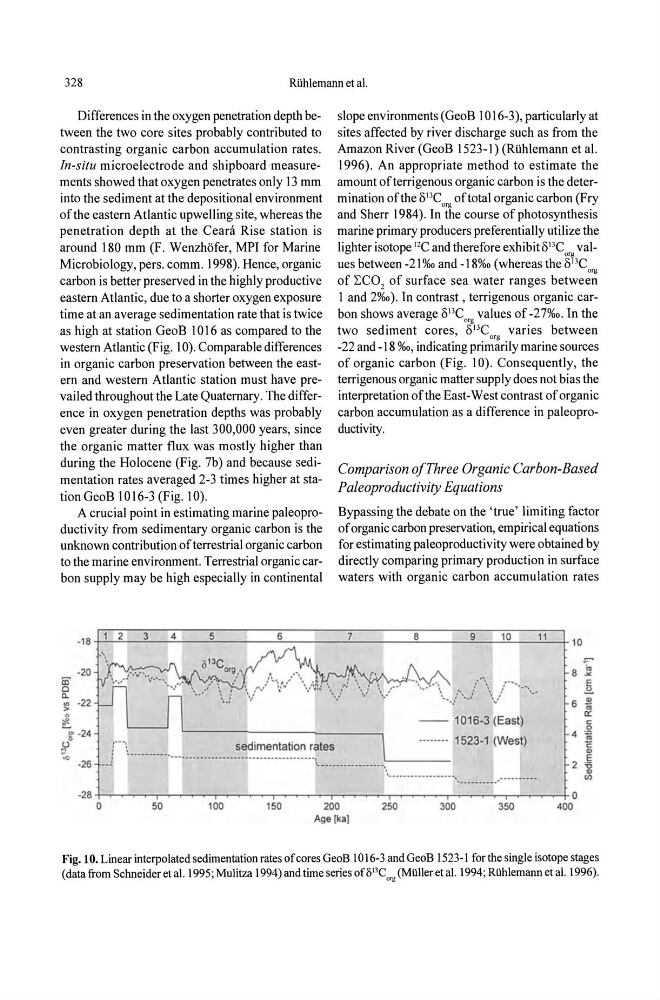
western Atlantic (Fig. 10). Comparable differences
in organic carbon preservation between the eastern and western Atlantic station must have prevailed throughoutthe Late Quaternary. The difference in oxygen penetration depths was probably
even greater during the last 300,000 years, since
the organic matter flux was mostly higher than
during tlle Holocene (Fig. 7b) and because sedimentation rates averaged 2-3 times higher at stationGeoB 1016-3 (Fig. IO).
A crucial point in estimating marine paleoproductivity from sedimentary organic carbon is the
unknown contribution ofterrestrial organic carbon
to the marine environment. Terrestrial organic carbon supply may be high especially in continental
slope environments (GeoB 1016-3), particularly at
sites affected by river discharge such as from the
Amazon River (GeoB J 523-1) (Rtihlemann et al.
1996). An appropriate method to estimate the
amount of terrigenous organic carbon is the determination of the 8 13 C e ,. oftotal organic carbon (Fry
and Sherr 1984). In the course of photosynthesis
marine primary producers preferentially utilize the
lighter isotope 12C and therefore exhibit 8 13 C e ,g values between -21 %0 and -18%0 (whereas the 8 13 C e ,g
of LCO z of surface sea water ranges between
I and 2%0). In contrast, terrigenous organic carbon shows average 8 13 C mg values of -27%0. In the
two sediment cores, 8 13 C e ," varies between
-22 and -18 %0, indicating primarily marine sources
of organic carbon (Fig. 10). Consequently, the
terrigenous organic matter supply does not bias the
interpretation of the East-West contrast of organic
carbon accumulation as a difference in paleoproductivity.
Comparison o/Three Organic Carbon-Based
Paleoproductivity Equations
Bypassing the debate on the 'true' limiting factor
of organic carbon preservation, empirical equations
for estimating paleoproductivity were obtained by
directly comparing primary production in surface
waters with organic carbon accumulation rates
_ 18~~2~~3 ___ 4~ __ ~5 ________ ~ ________ ~ __ ~ __ ~ 8~ ____ ~9 __ ~ 1~0 __ ~~-+
-20
co
c
Cl.
'" -22
,.
~
- 1; -24
~
- - 1016-3 (East)
sedimentation rates
-------- 1523-1 (West)
,a._,
t L _________ ..
-;0 -26 __ J
---- ---- ••••••.. -.... --- ----------.--.-... _ •• ___ __ _____ ___ ..,' -. ------'w -- --- _ .. --- -- -----..... _ .. _ w . w ___ .. - - - _ . . . . . _ .
-28 +-~~~~~~~~~~~~~~-r~~~_.~----._~--~~~~~
a
50
100
150
200
Age [ka}
250
300
350
Fig. 10. Linear interpolated sedinlentation rates of cores GeoB 1016-3 and GeoB 1523-1 for the single isotope stages
(data from Schneideret al. 1995; Mulitza 1994) and tinle series ofo l3 e o ,. (Miilleret al. 1994; Rtihlemann et al. 1996).
Rtihlemann et al.
Differences in the oxygen penetration depth between the two core sites probably contributed to
contrasting organic carbon accumulation rates.
In-situ microelectrode and shipboard measurements showed that oxygen penetrates only 13 mm
into the sediment at the depositional environment
of the eastern Atlantic upwelling site, whereas the
penetration depth at the Ceara Rise station is
around 180 mm (F. Wenzhofer, MPI for Marine
Microbiology, pers. comm. 1998). Hence, organic
carbon is better preserved in the highly productive
eastern Atlantic, due to a shorter oxygen exposure
time at an average sedimentation rate that is twice
as high at station GeoB 1016 as compared to the
western Atlantic (Fig. 10). Comparable differences
in organic carbon preservation between the eastern and western Atlantic station must have prevailed throughoutthe Late Quaternary. The difference in oxygen penetration depths was probably
even greater during the last 300,000 years, since
the organic matter flux was mostly higher than
during tlle Holocene (Fig. 7b) and because sedimentation rates averaged 2-3 times higher at stationGeoB 1016-3 (Fig. IO).
A crucial point in estimating marine paleoproductivity from sedimentary organic carbon is the
unknown contribution ofterrestrial organic carbon
to the marine environment. Terrestrial organic carbon supply may be high especially in continental
slope environments (GeoB 1016-3), particularly at
sites affected by river discharge such as from the
Amazon River (GeoB J 523-1) (Rtihlemann et al.
1996). An appropriate method to estimate the
amount of terrigenous organic carbon is the determination of the 8 13 C e ,. oftotal organic carbon (Fry
and Sherr 1984). In the course of photosynthesis
marine primary producers preferentially utilize the
lighter isotope 12C and therefore exhibit 8 13 C e ,g values between -21 %0 and -18%0 (whereas the 8 13 C e ,g
of LCO z of surface sea water ranges between
I and 2%0). In contrast, terrigenous organic carbon shows average 8 13 C mg values of -27%0. In the
two sediment cores, 8 13 C e ," varies between
-22 and -18 %0, indicating primarily marine sources
of organic carbon (Fig. 10). Consequently, the
terrigenous organic matter supply does not bias the
interpretation of the East-West contrast of organic
carbon accumulation as a difference in paleoproductivity.
Comparison o/Three Organic Carbon-Based
Paleoproductivity Equations
Bypassing the debate on the 'true' limiting factor
of organic carbon preservation, empirical equations
for estimating paleoproductivity were obtained by
directly comparing primary production in surface
waters with organic carbon accumulation rates
_ 18~~2~~3 ___ 4~ __ ~5 ________ ~ ________ ~ __ ~ __ ~ 8~ ____ ~9 __ ~ 1~0 __ ~~-+
-20
co
c
Cl.
'" -22
,.
~
- 1; -24
~
- - 1016-3 (East)
sedimentation rates
-------- 1523-1 (West)
,a._,
t L _________ ..
-;0 -26 __ J
---- ---- ••••••.. -.... --- ----------.--.-... _ •• ___ __ _____ ___ ..,' -. ------'w -- --- _ .. --- -- -----..... _ .. _ w . w ___ .. - - - _ . . . . . _ .
-28 +-~~~~~~~~~~~~~~-r~~~_.~----._~--~~~~~
a
50
100
150
200
Age [ka}
250
300
350
Fig. 10. Linear interpolated sedinlentation rates of cores GeoB 1016-3 and GeoB 1523-1 for the single isotope stages
(data from Schneideret al. 1995; Mulitza 1994) and tinle series ofo l3 e o ,. (Miilleret al. 1994; Rtihlemann et al. 1996).